Short answer
Six insects account for nearly everything found in a kitchen cabinet, and they sort faster by behavior than appearance. Webbing means a moth. A snout means a weevil. The rest are small brown beetles, three of them worth telling apart.
- Look at the food first. Webbing clumping cereal together means the larvae, and why they crawl away from the food; dry dust and pinholes mean a beetle.
- Then the head. A snout longer than the head is what people mean by flour weevil; no snout and a flat oval body is the beetle in your flour that is not a weevil.
- Either way, the package goes into an outdoor trash can and what you keep goes into containers that actually seal against pantry insects.
Start with what it is doing, not what it looks like
Four of the six are small, brown, oval, and photograph badly. Behavior narrows it faster than description.
- Flies like a small moth, makes for a lamp: the adult Indianmeal moth, wing pattern and all.
- Cream caterpillar trailing silk across a shelf: the larva, which leaves the food to pupate.
- Flat beetle walking through flour or a cake mix: a flour beetle, not a weevil.
- Hard beetle with a snout, in rice or whole grain: how a weevil got inside a sealed bag.
- Humped beetle, no head showing, out of the spice rack: drugstore or cigarette beetle, settled by the wing covers.
- Pale film in pet food that shifts as you watch: what turns up in the bag, and whether it stays.
- Small tan fly circling the fruit bowl rather than the dry goods: not a pantry bug, and a different job.
- Moth in the bedroom, nowhere near food: pantry moth or clothes moth, told apart by where it flew.
The six you actually find
Sizes are the published ones, in millimeters and inches. The fourth column does the work.
| What you see | Size | Where it turns up | The one tell | Page that covers it |
|---|---|---|---|---|
| Small two-tone moth heading for the ceiling (Plodia interpunctella) | Body 8–10 mm (5/16–3/8 in); wingspan 16–20 mm (about 3/4 in) | Cereal, dried fruit, nuts, birdseed | Pale gray-tan inner third of the wing, coppery outer two-thirds | The moth, the larvae |
| Flat oval reddish-brown beetle, blunt head (Tribolium castaneum, T. confusum) | About 3.5 mm (1/7 in) | Flour, meal, cake mix, and bag fines | No snout; cannot chew into an intact kernel | Flour beetles |
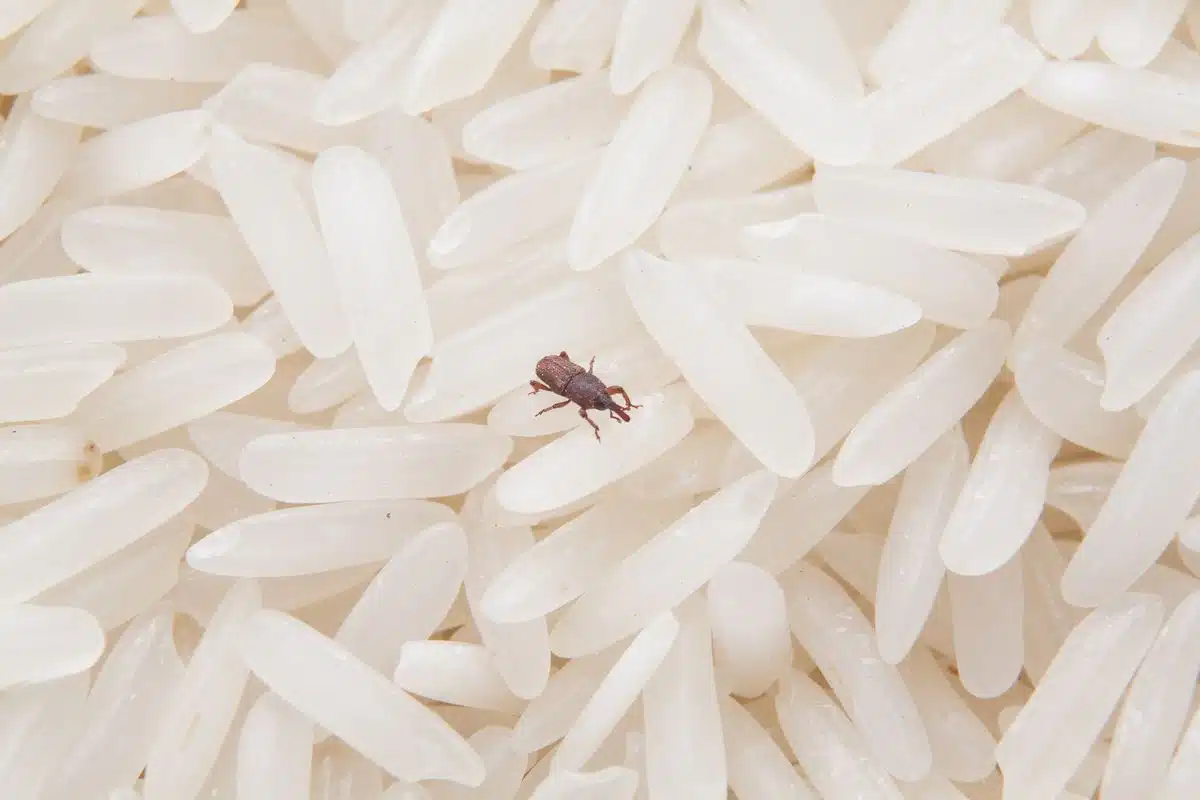
| Hard dark beetle with a snout (Sitophilus oryzae, S. granarius) | Rice weevil 2.5–3.5 mm (about 3/32 in); granary weevil up to 5 mm (3/16 in) | Rice, wheat berries, dried corn, birdseed | Rostrum longer than the head; four pale spots on the rice weevil | Rice and granary weevils |
| Humped beetle, head invisible from above (Stegobium paniceum) | 2–3.5 mm (about 1/8 in) | Spices, baking mixes, pet food, paper | Lengthwise grooves with rows of pits on the wing covers | Drugstore beetle |
| Same hump, slightly rounder (Lasioderma serricorne) | 2–3 mm (about 1/8 in) | Paprika and dried herbs, potpourri, wreaths, pet food | Smooth wing covers; antennae saw-toothed the whole way | Cigarette beetle |
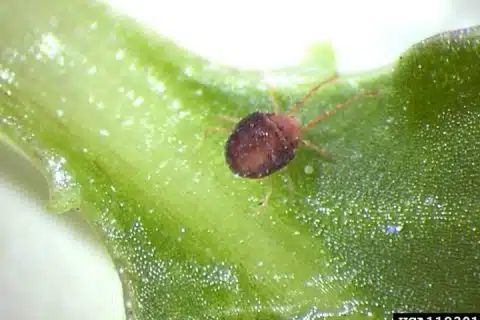
| A pale film that shifts, or a mottled oval beetle (Trogoderma variabile, storage mites) | Warehouse beetle about 3 mm (1/8 in); mites too small to see singly | Dry dog and cat food, especially crushed kibble | Shed hairy larval skins, or moving dust on the shelf | Bugs in dog food |
Size will not name any of these: every beetle above falls between roughly 2 and 3.5 mm, about 1/12 to 1/7 in, and no extension source reports a length difference usable at a counter. Sort by the tell.
Where pantry bugs come from
The answer is the same for all six, which is unusual and useful. The insect was in the package when you carried it home. Eggs go in at the field, the mill, or the warehouse, and UC IPM traces most household infestations to a package that arrived infested, opened ones far more often than sealed. It is why extension services file all six together as pantry pests.
So a spotless kitchen gets them, and housekeeping was never the variable. The mechanism inside a whole grain is the clearest version of it. Kentucky’s ENTFACT-612 adds the part that makes the search irritating: adults of some species travel a good distance from the article they emerged from.
Tiny bugs in the pantry: sorting by size and color
Color and size are what people search on and what separates these insects worst. If that is all you have:
- Dark, barely more than a speck, near dry food: tiny dark specks near dry food.
- Brown, hard-shelled, domed, no head showing: the two humped pantry beetles.
- Brown, and you watched it fly: small brown bugs with wings.
- Pale, moving as a layer rather than as individuals: pale bugs indoors. In pet food, usually storage mites, which are not insects.
Are pantry bugs harmful?
None of the six bites or stings, and Clemson’s factsheet records no disease associated with them. UC IPM attaches one qualification: these insects may introduce microorganisms that go on to produce mycotoxins in food stored warm and humid. That is why the guidance is to throw an infested package out rather than sift it. The beetle comparison page has the longer version.
How to get rid of pantry bugs: which protocol you need
All six end the same way: find the package, get it out of the house, vacuum the shelf, freeze or discard what is borderline, store the rest sealed. Five pages here write that out step by step, which is why it is not repeated here.
- Moths, webbing, a cocoon in a shelf joint: the pantry moth removal protocol.
- Weevils in rice, flour beetles in flour: the step-by-step pantry protocol for both.
- Humped brown beetles out of spices or a dried wreath: the cleanout sits at the end of drugstore beetle or cigarette beetle.
- Anything in dry pet food: whether the bag stays is a different decision, since mites are not handled like a weevil.
Freezing is the figure people cut short. Kentucky’s floor is 0 °F (−18 °C) for four days; Iowa State gives three for grain. Take the longer one and add margin, since a packed home freezer runs warmer than its dial says, which makes a week safer. Iowa State’s heat alternative is 140 °F for 15 minutes.
Keeping them out
Two habits and one purchase. Decant on the way in rather than after the trouble starts, so a bag arriving with something inside has nowhere to spread. And look at the back of the cabinet often enough that a forgotten jar of paprika cannot run a whole generation unwatched. The habits that keep moths and weevils out is the routine written down.
The purchase is storage, where the seal decides everything and the material very little: which containers actually seal against pantry insects. What a pheromone trap monitors, and what it does not do belongs here too: a trap tells you whether a cabinet is still producing moths, it does not clear one.
Every page on this cabinet
- Identify: the adult moth, its larvae, flour beetles, rice weevils, flour weevils, drugstore beetle, cigarette beetle.
- Compare: moth against clothes moth, drugstore against cigarette beetle.
- Remove: the moth protocol, the weevil and flour beetle protocol, the pet food decision.
- Prevent: the storage habits that keep both out.
- Equipment: containers that seal, pheromone traps.
Outside the cabinet: the rest of what turns up in a kitchen, the fruit fly source hunt for the small flies that arrive with a fermenting spill rather than a package, the identification hub, sorted by color, size and room, and the house-wide prevention guide for everything past food storage.
FAQ
What are the little bugs in my pantry, if I only saw one?
One insect is enough to identify and not enough to locate. Put it on white paper and answer two questions: is there a snout, and is there webbing in the food nearby. Where it was found matters as much as what it is.
Do pantry bugs mean my kitchen is dirty?
No, and it is the thing people most often get wrong. These insects do not come in from outdoors hunting crumbs, they arrive inside food bought that way. Housekeeping decides how far it spreads, not whether it starts.
Do I have to throw out everything in the cabinet, or just the one package?
Open everything. Discard what shows insects, webbing, pinholes, or fine powder, and freeze what looks fine but sat beside it. Guidance is to discard an infested package rather than sift it. Unopened does not mean safe, since the infestation predates your kitchen.
Can pantry bugs move from the pantry to the rest of the house?
The adults do. Several of these fly, and Kentucky’s factsheet notes them turning up well away from the package they emerged from, which is how one ends up on a nightstand. That is a wanderer, not a second infestation.
How long does it take before the pantry is actually clear?
No extension source publishes a clearance time, and a figure in days would be invented. The protocols use a checkpoint instead: a week after the cleanout, look again. Nothing new on the shelves or in a trap means you found the source. Fresh adults mean a package was missed.
Sources
- University of California Statewide Integrated Pest Management Program, Pest Notes: Pantry Pests, UC ANR Publication 7452.
- University of Kentucky Department of Entomology, ENTFACT-612: Stored Product Pests in the Pantry.
- Clemson Cooperative Extension, Home & Garden Information Center, Pantry Pests, Factsheet HGIC 2439.
- Penn State Extension, Indian Meal Moth.
- Iowa State University Extension and Outreach, Yard and Garden, Rice Weevil and Granary Weevil.