Short answer
Springtails indoors are a reading, not an invasion. They eat mold and decaying plant matter, and no spray ends them, because a spray does not dry anything. Find the wet spot and the numbers drop on their own.
- Watch one for two seconds. A hop landing somewhere random is a springtail; a steady walk is something else. What a springtail actually is, and what it is not.
- Work the damp spots in order, starting under the sinks, until you find one that is wet right now.
- Dry it, fix whatever keeps re-wetting it, then bring indoor humidity down, room by room and hold it there.
Before anything else: confirm it jumps
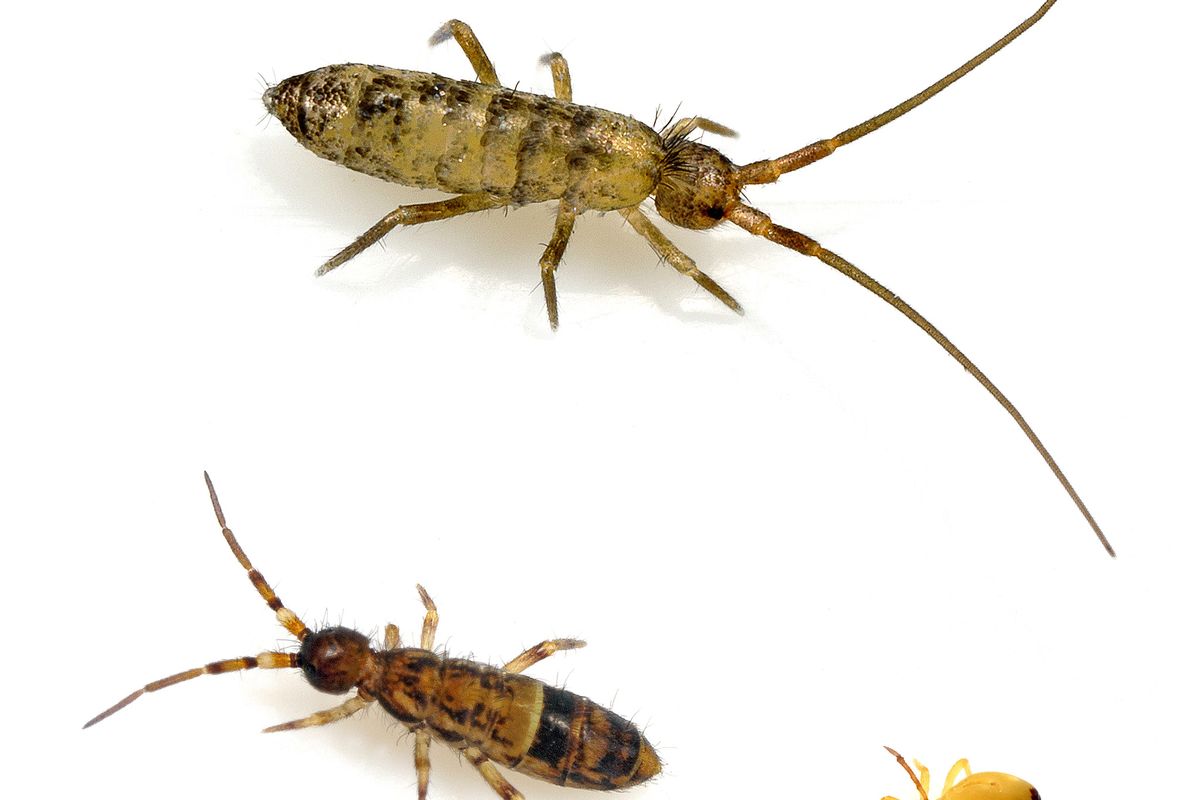
Disturb a springtail and it launches in whatever direction it happens to be pointed, up to several inches by UC IPM’s account. A booklouse walks and never leaves the surface. A flea jumps too, but a flea jumps at you, which is why fleas turn up on ankles and pets rather than in a sink cabinet. For more, booklice, which walk instead of jumping and very tiny bugs indoors, sorted by how they move.
Springtails are a moisture reading, not an infestation
An infestation feeds on something in your house and spreads through it. Pantry moths and the rest of the pantry bug lineup infest. Springtails do not: they eat mold, algae and decaying plant matter, and indoors they occupy the only surfaces wet enough to keep them alive.
So the count is a gauge. Dozens of springtails measures how much damp surface that room has, not how bad your bug problem is. UC IPM’s Pest Notes treats continued indoor presence as an indicator of a moisture problem and puts control on drying the area out; Clemson calls large numbers a sign of excess moisture from a leak, overwatering, or high humidity. You are looking for water, not an insect.
Which brings up the number everyone quotes. No extension publication names a relative humidity at which springtails stop reproducing: not UC IPM, not Clemson, not Minnesota. The 50% figure that circulates as a threshold is an indoor comfort target public-health guidance recommends anyway. Aim at it; it is not a switch. How sources are chosen here covers the standard. Silverfish run on the same lever, which is why the silverfish protocol reads like this one with a different animal.
Find the water in the first hour
Work in order of probability, and don’t stop at the first damp thing: houses often have two.
| Where to look | What confirms it |
|---|---|
| Back corner of the sink cabinet | Particleboard darker than the panel around it |
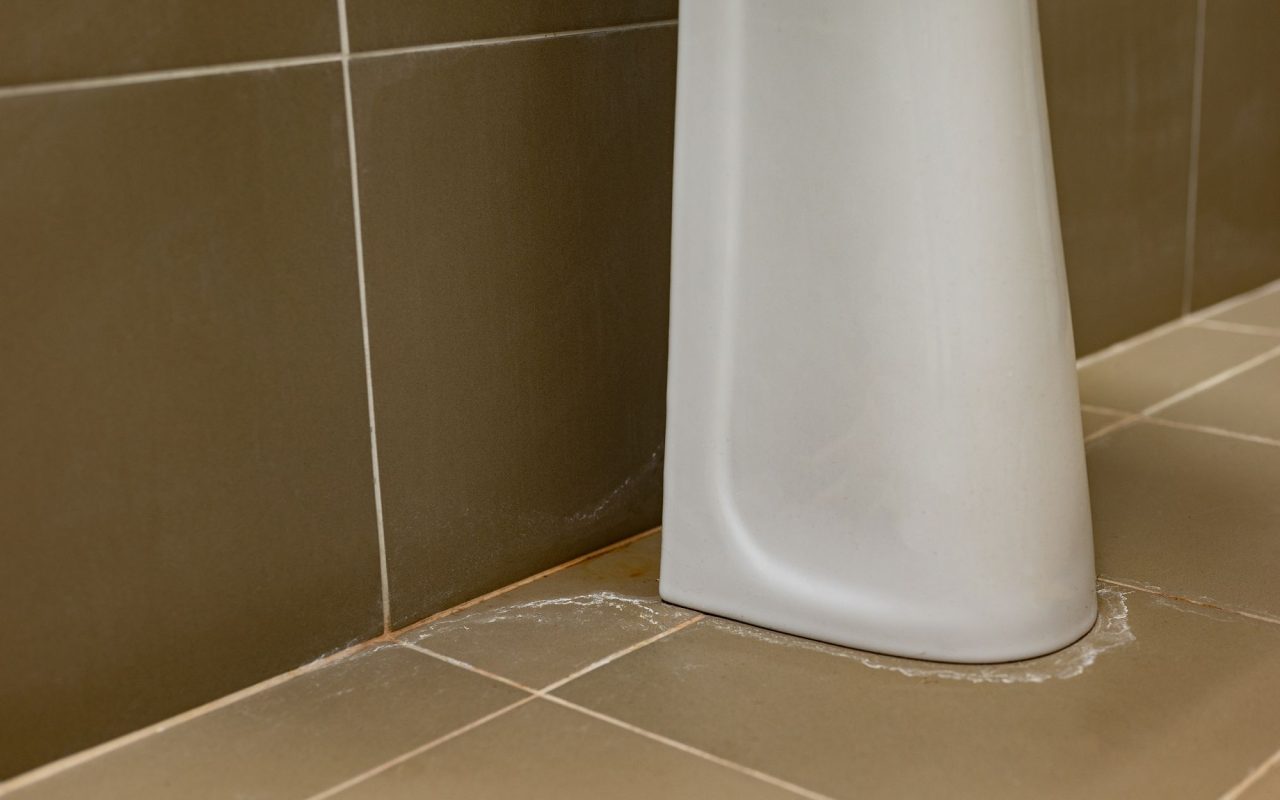
| Shower tray and its caulk line | Caulk still dark hours after the last shower |
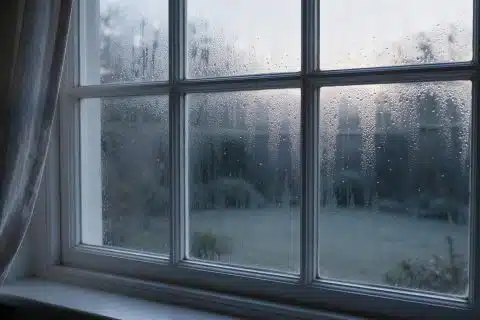
| The coldest exterior wall | Condensation film in the morning |
| Saucer under a houseplant | Standing water, or soil wet a knuckle deep |
| Bath mat or laundry left on the floor | Damp floor underneath when you lift it |
| Basement corner behind stored boxes | Cardboard soft along its bottom edge |
| Window and sliding-door tracks | Water sitting in the track |
| Under the dishwasher or washing machine | Dry at noon, wet an hour after a cycle |
Some rooms repeat. In a bathroom it is nearly always the tray or the caulk line; the four bugs that turn up in bathrooms and the wingless black speck in a bathroom cover what else it might be. In a bedroom, check the wall shared with a bathroom, then the window track. Ones sitting in a dry tub or sink fell in and could not climb out; Clemson notes pool drains too.
Look at the wet hour, not the convenient one: a cabinet floor bone dry at four in the afternoon can be damp forty minutes after the dishwasher drains.
Dry it out: what to change, and in what order
Ventilation first, because it is free and works on the whole room. Run the bathroom fan past the end of the shower, not off with the light.
The source second, because that is the lever that ends it. A slow drip under a sink, a leaking shower door, or a plant watered on a schedule will out-produce any fan in that room. The same standing water feeds a different insect in a kitchen, which is why the fruit fly source hunt works down a list that looks a lot like this one. Clemson’s fix list runs the same way: find the leak, pull out wet wood, let pots dry between waterings.
A dehumidifier third, only where the first two can’t get you there, set to a target humidity rather than a timer. All of it is written out: how to bring indoor humidity down, room by room, picking and sizing a dehumidifier for the room, and bathroom moisture and drain habits.
Where they come from outside: mulch, slab and doorway
Most indoor springtail populations did not start indoors. They start in the ground against the house: mulch piled to the siding, leaf litter in the bed, an irrigation zone that runs long. Clemson’s control list includes reducing mulch.
Two opposite triggers push them in, which is what makes the timing confusing. A dry stretch bakes the top of the mulch and they move toward the only damp thing left: the shaded edge of the slab, the gap under a threshold. Heavy rain does it from the other side. Either way, hundreds indoors at once.
The outdoor fixes are dull and they hold. Pull mulch back so the base of the foundation stays bare, aim sprinklers away from the house, rake leaf litter out of that strip. Same perimeter work as the house-wide prevention guide; below grade, basement storage habits once the air is under control.
Diatomaceous earth, sprays, and what mechanical control can and cannot do
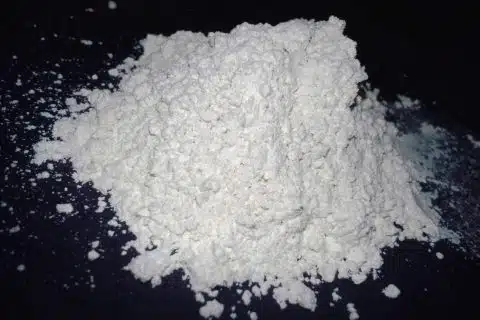
Diatomaceous earth kills by abrasion and drying: it scratches the waxy outer layer of a small arthropod, which then loses water faster than it takes it back on. Damp powder cakes and stops abrading.
Nobody has published a side-by-side test of it against springtails, and this page won’t invent one. The conflict between two plain facts is enough: the mechanism needs a dry surface, and springtails are on the wet one. Spread where they actually are, it sits inert. What diatomaceous earth does, and where it stops working covers placement.
Sprays end up in the same place. Clemson allows that a perimeter treatment can help, then adds what product pages leave off: insecticides break down quickly in moist environments and give only temporary control unless the environment is altered. When a spray is worth using at all is the longer version. A vacuum clears the cluster in front of you and changes nothing about why it formed.
How long until they are gone, and what a rebound means
You won’t find a generation time or an adult lifespan here. The sources behind this page don’t publish either as a figure you could act on. The clock that matters was never the insect’s; it is the substrate’s. Clemson says drying the area out should clear the problem within a few days, which is the easy case.
The hard cases are all substrate. A cabinet floor dries in an afternoon. A basement wall that took a slow leak for months gives the water back on its own schedule and feeds the population the whole time. A rebound is almost never a treatment failure: there was no treatment. It means a second damp spot you never found, or the first one re-wetting on a cycle. Check three days on, at the wettest hour.
Do springtails bite? And are they harmful?
No, and the sources are flat about it. Clemson states that springtails do not bite, do not damage buildings, and are not known to transmit diseases to humans. UC IPM says the same. They eat mold and decaying plant matter, which is why a mold problem and a springtail problem arrive together.
The belief has a reason nobody bothers to name. Springtails turn up in exactly the rooms where people already suspect mites or fleas, and one will land on damp skin and stay there because damp skin is damp, not because it wants anything. If something is genuinely biting, rule out the animal built for it: a flea jumps toward a host, not away. Pale bugs indoors sorts the rest.
One footnote: depending on which extension you read, a springtail may not even be an insect. Minnesota Extension and Clemson call them insects; UC IPM’s Pest Notes calls them insectlike arthropods. Order Collembola either way, and no version of it bites.
When it is worth calling a pro
Most springtail problems are a plumbing or a building problem in an insect costume, so the useful call is often to a plumber rather than an exterminator. Three situations change that: you have made a careful pass, cannot find the water, and the numbers keep climbing; the wet is structural, a crawlspace or a leak inside a wall; or they return after two full passes at drying, which means you are missing a source, not a technique.
What a pest company buys you here is inspection more than treatment. What hiring a professional actually buys you lays out the same decision on a species that runs on the same lever.
FAQ
What is the humidity level that stops springtails from breeding?
No extension publication names one: not UC IPM, not Clemson, not Minnesota Extension. The 50% relative humidity quoted everywhere as a threshold is an indoor comfort target from public-health guidance. Aim at it, but it is not a biological switch, and a page printing an exact cutoff invented it.
Why did hundreds of springtails appear all at once?
Because something changed outside, not because they bred overnight in your kitchen. They were already a group in mulch or damp soil against the foundation, and they moved as one. Heavy rain saturating that bed does it, and so does a dry stretch that pushes them toward your slab edge.
Will a spray or an insecticide get rid of springtails?
A contact spray kills what it lands on and changes nothing about why they were there, so the surface refills. Clemson allows that a perimeter treatment can help, then says the rest out loud: insecticides break down quickly in moist environments and give only temporary control unless the environment is altered.
Do springtails lay eggs indoors, or come in from outside?
Both, and which one depends on the house. Populations usually start outdoors in mulch and damp soil and migrate in at ground level. But a permanently damp indoor spot, an overwatered pot or a cabinet floor under a slow drip, supports them with no outdoor supply.
They came back after two weeks. What did I miss?
Usually a second damp spot, or the first one on a cycle. Look for what re-wets on a schedule: a dishwasher drain, a shower used once a day, condensation forming overnight on the coldest wall. Check at the wettest point of that cycle.
Sources
- University of California Statewide Integrated Pest Management Program, Pest Notes: Springtails, UC ANR Publication 74136.
- Clemson Cooperative Extension, Home & Garden Information Center, Springtails, HGIC 2445.
- University of Minnesota Extension, Springtails.
- Texas A&M AgriLife Extension, Springtails.