Short answer
If it’s genuinely tiny, under about 2mm, and you’re not sure what color or room it fits, you’re almost certainly looking at one of three bugs: booklice, springtails, or clover mites. Color and location matter less here than movement, since all three can turn up in different rooms and different shades. Watch it for a few seconds before you do anything else.
- Watch how it moves: a slow walk, a sudden jump, or barely any movement at all.
- Note where you spotted it: damp paper or cardboard, a spot near water, or a sunny window or wall.
- Match those two clues to the right species below, then check its full profile.
Which bug is it?
If the bug just walks, no jumping, no drama, and you’re finding a few of them clustered together, look at where they are before anything else. Booklice show up wherever paper or cardboard has picked up a bit of moisture: old books, a damp basement box, wallpaper paste that never fully dried. They’re pale and soft-bodied, and their calm, slow crawl is really the clearest sign. The full booklice profile covers what draws them in and how to dry the spot out.
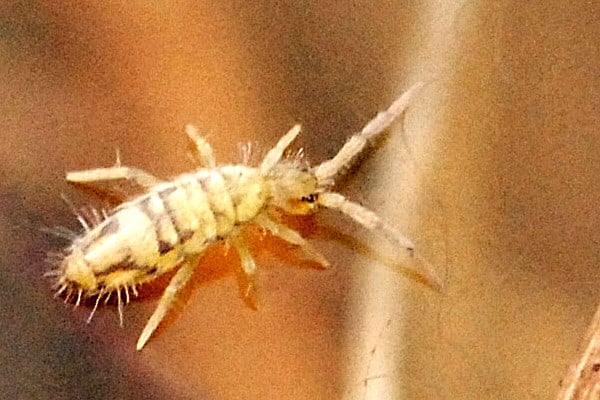
If it seems to disappear and pop up several inches away, that’s not your eyes playing tricks, that’s a jump. Springtails are gray and stick close to moisture: bathroom grout, a sink cabinet with a slow drip, damp potting soil on a windowsill plant. The spring-loaded hop is unique enough among these three that it’s basically a confirmation on its own. Details and moisture fixes are on the springtail page, and the springtail removal protocol runs the search for the wet spot in order.
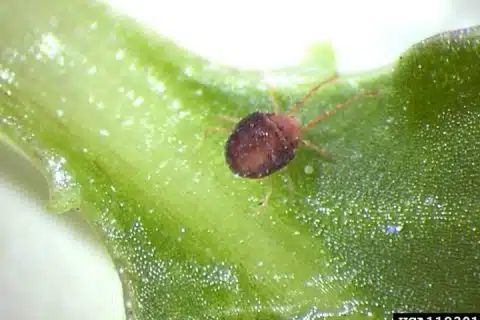
A bright red speck that’s barely moving, especially on a sunlit windowsill, screen, or exterior wall, is almost always a clover mite. Look closely, a magnifying glass helps, and you’ll notice the front pair of legs is noticeably longer than the rest, which is an easy tell once you know to look for it. They’re most active in spring and fall and tend to cluster in the warmest, sunniest spot they can find. The clover mite page has the rest.
Still not a clean match? The identification hub covers the full catalog by size, color, and behavior, in case what you’re seeing is small but not quite this small.
FAQ
Are these bugs dangerous to have in the house?
None of the three cause structural damage or pose a real risk in typical household numbers. Clover mites can leave a reddish smear if crushed on light fabric or paint, which is a cleanup nuisance more than anything serious.
Why am I suddenly seeing a lot of them at once?
All three tend to show up in clusters when moisture conditions shift: a humid stretch, a slow leak, condensation building up on glass. Addressing the damp spot usually does more to reduce numbers than dealing with the bugs one by one.
What if it doesn’t match any of these three?
If the size, color, or movement doesn’t line up with booklice, springtails, or clover mites, it’s worth checking the rest of the identification catalog, since plenty of other small household bugs sit just above the 2mm mark.
Do these three need different fixes?
Generally, yes, because the cause behind each is different. Booklice and springtails both come back to indoor moisture, so drying out the spot they were found in matters most. Clover mites are drawn in from outside, often from grass or clover right against the foundation, so the fix tends to focus more on that immediate exterior area. Each species page goes into more detail.