Short answer
Springtails in a bathroom are not coming up the drain. They are living on a surface that never dries between showers: a saturated grout line, the particleboard floor of a leaking vanity, a baseboard wicking water off the tile. Finding that surface is the treatment. Everything else is housekeeping.
- Confirm it jumps. A gray speck that launches several inches sideways when you get close is a springtail; one that walks steadily is a booklouse. The walk-or-jump test, in detail.
- Ignore the drain. Go looking for a surface that is still wet six hours after the last shower.
- Dry that surface, fix whatever keeps re-wetting it, and the colony ends on its own. The full moisture-first protocol covers the rest of the house.
They are not coming up the drain
This is the expensive wrong turn, because it sends you down the pipe with bleach while the colony sits three feet away on the tile.
Drain flies genuinely do live in the pipe. Their larvae develop inside the gelatinous film coating the inside of a slow drain, which is why scrubbing that film out is the only thing that ends them. Springtails have no such life stage. They graze mold, algae and decaying organic matter on open, wet surfaces, and they need to sit on damp material to stay alive. A sealed pipe full of moving water is not habitat for them; a permanently damp grout joint is.
So nothing poured down the drain changes a springtail count: not bleach, not an enzyme gel, not a kettle of boiling water. If your bathroom has both problems at once, that is a coincidence of habitat. The four bugs that turn up in bathrooms sorts out which one you actually have.
Why humid air alone does not feed them
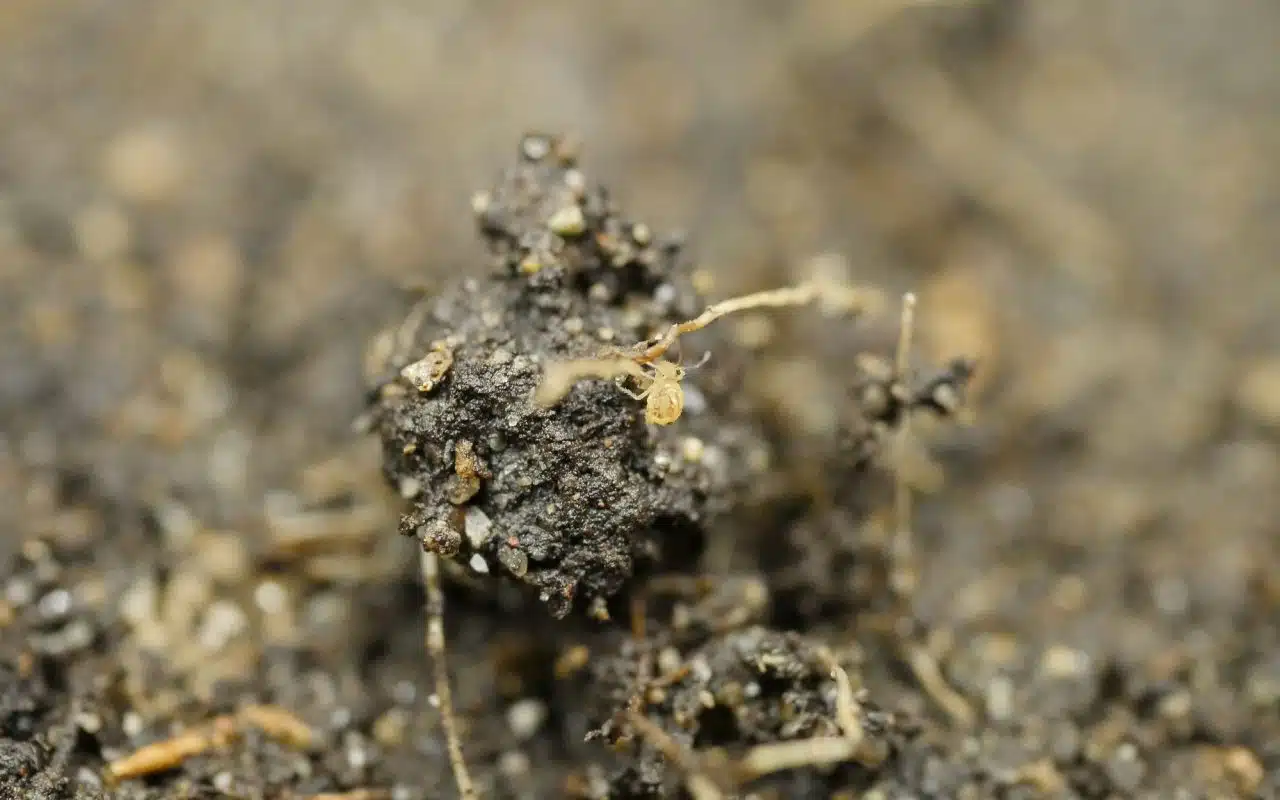
A springtail is 1 to 2 mm long, about a sixteenth of an inch, with a thin cuticle that loses water fast. It compensates with a small tube on the underside of the abdomen, the collophore, which takes water up by direct contact with a wet surface. That is the whole mechanism, and it explains the behavior you are seeing: a springtail has to be touching free water or a substrate close to saturation. It cannot drink the air.
Which is why a hygrometer is the wrong instrument here. A bathroom can read a perfectly reasonable number on the wall and still support hundreds of springtails along one grout line that never dries. The reverse holds too: a room that steams up twice a day but has nothing saturated in it gives them nowhere to live. Humidity is what makes a surface slow to dry. It is not itself the water supply.
Do not go hunting for a target number, either. No extension publication gives a humidity reading at which springtails stop breeding, so a page printing an exact cutoff made it up. The 50% figure people quote comes from indoor comfort guidance and is worth aiming at for its own reasons, but a bathroom can sit under it and still keep one joint saturated. Bringing indoor humidity down, room by room is the long version.
The six wet points in a bathroom, in order
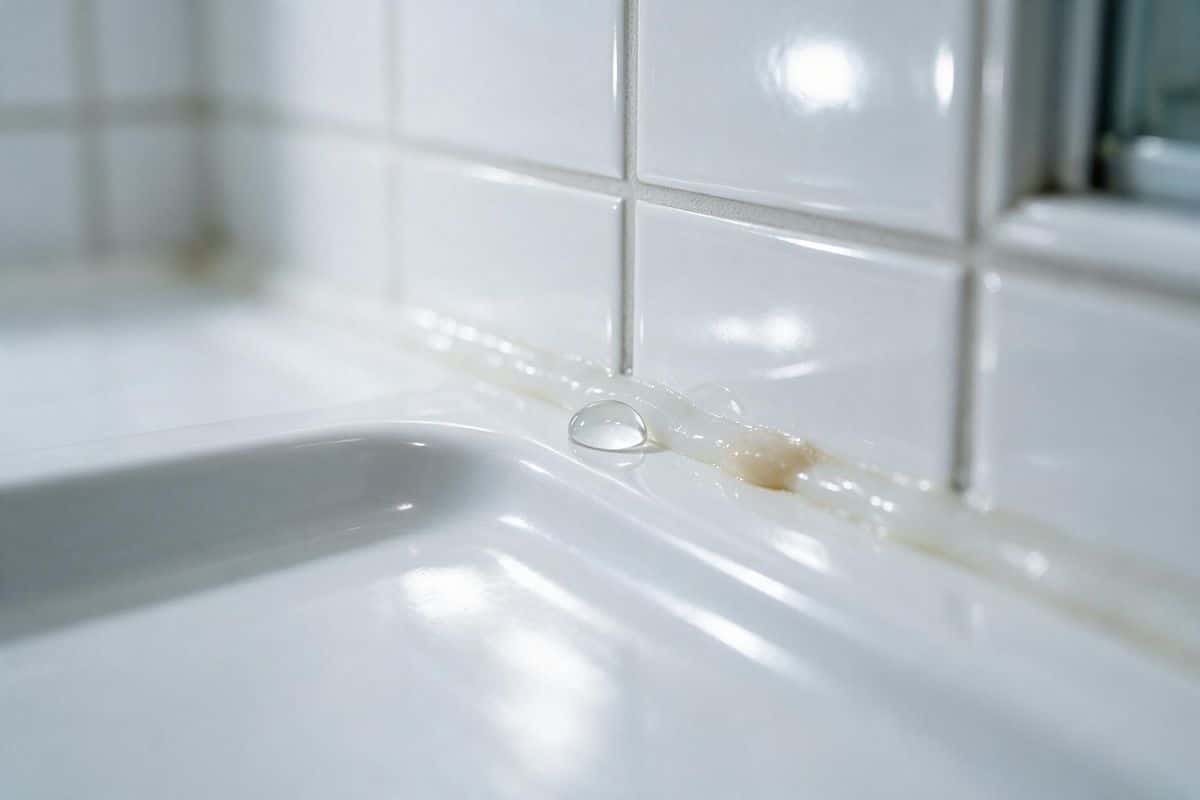
Work down the list in order of probability. Do not stop at the first damp thing you find, because a bathroom that has one wet point often has two, and the second one is why they come back.
| Where to look | What confirms it |
|---|---|
| Grout line where the shower tray or tub meets the floor | Still dark six hours after the last shower, or soft under a fingernail |
| Floor of the vanity cabinet, back corner | Particleboard swollen or darker than the panel beside it; a ring under the trap |
| Baseboard and toe kick along the tub wall | Paint blistered at floor level, or caulk pulled away from the tile |
| Corner of the shower tray and its wall joint | Water still standing there hours after the tray has drained |
| Wall and floor behind the toilet tank | Condensation beading on the porcelain and running down to the tile |
| Bath mat, towels or a laundry basket left on the floor | Floor damp underneath when you lift it |
Springtails found dry and stranded in the tub or the sink basin are not evidence of anything below them. A basin collects and holds whatever drops into it, which is why the numbers there look so much worse than the rest of the room; springtails in a bathtub or sink takes that case on its own. Look at the edges, not the bowl.
The check that settles it: dry it, then look at hour six
You are not testing for insects. You are testing whether a surface can re-wet itself, which is a cleaner question.
Towel every candidate spot completely dry. Then check twice: once about 40 minutes after the next shower, and once six hours later with the room unused. Anything dry at hour six is not your source, no matter how many springtails were on it. Anything still wet at hour six, with no water run in between, is a leak or a wick, and that is the spot.
One more split worth making, because it decides who fixes it. Tape a hand-sized square of plastic sheeting or foil tightly over the suspect spot and leave it overnight. Water beading on the room side of the plastic means condensation, an air problem. A spot that is wet underneath the plastic means water is arriving through the material, and no amount of ventilation will reach it.
The shortcut: get down at floor level with a flashlight held almost flat against the tile. Raking light across a surface shows a damp patch as a dull, non-reflective area long before the surface looks wet from standing height, and it finds the edge of the patch, which is what points at the source.
What to change once you have found it
Each finding has a different owner. Getting that wrong is why people repeat the same fix for months.
- Saturated grout or failed caulk. This is a seal problem, not a cleaning problem. Cut the old caulk out and re-bead it; regrout the joint if the grout crumbles. Scrubbing bleach across it kills the mold film they were grazing and leaves the water exactly where it was, so they return in a week.
- A leak under the vanity. Fix the fitting first, then get the wet material out. Swollen particleboard holds water for weeks and keeps feeding the colony long after the drip has stopped. Drying it in place rarely works; cutting it out does.
- Condensation only. This one is ventilation and habits, and it is the cheapest of the three. The bathroom moisture routine covers the fan, the bath mat and the caulk schedule that keep a room from re-soaking itself.
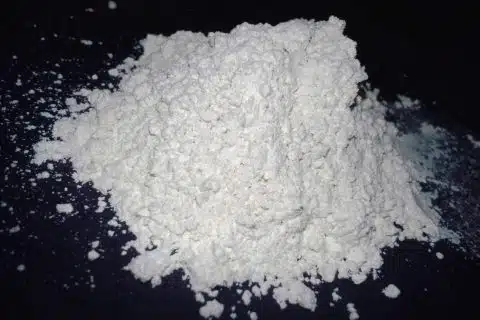
Don’t spray the baseboard: a wet surface is the worst place to put a residual insecticide. Clemson is explicit that these products degrade fast in damp conditions and buy a few days at most unless the moisture itself is fixed. Diatomaceous earth fails in the same room for the same reason: it works by abrasion on a dry cuticle, and damp powder cakes and stops abrading. See why the dust and this pest are a bad match almost everywhere but a dry houseplant pot for the full mechanism.
They came back after the room was dry
A rebound is almost never a treatment failure, because there was no treatment. Usually you missed the second wet point, which is why the list above says not to stop at the first damp thing.
The other answer is that the water is inside the assembly rather than on it: a supply line weeping in the wall, a failed shower pan, a soaked subfloor giving its water back slowly. Springtails in that cavity keep appearing at the baseboard gap no matter how dry the tile looks. That is a building repair, not a pest problem.
One exception, and only on a ground floor: hundreds arriving at once usually came in from the mulch against the foundation after heavy rain or a dry spell, not from anything in the room. The main protocol handles that perimeter work, and the springtail profile covers what the animal is and what it is not.
FAQ
Do springtails come up through the bathroom drain?
No. They have no aquatic larval stage and no reason to be in a pipe. That is drain fly behavior, and the two get confused because both turn up near the same fixtures. A springtail sitting near the shower drain is on the wet tile around it, not in it.
Why are they only in the bathroom and nowhere else in the house?
Because the bathroom is usually the only room with a surface that stays wet all day. The rest of the house dries out between uses; a grout joint at the base of a shower may not. That is a compliment to your house, not a mystery.
Will bleach, vinegar or a drain cleaner get rid of them?
Bleach removes the mold film they feed on, which knocks the numbers down for a few days and looks like a fix. The surface is still wet, the film regrows, and so does the population. Nothing poured down a drain touches them at all.
I keep finding dead ones in the empty tub. Where are they coming from?
From above the rim, not from the drain below it. A tub full of stranded springtails tells you the living population is on the wet surfaces around the tub, and that is where to look; the bathtub and sink case covers why a basin ends up holding them.
Do springtails bite?
No. The extension sources are flat about it: no biting, no damage to the building, no known role in transmitting disease. What people feel is a springtail settling on damp skin and staying put, because damp was the only thing it was looking for. If something on your skin is genuinely reacting, that is a question for a health professional rather than a bug guide.
Sources
- University of California Statewide Integrated Pest Management Program, Pest Notes: Springtails, UC ANR Publication 74136.
- Clemson Cooperative Extension, Home & Garden Information Center, Springtails, HGIC 2445.
- University of Minnesota Extension, Springtails.