Short answer
Drain flies breed in the slimy film inside a pipe. That film is the target, not the insect. Swatting adults buys two days: UC IPM puts egg hatch at about 48 hours.
- Find the drain: coat a cup inside with petroleum jelly, invert it over every drain in the room, and read them a day later. Not sure what it is? See the gnats and drain flies identification guide.
- Scrub the pipe wall with a long, stiff brush. Anything poured down leaves the film in place.
- Wait three weeks: a generation runs 8 to 24 days.
Which drain is it? Run the cup test first
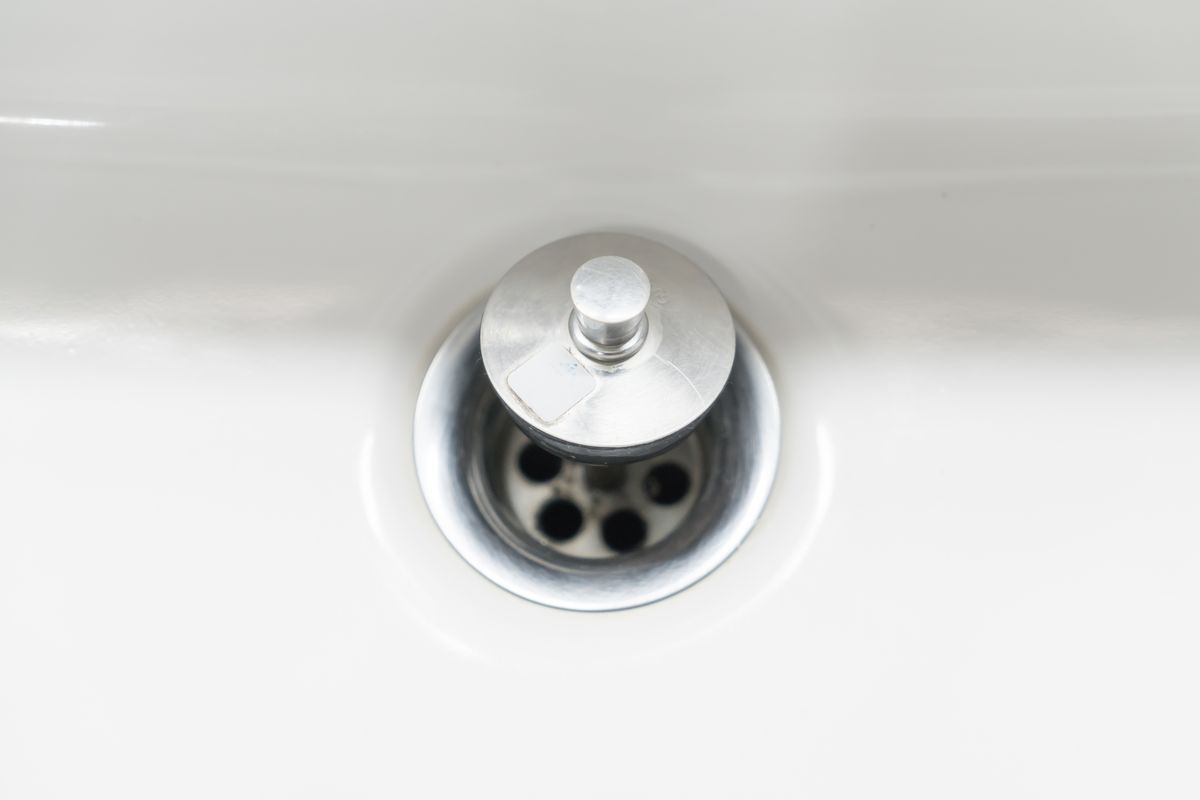
Drain flies are weak fliers that stay close to where they developed, UC IPM notes, so one on the wall beside a drain is good evidence. But two drains in one room can both be active, so UC IPM says check every drain. Pull the drain plate, scrape the sides with a dull knife, and look for larvae in the slime.
If that comes back empty, they may be deeper than you can reach. That is the cup test: coat the inside of a clear cup with petroleum jelly or vegetable oil, invert it over the opening, and set one on every drain in the room. Emerging flies stick to the coating, so the morning reading is a record.
Duration is where the fact sheets disagree. UC IPM says 24 hours. The University of Kentucky (ENTFACT-615) describes the same trap in clear plastic cups and says several days. Iowa State tapes plastic film over the drain and expects flies underneath in a day or two. Texas A&M AgriLife tapes across the opening and warns never to seal it: without airflow the flies stay put and the test reads clean.
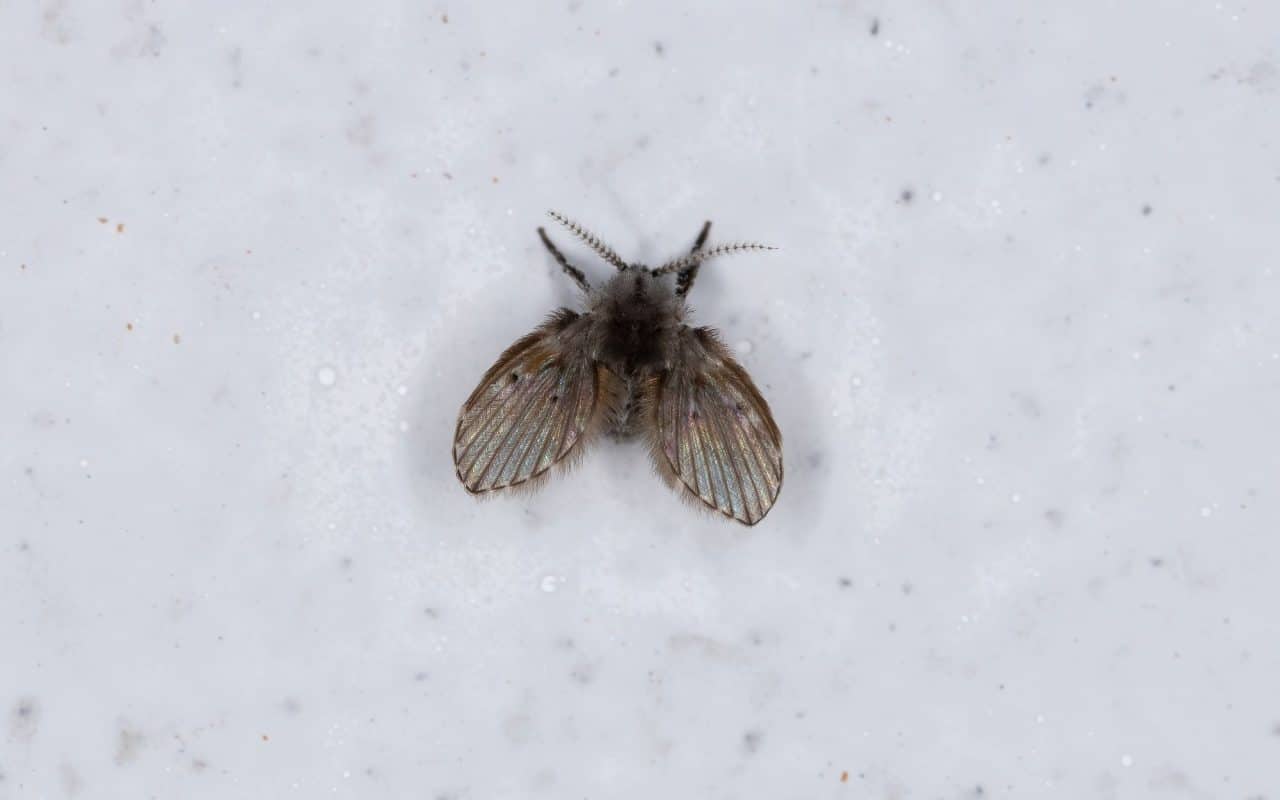
An insect that hovers over the fruit bowl rather than sitting on tile is not this one: drain flies (Psychodidae, usually Psychoda or Clogmia) hold hairy wings roof-like and hop rather than fly. If you cannot yet tell which of the three small flies you have, gnat vs fruit fly has three answers, not two. See the fruit fly profile, or the kitchen version at how to tell fruit flies for sure. Circling a potted plant? That is the step-by-step gnat protocol. Damp bathrooms have their own list in bugs in the bathroom.
What is actually living in there: the larvae and the film
The film is not dirt. It is a soft gel of decaying organic matter on the inner wall of any slow-running pipe, and it is both the egg-laying surface and the food. The University of Kentucky describes eggs laid in groups on those films; Texas A&M AgriLife puts an egg mass at 30 to 100 eggs, hatching in under 48 hours.
The larva explains why the usual fixes fail. At its final stage it reaches about 6 mm (1/4 in), longer than the adult, pale with a distinct head and a siphon at one end for breathing underwater; Purdue Extension calls that a darkened breathing tube. It grazes on fungi, bacteria and algae in the slime, and lives in the film, not the water below.
These larvae are also hard to drown. The University of Kentucky states they trap air bubbles and can stay submerged a day or more; Texas A&M AgriLife notes they tolerate temperature extremes and low oxygen. Flushing does not suffocate them. Texas A&M adds a twist: in a septic field line these larvae are useful, breaking organic waste into water-soluble compounds.
Why boiling water, bleach and drain cleaners don’t get rid of them
This is how a drain fly problem drags on for months. UC IPM calls it a misconception: boiling water or bleach poured down a drain does not remove the organic film, and gives short-term control at best. Purdue Extension (E-233-W) prints it in capitals: bleach and hot water will not eliminate breeding sites. Iowa State and Texas A&M AgriLife report no benefit from bleach or ammonia.
None of them explain why, so read this as reasoning rather than citation. A rinse is a few seconds of contact with a gel bonded to the pipe wall, and water poured in runs down the middle, where nothing lives.
| What you do | What it does | What it leaves |
|---|---|---|
| Boiling water poured in | Rinses loose debris | The film and its larvae |
| Bleach or ammonia | No documented benefit | The film and its eggs |
| Poured drain cleaner | Works on a clog | The coating above it |
| Aerosol at adults | Clears the room now | The next hatch |
| Stiff brush on the wall | Strips the film off | Nothing, if you reach it all |
| Enzyme or bacterial treatment | Digests buildup over time | An established film |
Boiling water keeps one honest use, and here the institutions part company. Texas A&M AgriLife puts it after the brush, as a flush. Iowa State allows it for drains that cannot be scrubbed, poured slowly down the sides. UC IPM endorses neither. Sprays run into the same problem: UC IPM discourages insecticides in homes because only one or two drains are involved, and the University of Kentucky says not to pour them down drains. A bait trap runs into the same wall: an apple cider vinegar trap catches fruit flies, not drain flies. More in when a bug spray is worth using and when it isn’t.
The mechanical pass, step by step
If the sink drains slowly, snake it before cleaning: a blockage slows the water and feeds the buildup, and UC IPM puts that step first. Then the brush. UC IPM specifies a hard bristle brush with an industrial drain cleaner, Texas A&M AgriLife a stiff long-handled brush, Iowa State any stiff tool that reaches. It must clear the strainer, reach through the water in the trap, and scrape rather than sweep. Work the wall in a circle, with pressure: the trap bottom is not the target, the wall above it is where the eggs go.
The shortcut: a sink with a J-trap gives you a better angle than any brush. UC IPM says to remove the trap and clear the debris out directly. Refit it, run water, then brush from above until it comes back clean.
Prevention is a habit, not a purchase. UC IPM notes that regular use of an enzymatic drain cleaner may help prevent buildup returning, and Texas A&M AgriLife and Iowa State say the same of bacterial treatments. Drain routines in the bathroom prevention guide transfer directly, drying the room is covered in how to reduce humidity in your house, and a seasonal sweep belongs in the home bug prevention checklist.
How long until they’re gone
Expect three weeks. UC IPM gives a full life cycle as 8 to 24 days, depending on temperature. The institutions differ: the University of Kentucky says about 10 to 15 days at 70 °F (21 °C), while Texas A&M AgriLife gives the larval stage alone as 8 to 24 days plus 1 to 2 days as a pupa. A drain that looks quiet on day four proves nothing.
Adults are short-lived: Texas A&M AgriLife gives 3 to 4 days without food, 1 to 3 weeks with nectar. Which is why swatting feels like progress and never is: you are trimming days off the end of a cycle that reloads every 48 hours.
When it isn’t your sink: UC IPM writes that very large numbers probably point to a development site bigger than a few indoor drains, and that these flies can be produced in bulk at sewage treatment facilities and blown to nearby buildings. The tell is direction: more flies outside than inside means scrubbing your drain changes nothing.
The three-week checkpoint reads two ways: fewer flies each week means you found the site, no change means something went unchecked. Wider triage sits at very tiny bugs in the house.
The drains everyone forgets
UC IPM’s residential list starts with bathroom drains, but the pipe you rarely use beats the one you use daily: moving water keeps the film thin. The University of Kentucky notes drain flies are often a temporary problem noticed after a vacation, fading once household water starts moving again.
Worth checking: a guest toilet flushed once a month, tank included; a basement or garage floor drain; the pan under a refrigerator and an icemaker’s condensate line; the safety guard inside a garbage disposal, which Purdue also lists; a sump pit. Outdoors, the University of Kentucky adds wet ground under an air conditioner drain and clogged guttering. If nothing turns up, UC IPM’s harder list follows: elevator pits, material under a leaking pipe, and pipes in crawlspaces, wall voids or under a slab.
A bathroom producing insects usually produces more than one kind. If yours never flies, tiny black bugs in the bathroom with no wings is the page; if it is brown and house-wide, start at tiny brown flying bugs in the house. Kitchen cases sort out at bugs in the kitchen. If the fly there could equally be a fungus gnat or a fruit fly, the three-way comparison settles it. For a damp room rather than a dirty pipe, the humidity-first silverfish protocol and the prevention guide cover ground drain work cannot.
FAQ
What do drain fly larvae look like, and where are they?
Pale and legless, with a distinct head and a breathing siphon at one end, about 6 mm (1/4 in) at the final stage, longer than the adult. They live in the gel film on the pipe wall, not the water.
How long do drain flies live?
Texas A&M AgriLife gives adults 3 to 4 days without food, 1 to 3 weeks with nectar. The full cycle matters more: UC IPM says 8 to 24 days depending on temperature, the University of Kentucky about 10 to 15 days at 70 °F (21 °C).
Is bleach or boiling water enough on its own?
No. UC IPM calls it a misconception: those treatments do not remove the organic film, and give short-term control at best. Purdue Extension says bleach and hot water will not eliminate breeding sites.
Are drain flies harmful?
They don’t bite people or pets, and they are not a documented vector of disease in homes. UC IPM does note that drain flies could carry pathogens up from the drain they breed in, and that fragments of dead adults can become airborne allergens.
They came back two weeks later. What did I miss?
Usually a second drain you never trapped, which is why UC IPM says to cover every drain in the room. Or the brush missed part of the wetted wall, typically the trap or an overflow.
Sources
- University of California Statewide IPM Program, Pest Notes: Moth or Drain Flies, UC ANR Publication 74167.
- University of Kentucky Entomology, Drain Flies or Moth Flies, ENTFACT-615.
- Purdue Extension, Small Flies, E-233-W.
- Texas A&M AgriLife Extension, Drain Flies (Moth Flies or Filter Flies), E-184.
- Iowa State University Extension and Outreach, Moth Fly.