Short answer
Tiny brown flying bugs in the house usually turn out to be one of four things: a drugstore beetle, a cigarette beetle, a fruit fly, or an adult pantry moth. All four are common in kitchens and pantries, and from across the room they can look almost the same.
- Watch how it flies for a second. A fluttering, uneven flight with visible wings folded in a slim triangle points to a real moth. A straighter, more direct flight points to a beetle or fly.
- If it’s not flying like a moth, especially if it’s landing on food or crawling around jars, it’s more likely one of the two beetles or the fruit fly.
- For the full breakdown of those three, including size and where each tends to show up, see the complete comparison at small brown bugs with wings.
Which bug is it?

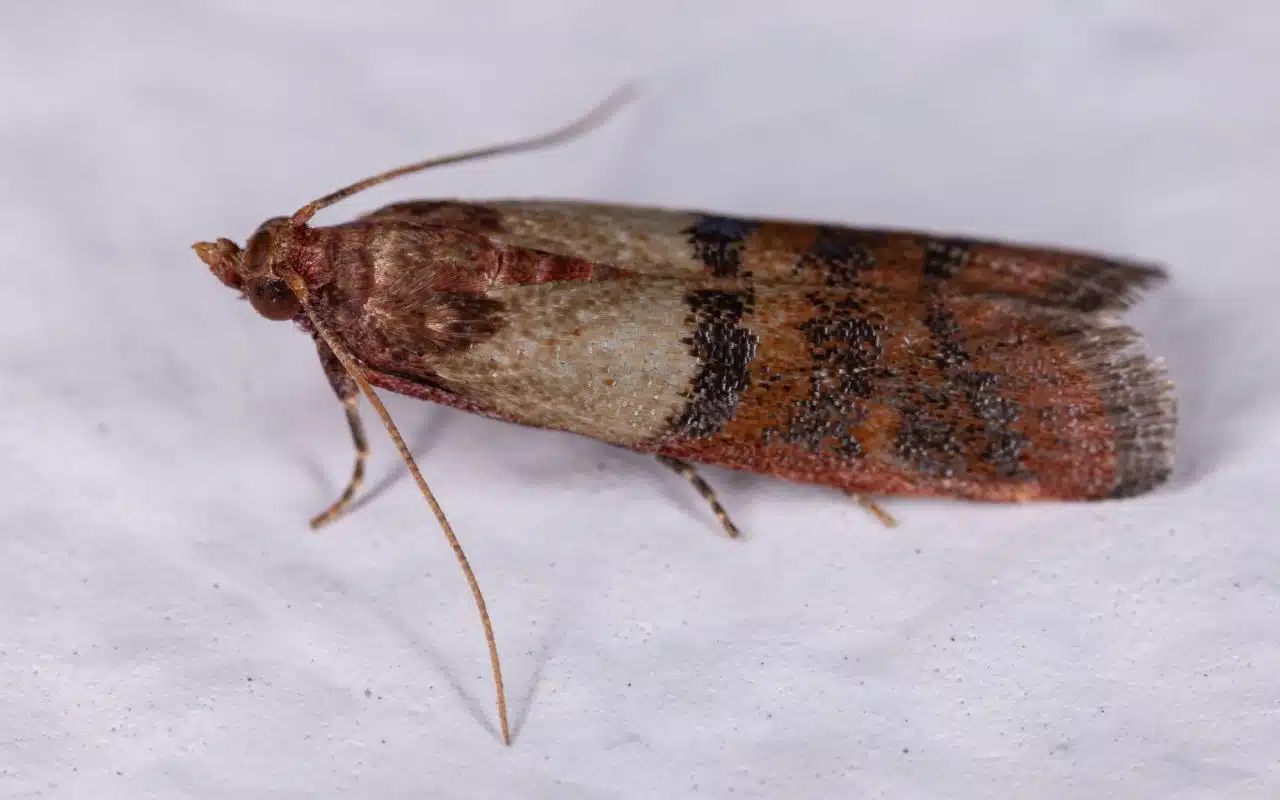
Start by ruling a moth in or out. An adult pantry moth is tan to copper colored with a faint banded pattern on the wings, and it tends to flutter low near cabinets and dry food shelves, often around dusk. Technically it’s a medium-sized insect, with a body around 8 to 10 mm and a wingspan of roughly 16 to 20 mm (about 3/4 inch), but next to a garden moth it reads as small, which is why so many people searching for tiny flying bugs end up looking at this one. Its full profile is at the pantry moth page.
If what you’re seeing doesn’t move like a moth, you’re probably looking at a drugstore beetle, a cigarette beetle, or a fruit fly instead. These three get mixed up constantly because they’re all small, brownish, and drawn to stored food or ripening fruit. Rather than repeat that comparison here, the full side-by-side, with the details that actually separate them, lives at small brown bugs with wings.
FAQ
Could it just be a moth that wandered in from outside?
It’s possible, but outdoor moths are usually larger and more randomly patterned. A small tan moth fluttering specifically near kitchen shelves or dry food storage is more likely a pantry moth than a stray visitor from the yard.
What’s the quickest way to tell a beetle from a fly?
Beetles have hard wing covers that meet in a straight line down the back and a compact, rounded body. A fruit fly has a soft body, noticeably red eyes, and tends to hover around fruit bowls or drains rather than pantry shelves. The differences between the two beetle species are covered at small brown bugs with wings.
Can I have more than one of these at the same time?
Yes, that happens more often than you’d think. A kitchen with an open bag of flour and a bowl of ripening fruit can host a pantry beetle and fruit flies at once, since they aren’t competing for the same thing.
Where can I find more identification help?
The identification hub covers the site’s full identification tools. For individual profiles, see pantry moth, drugstore beetle, cigarette beetle, and fruit fly.