Short answer
Here is how to get rid of flour weevils for good: these pantry pests do not bite and are not linked to disease, but they do contaminate dry goods, so the fix is to inspect everything in the pantry, discard what is infested, clean the shelves, and reseal what is left in airtight containers. Which pantry bug you actually have is worth settling first.
- Check every dry good in the pantry, not just the package that first caught your eye.
- Bag and toss anything with holes, dusty residue, or crawling adults straight to the outdoor trash can.
- Freeze borderline packages for at least four days, then restock everything in sealed containers.
The full protocol: how to get rid of flour weevils for good

Inspect every package in the pantry
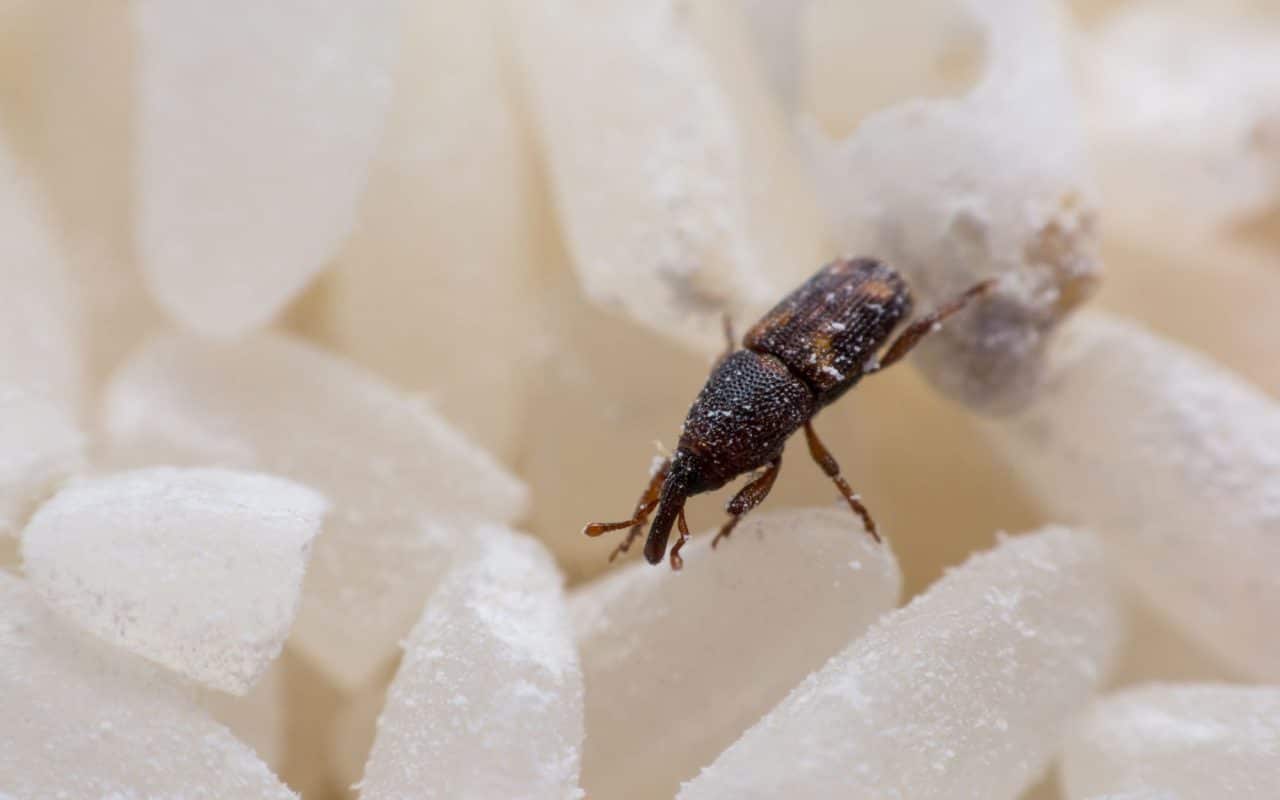
Do not stop at the one box you noticed. Pull out every bag of rice, dried beans, pasta, flour, cereal, and whole grain and check it under decent light. Look for tiny holes chewed through the cardboard or plastic, a dusty or gritty texture mixed into the food, and small crawling adults inside the package or gathered near the seam. If you see silk webbing clumping the food together, that points to pantry moths instead, since this pest leaves no webbing at all. A true grain weevil has a long snout with chewing mouthparts at the tip, which is the one feature that separates it from the flatter, snoutless flour beetle that more often turns up in flour and cereal. Whole grains like rice, wheat berries, and dried corn tend to be the true weevil’s preferred target, while flour and cereal draw the flour beetle more often, though in practice both can show up anywhere in the pantry, including dried beans and pasta. Either way the cleanup steps below are the same, so do not get stuck trying to pin down the exact species before moving on.
Bag and discard anything infested
Once a package shows holes, dusty residue, or live adults, seal it in a bag and carry it straight out to the outdoor trash can. Do not pour it into the kitchen trash can, since that just gives any survivors a way back into the house before pickup day. Check unopened packages sitting near the infested one too, especially anything bought around the same time. Most infestations trace back to eggs or larvae that were already inside a package when it left the store, so a clean-looking box on the same shelf is not automatically safe just because the bag has not been opened yet.
Vacuum and wipe the shelves
Vacuum every shelf the pantry goods sat on, working into the corners, along the back wall, and into the screw holes that hold the shelf brackets in place. Weevils and their larvae collect in those small gaps where spilled grain or flour has built up over time, often without anyone noticing. Empty the vacuum canister or bag outside when you are done, not into the kitchen trash, or you have just moved the problem a few feet. Follow up with a wipe-down using warm water, then let the shelves dry completely before anything goes back on them.
Freeze anything borderline
For packages that look untouched but sat on the same shelf as an infested one, freezing is the safest middle step before you decide to keep or toss them. Set your freezer as close to 0F (-18C) as it will go and leave the package in for at least four days, treat 96 hours as a floor, not a guarantee. Home freezers often run warmer than 0F, especially in a door shelf or a unit that gets opened a lot, so if you are not sure how cold yours actually runs, lean toward the longer end rather than cutting it short. This step kills eggs and larvae that a visual inspection alone will not catch.
Switch to airtight, gasket-sealed containers
Once the pantry is clear, do not put dry goods back into their original paper or thin plastic packaging. A cardboard box or a bag with a fold-over top does not keep pests out, and the packaging itself is often where the original infestation started. Move rice, flour, cereal, pasta, and dried beans into containers with a rubber gasket seal instead. This will not undo an infestation that is already inside a package when you buy it, since that starts before it reaches your kitchen, but it does keep any survivors from spreading once they are in your house.
Recheck the pantry after a week
Come back in about a week and look over the shelves and containers again. A few adults showing up inside a sealed container usually just means eggs were already in the food when it was stored, not that the container failed you. If you keep finding adults across several containers, or see them out on the shelves themselves, the cleaning step probably missed a pocket of spilled food somewhere, and it is worth vacuuming again before you restock anything else.
Don’t do this: toss the one package you found and restock everything else without checking it first. Weevils travel from package to package sitting on the same shelf, so a single-box cleanup usually just means dealing with this again in a few weeks.
The shortcut: run a flashlight along the shelf edges and screw holes before you vacuum. That is where spilled flour and grain collects out of sight, and it is usually the spot people miss on the first pass through.
Getting rid of weevils that are not flour weevils
The protocol above is written around the pantry, and it works unchanged for every stored-product weevil: rice weevil, granary weevil, maize weevil, and the bean and cowpea weevils that come home inside dried pulses. They differ in which grain they prefer and in whether the adult can fly, and in nothing that changes what you do. Find every open package, bag and bin the infested ones outdoors, vacuum the shelf, freeze the borderline goods for four days at 0 °F (−18 °C), then move everything into containers with a real gasket seal.
One family of weevils does need a different answer, and it is the one people most often mistake for a pantry problem. Outdoor weevils — the black vine weevil above all, but also the strawberry root weevil and several others — walk in under a door in late summer and autumn when the ground outside dries out. They are larger, often 6 to 10 mm, dull black or grey, and they turn up on a windowsill, in a bath tub or along a skirting board rather than in food. They cannot eat anything indoors and they die within a few days.
The shortcut: if the weevils are in the food, work the pantry. If they are on the floor and the food is clean, work the doorway. Emptying a cupboard because of an insect that wandered in from the garden costs a weekend and fixes nothing.
For the outdoor kind, the fix is exclusion rather than treatment: a door sweep, sealed utility penetrations, and keeping mulch and dense planting back from the wall. The basement and storage prevention guide covers the same entry points, and the small brown bugs guide helps if you are not yet sure which of the two you are holding.
FAQ
Do flour weevils bite or spread disease?
No. True grain weevils and the flour beetles people often mistake for them do not bite and are not known to spread disease to people. The concern with an infestation is food contamination, not a personal health risk from the insect itself.
How can I tell a flour weevil from a flour beetle?
Look for the snout. A true weevil has a long snout with chewing mouthparts at the tip, while the red or confused flour beetle has a flat body and no snout at all. In practice, the flour beetle is the one people find in flour and cereal more often, even though most people reach for the word weevil either way. The fix is the same for both, so getting the name exactly right matters less than actually cleaning the pantry.
Is it safe to eat flour that had weevils in it?
General food-safety guidance tends to treat a weevil infestation as a quality and comfort issue rather than a hazard, so sifting the insects out is a judgment call some households make and others do not. If you are not comfortable with it, the simplest option is to discard the package and start fresh. That is a personal decision, not something with one universal right answer, and when in doubt it is reasonable to just toss it.
How long does it take to fully get rid of flour weevils?
Most of the cleanup, inspecting, discarding, and vacuuming, can be done in an afternoon. The part that takes longer is the freezer step for borderline packages, which needs at least four days at 0F to be effective, plus a follow-up check about a week later to confirm nothing new has turned up before you consider the pantry clear.
Sources
- University extension entomology and integrated pest management (IPM) fact sheets