Short answer
Almost half the bugs in our catalog are some shade of brown, so “small brown bug” on its own doesn’t narrow much down. What actually sorts the candidates is where you’re seeing it and whether it takes off when you get close.
- Note which room it turned up in — bedroom and closets point one way, kitchen and pantry shelves point another.
- Watch whether it flies or just crawls. That one detail splits most of the candidates in half.
- Still not sure? The full identification chart lays out every trait side by side.
Which bug is it?

If you’re finding it in a bedroom or closet and it’s crawling rather than flying, look closely at the shape. A short, bristly body around 2 to 5 millimeters that seems to inch along fabric or the edge of a rug is usually a carpet beetle larva — it never develops wings at this stage, so it won’t take off no matter how close you get. If instead something plain beige and roughly the same size flutters up off a sweater or out of a closet, that’s more likely a clothes moth. These two turn up in the exact same spots and get mixed up constantly, which is why we put together a dedicated comparison at small brown bugs in the bedroom if you want the side-by-side.
Kitchen and pantry sightings split a different way. If the bug flies and you’ve noticed it near stored food, dry goods, or spice jars, you’re probably looking at one of three reddish-brown fliers: a drugstore beetle, a cigarette beetle, or a fruit fly, the last one distinguished by its red eyes and habit of landing directly on ripening produce or around the sink drain. Telling the two beetles apart from a distance is genuinely hard, so we wrote a separate breakdown at small brown bugs with wings that goes through the details.
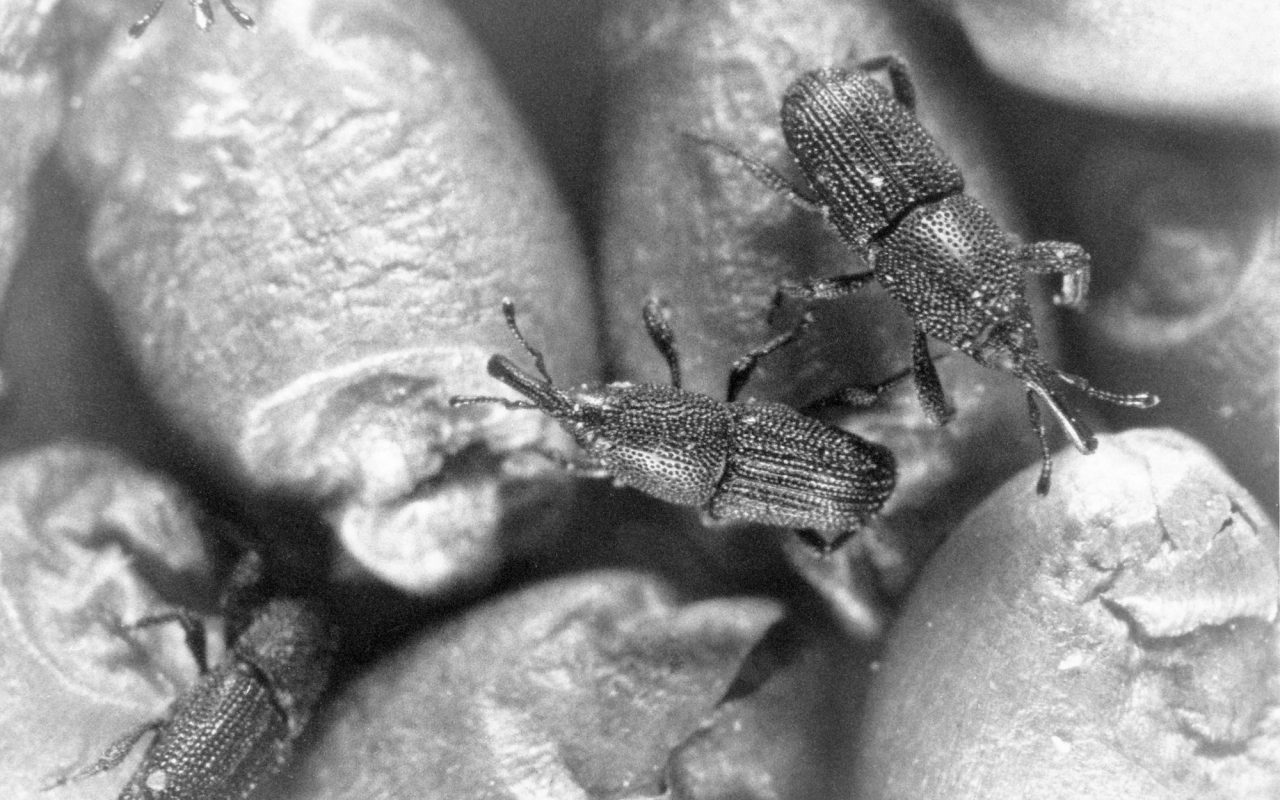
If it’s in the kitchen but doesn’t seem to fly, or you can make out a small snout on its head, that points to a flour or rice weevil. These show up in bags of rice, pasta, or flour. The rice weevil does fly, which is why one can turn up some distance from the package it emerged from; the granary weevil has no functional wings under its wing covers at all and can only walk.
One more kitchen pattern worth calling out on its own: a moth-like insect with tan, slightly coppery wings that you only seem to notice around dusk, drifting near the pantry shelf rather than the fruit bowl, is more likely a pantry moth than a clothes moth, even though the two look similar at a glance.
FAQ
Why are there so many small brown bugs in the house?
Brown and tan shades work as camouflage in fabric, wood, cardboard, and dry food, so a lot of unrelated household insects end up looking similar at a glance. Color alone rarely tells them apart — the room you found it in and whether it flies are much more useful clues.
Does the size of the bug matter for identification?
Not as much as people expect. Most of the candidates fall somewhere between 2 and 12 millimeters, so the ranges overlap a lot. Treat size as a secondary check after you’ve noted the room and whether it flies.
What if I found it somewhere other than the bedroom or kitchen?
These two rooms cover the large majority of small brown bug sightings, but if yours turned up elsewhere, the full identification chart lists every trait — color, size, flight, and typical location — for the whole catalog.