 Fabric damage
 Short answer
A small, plain buff-tan moth that scurries into a dark closet corner instead of fluttering toward a window, paired with ragged holes in a wool sweater or blanket, is almost always one of the clothes moths. Here is the fast version if you just found one.
- Pull every stored wool, fur, or felt item out of the closet and check each one for irregular holes or silk feeding tunnels, not just the piece you noticed first.
- Wash washable items on a hot cycle or send them to the dry cleaner, and freeze delicate non-washables at 0°F (-18°C) for at least 3 days, longer if your freezer tends to run warm.
- Vacuum the closet thoroughly, including corners, baseboards, and under any stored boxes, then take the vacuum bag or canister outside right away to empty it.
Identification
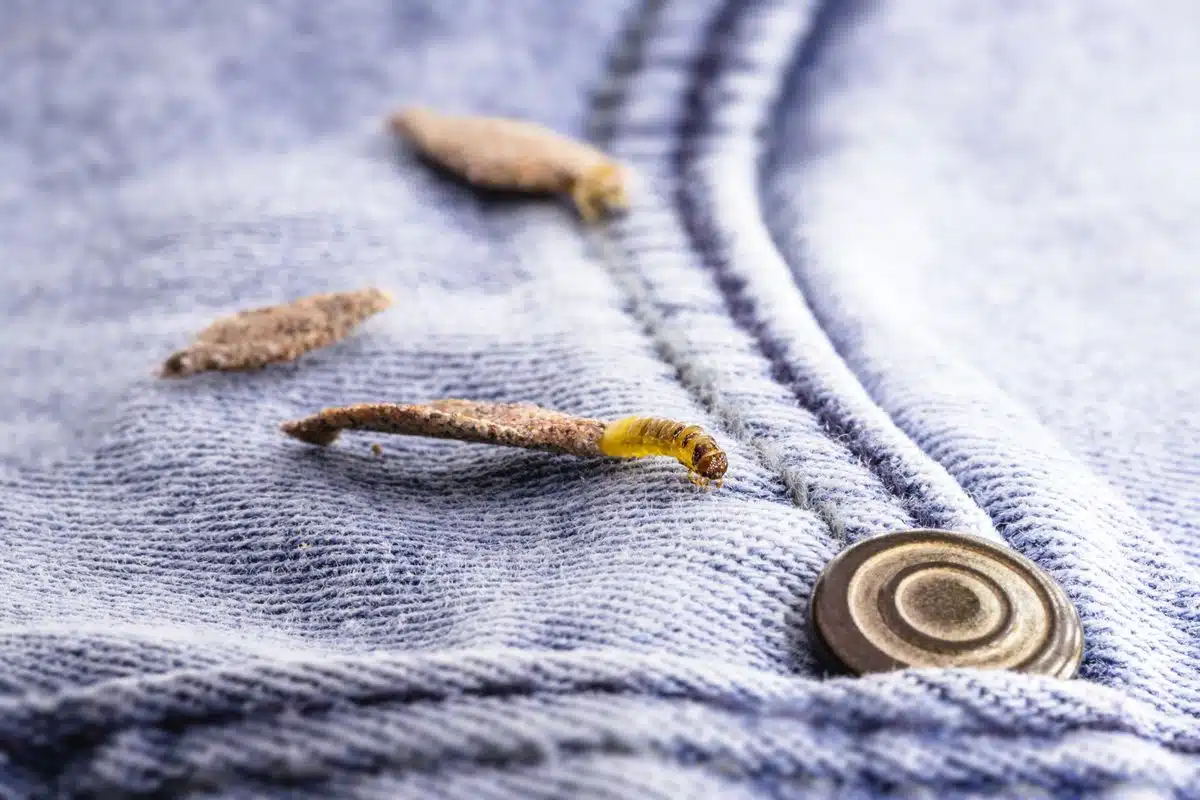
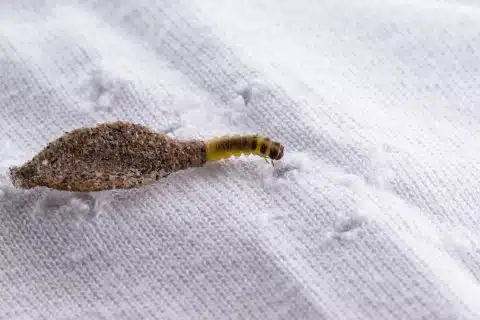
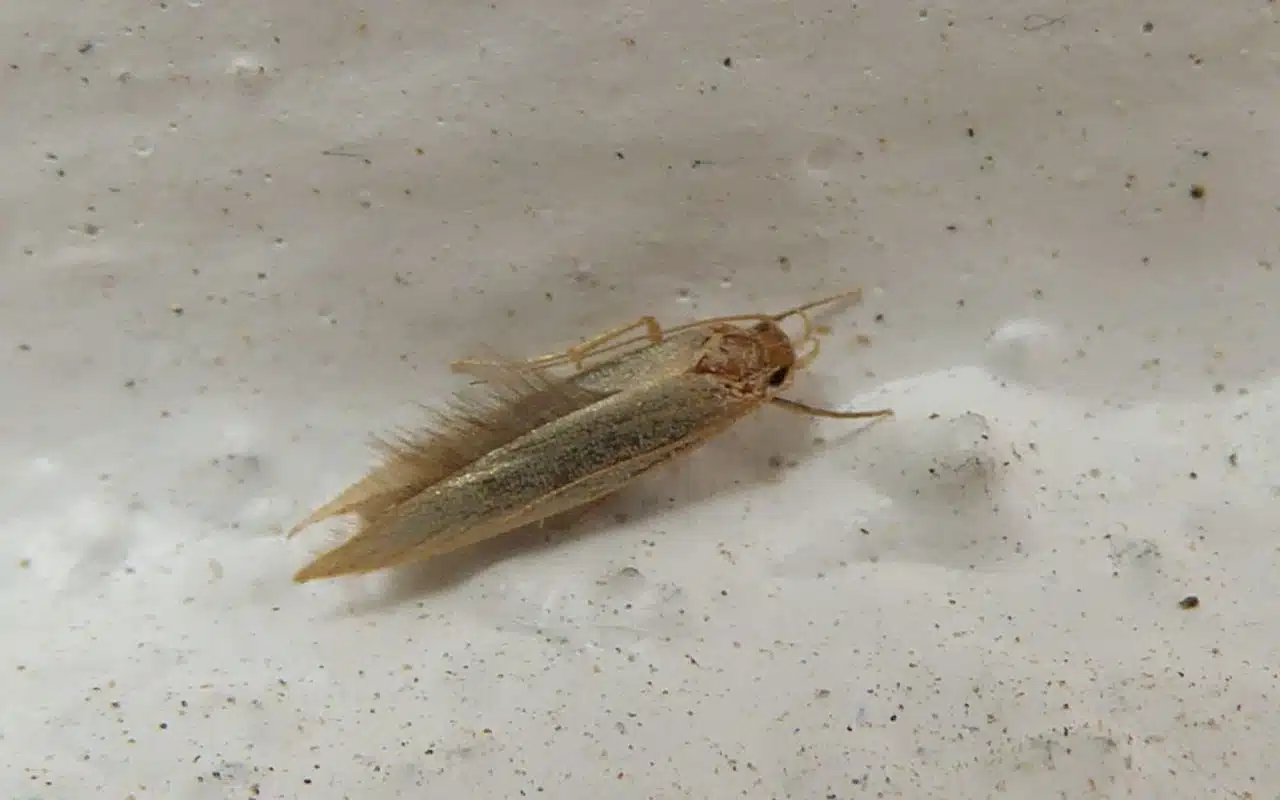
Adult clothes moths run small, with a body around 6 to 8mm long and a wingspan of roughly 9 to 16mm. The wings are a uniform buff or golden-tan color, no spots, no bands, no two-tone shading of any kind, which is the single detail that separates them from most other moths found indoors. They are weak fliers. Disturb one in a closet and it tends to scurry along a shelf or make a short, low hop rather than beat toward a lamp or window. That avoidance of light is a habit, not an accident: adults are photophobic, so you will find them tucked into dark closet corners, folded into a stored coat, or behind hanging clothes rather than at the windowsill. The larva is the one actually doing the damage, a small white or cream caterpillar that either spins a loose silk feeding tunnel across the fabric surface (webbing clothes moth) or drags around a tiny portable silk case as it feeds (casemaking clothes moth). It favors fabric that has been worn and sweated in over fabric fresh from the closet, which is part of why one sweater gets hit while others folded right next to it are left alone.
Look-alikes
The pantry moth, already covered on this site, is the most common mix-up. Its wings show a two-tone pattern, pale gray near the body and coppery-brown toward the tips, and it turns up around stored food and window glass rather than folded wool. Clothes moths skip that pattern entirely and stay out of the light, in fabric storage rather than at the window. The other look-alike is not a moth at all: the carpet beetle, also covered on this site. At rest it has an oval, hard-shelled body with no elongated wing shape, closer in outline to a tiny ladybug than to a moth. If what you are looking at is oval and compact instead of moth-shaped, check the carpet beetle profile instead.
The shortcut: Check the underside of stored items and along the seams first. Larvae go for fabric that still carries sweat or body oil, so the item you wore last before packing it away is usually the one worth checking closest.
Clothes moths FAQ
Do clothes moths bite?
No. Clothes moths do not bite, sting, or carry disease. The only damage they cause is to fabric, not to people or pets.
What is the difference between webbing and casemaking clothes moths?
It comes down to the larva. A webbing clothes moth larva spins a loose silk tunnel across the fabric as it feeds. A casemaking clothes moth larva builds a small portable case out of silk and drags it along, visible as a tiny grain-shaped tube stuck to the fabric. That case is the one reliable way to tell the two species apart.
How long do I need to freeze a wool sweater to kill the larvae?
General guidance treats 0°F (-18°C) for at least 3 days as a floor, not a guaranteed cure, in the same ballpark used for carpet beetles on this site. Home freezers often run warmer than that, so give it longer if you are not sure of your freezer’s temperature. Freezing also will not undo holes already chewed. It only stops the larvae still inside the item.
How do I keep clothes moths from coming back once the closet is clear?
Store cleaned, fully dry items in a sealed container or a zippered garment bag. A female strongly prefers fabric that still carries sweat or body oil for laying eggs, so clean stored fabric is far less attractive to her. A scented deterrent hung near stored wool can discourage new egg-laying, but it will not kill an infestation already in progress, only laundering, dry cleaning, or freezing does that. A pheromone trap is worth hanging too, though only for monitoring: it tells you whether adults are still around, it does not do the killing itself. If the problem keeps coming back despite all this, it may be worth calling a licensed pest control professional.
Sources
- University extension entomology and integrated pest management (IPM) fact sheets