Short answer
You almost never catch the larva in the act. What you find is what it left: a patch of silk, gritty specks the color of the cloth, and a grazed area not yet open into a hole.
- A tan moth running across a dark closet shelf instead of flying is the earliest warning. It eats nothing, but it lays within a day or two of emerging. See the clothes moth species profile.
- Check under collars and cuffs, along seams and folds, and on carpet beneath furniture. Clothing in regular use is rarely hit.
- Silk plus fabric-colored frass means clothes moths. Shed skins and no webbing point to carpet beetle larvae instead.
Most people go looking for clothes moth larvae after finding a hole, hoping to match a photo. Wrong order: by then the larva has usually finished feeding and moved on, and the evidence is what it left. So this guide runs the other way, earliest sign first.
What the larva looks like, and why you won’t see one
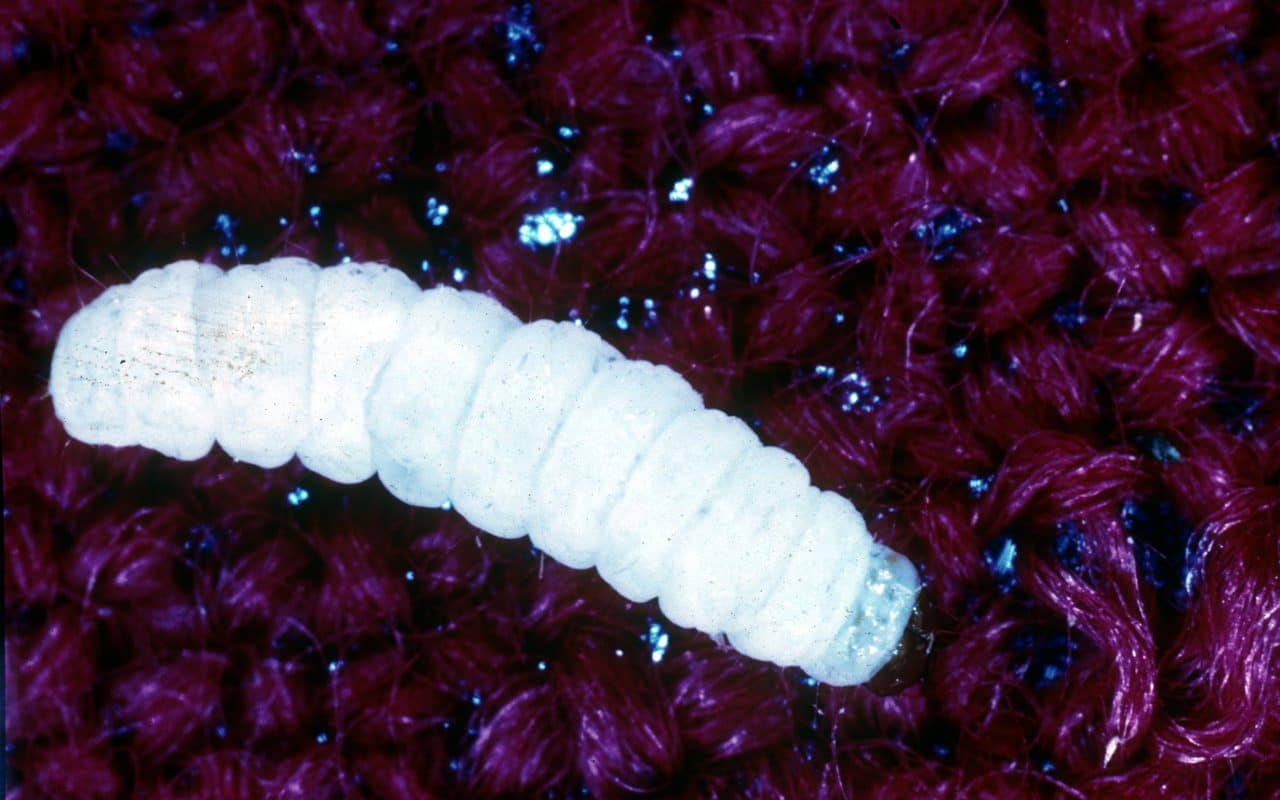
A full-grown webbing clothes moth larva is 12 to 13 mm, roughly half an inch, cream-colored with a brown head capsule and no eyes. Smooth, not bristly. But it reaches that size only at the end of a larval stage running 35 days to two and a half years. Newly hatched from a pinhead-sized egg it is nowhere near that, and it feeds under a blanket of silk in the folds of something you never wear. For what it eats, see do moths eat clothes.
Sign 1: an adult that runs instead of flying
Clothes moth adults shun light and fly weakly, so they stay near the infested item rather than heading for a lamp. Penn State Extension puts it plainly: when you find one, it is more likely to escape by running rapidly than by flying.
What that gives you is timing. The adult damages nothing, but clothes moths mate and lay within one to two days of emerging, and eggs hatch in 4 to 10 days in summer. One moth is not proof of an infestation. It is a clock: eggs are going onto something nearby right now.
Sign 2: silk patches and grit the color of your fabric
The webbing clothes moth larva carries no case. It spins flat patches of silk on the cloth, excrement and loose fibers collect in that silk to form a temporary feeding tube, and it feeds underneath. When it moves on it abandons the tube, which is why the evidence outlasts the animal.
The color of the grit settles it. Clothes moth excrement can carry dye from the fibers the larva ate, so the specks come out the color of the garment. Gray pellets on a gray sweater are not a coincidence. They are that sweater. It also means frass is hardest to see on the very garment it came from, so shake the item over a light surface.
Sign 3: the wool thins before it opens
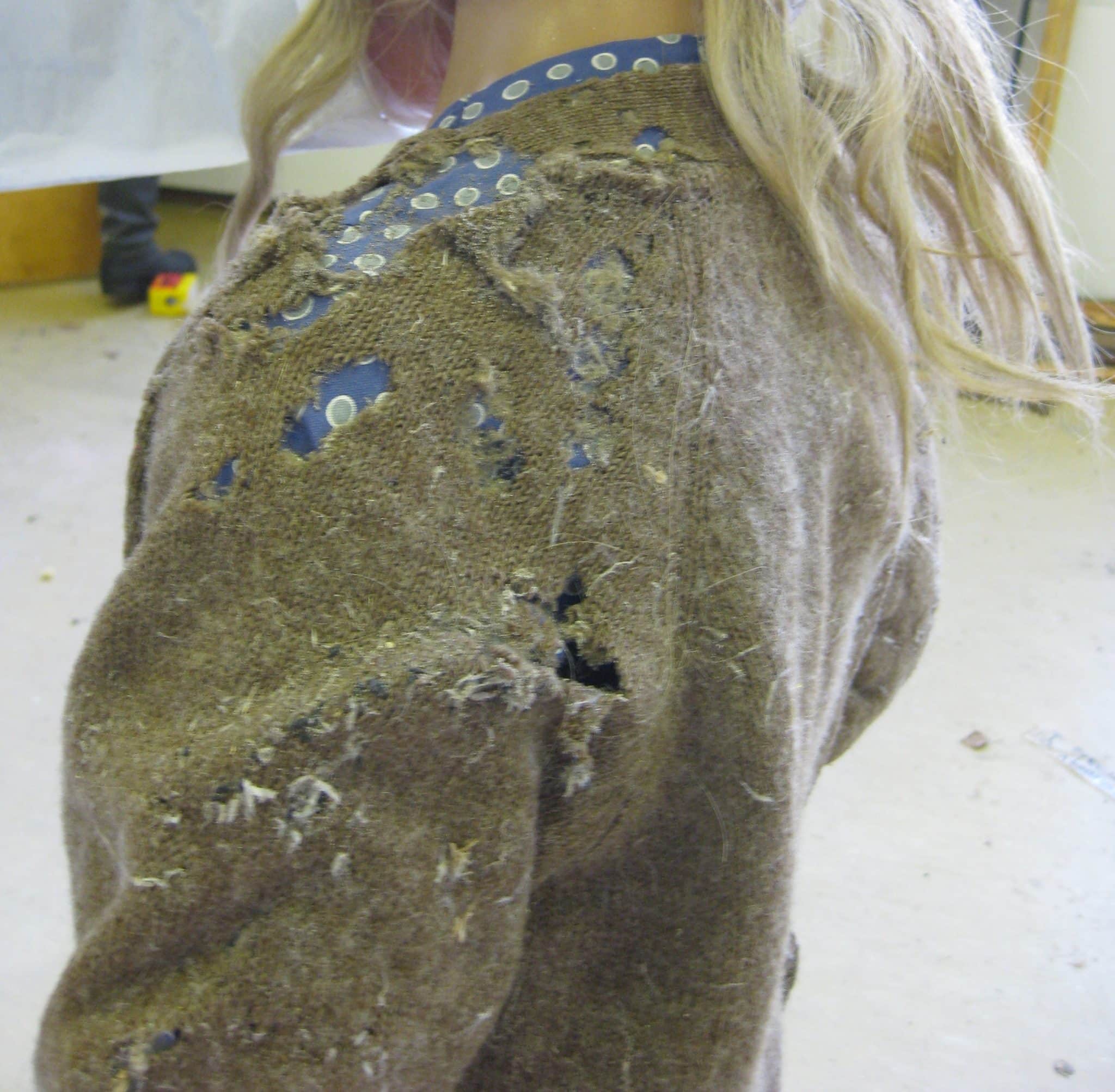
Larvae graze along the surface, cutting fibers off near the base. Penn State Extension describes the result as furrows in the wool, with holes appearing only occasionally and during heavy infestations. University of Kentucky Extension calls the same thing threadbare spots.
So the hole is late. Before it comes a patch where the nap is shorter, the weave shows through, and the cloth feels thinner between your fingers than the fabric alongside. Catching a garment here is the difference between laundering and mending.
Sign 4: the hole, and where it sits
Location tells you more than shape. Damage turns up beneath collars and cuffs, in upholstery crevices, and on carpet under furniture, and fabric with food or sweat stains gets hit harder. Kentucky is blunt about the flip side: clothing in regular use is seldom infested, and neither are rugs that get normal traffic or routine vacuuming.
So one clean hole in the middle of a sweater you wear weekly is not a typical moth hole. Check the inside of that collar first. No silk and no frass there, and think snags or friction wear.
| What you find | What it means | What to do next |
|---|---|---|
| A moth running, not flying, in a dark closet | Adults emerged nearby and are laying now | Inspect fabrics within a few feet, not the house |
| A silk patch with gritty specks the color of the cloth | A larva fed under it, and that garment is the food | Isolate it, check what was stored touching it |
| A thin, furrowed, threadbare patch | Grazing, fibers cut at the base, not through | Launder or dry clean while it is still whole |
| A hole in a hidden, undisturbed spot | Feeding ran long enough to go through | Clean it, check everything stored with it |
Where to look first on a stored garment: bright light, inside out, collar seam, then cuffs, then every fold and crease. UC IPM recommends brushing woolens along seams, folds, and pockets, which destroys eggs and exposes larvae. Larvae dislike light and drop off when they lose cover, so work over a sheet.
Clothes moth or carpet beetle?
Both eat keratin and work in dark undisturbed places, and UC IPM admits damage alone does not always separate them. Three things do. Carpet beetle larvae spin no webs. They shed brown, shell-like, bristly skins as they molt, and cast skins with no webbing are the tell. Carpet beetles also tend to wreck one large area of a garment, while moth damage shows up as scattered holes. And the adults split on light: carpet beetles head for windowsills, clothes moths stay dark. More in our guide to carpet beetle larvae.
Clothes moth eggs: worth knowing about, not worth hunting for
A female lays roughly 40 to 50 white eggs the size of a pinhead, glued to the fabric threads by an adhesive secretion, hatching in 4 to 10 days in warm weather and longer in winter. All true, and almost none of it usable: a pinhead-sized white egg cemented to a cream wool sweater is not something a person finds by looking. Hunt for eggs on a pale garment, find nothing, decide it is fine: worst outcome available.
Inspect the hidden areas for silk and frass instead, then treat the infested item rather than chasing eggs. Laundering 20 to 30 minutes in water at 120°F or hotter kills every stage, and dry cleaning or a dryer’s heat does the same. For anything that cannot take heat, Kentucky’s freezing guidance is 0°F for a week, or 72 hours at minus 20°F, bagged first against frost. Keeping it clean afterward is a separate job, covered in how to keep moths out of a closet.
Do not spray the garment: Penn State Extension and UC IPM agree on fabric pests: never apply pesticides to clothing or bedding. Before buying cedar, sachets, or mothballs for the closet, read what clothes moth repellents actually do.
FAQ
What do moth eggs look like on clothes?
White, pinhead-sized, glued to the threads. A hand lens may find a cluster on dark wool; on pale wool it will not. Look for silk and frass instead.
How do I identify moth holes in clothes?
Judge location first: under collars and cuffs, in folds, in upholstery crevices, under furniture. Check the edges for silk and fabric-colored frass. Scattered small holes fit moths, one large ruined patch fits beetles.
How big do clothes moth larvae get?
12 to 13 mm, about half an inch, cream-colored with a brown head, and only at the very end of a larval stage lasting 35 days to two and a half years.
What does a webbing clothes moth cocoon look like?
A small silken cocoon spun on the fabric itself, with fibers and excrement worked in. Pupation takes 8 to 10 days in summer, 3 to 4 weeks in winter.
Does one moth in the closet mean an infestation?
Not on its own, but eggs are probably being laid nearby, since adults lay within a day or two of emerging. Inspect the wool within a few feet, not the whole closet.
Sources
- University of California Statewide Integrated Pest Management Program, Pest Notes: Clothes Moths, UC ANR Publication 7435.
- Penn State Extension, Clothes Moth.
- University of Kentucky Entomology, Clothes Moths, ENTFACT-609.
- University of California Statewide Integrated Pest Management Program, Pest Notes: Carpet Beetles, UC ANR Publication 7436.