Short answer
A bedroom has no drain, no trap, nothing you rinse. So moisture feeders on a bedroom baseboard mean more than the same cluster in a bathroom: water is arriving where you cannot see it, and has been for weeks.
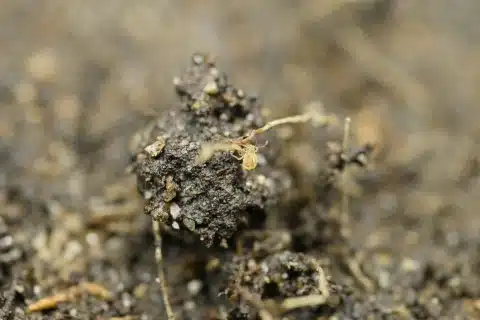
- Confirm the animal. Gray to blue-gray, 1 to 2 mm, vanishing in a hop that lands somewhere random rather than on you. What a springtail is, and what it gets confused with.
- Map the sightings before you move any furniture. Where they sit, and how high off the floor, narrows the water to one of six sources.
- Then fix the water, not the insect: find the wet spot and dry it, and hold the room’s humidity down.
Why a bedroom is the wrong room for them
A springtail carries almost no waterproofing. Its outer layer leaks, so it dries out in still air far faster than a beetle of the same size and has to stay on a surface holding a film of moisture. It eats mold, algae and decaying plant matter, and it lives where those live: the floor of a sink cabinet, a shower tray, a cold basement slab.
A bedroom has none of that by design. In a bathroom the answer is boring and within arm’s reach, which is why a jumping speck on bathroom tile rarely turns into a search. Here the water is hidden by definition: behind a wall, down from a ceiling, out of a pot, or straight out of the air. It is not about cleanliness, and vacuuming twice as often changes nothing.
Where they sit tells you which source
Do this before you pull the bed out. Note each sighting and its height off the floor. One springtail on a pillow got lost. A dozen in the same three feet of baseboard, three mornings running, is a map.
| Where you keep finding them | What it points at | What confirms it |
|---|---|---|
| Baseboard on the wall shared with a bathroom | A leak inside that cavity | Damp 30 to 90 minutes after someone showers |
| Behind the headboard, on an exterior wall | Condensation, not a leak | Wall face colder than the room, musty up close |
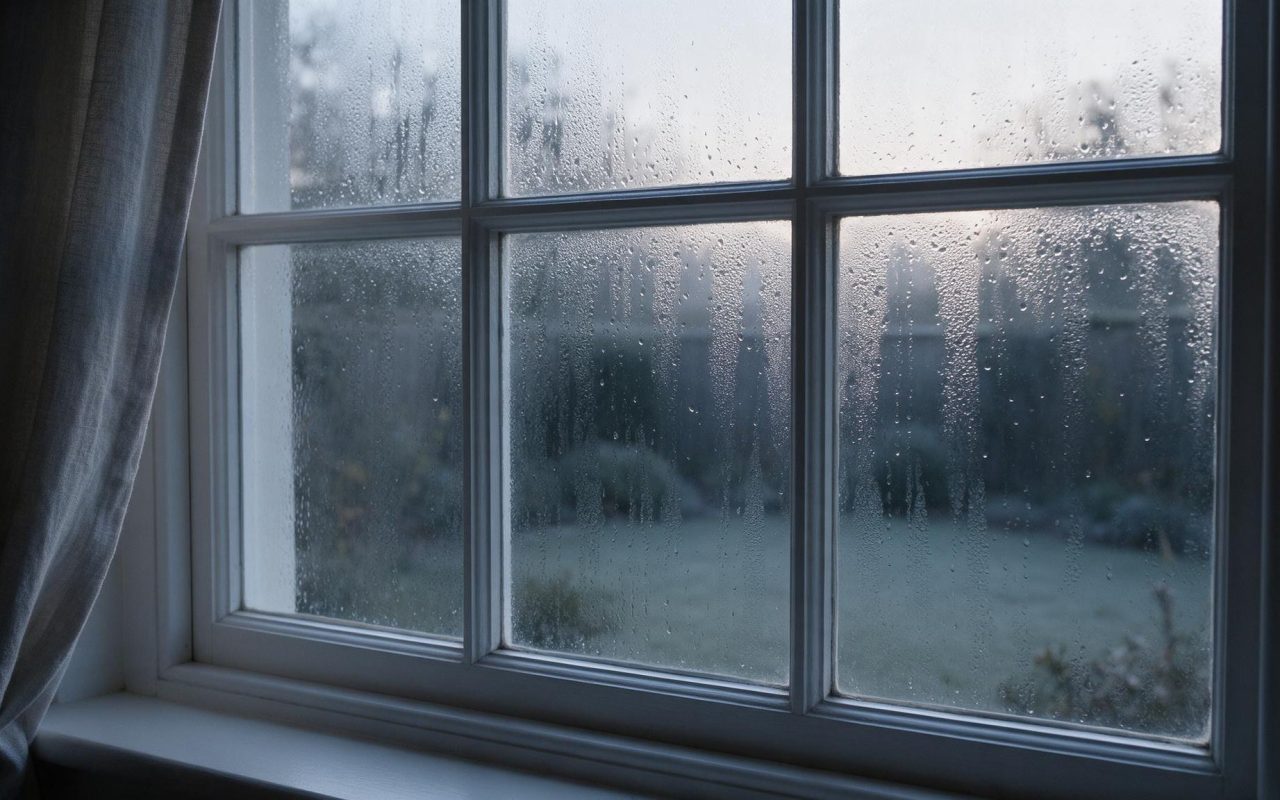
| Window track and the sill under it | Condensation off the glass | Water sitting in the track before sunrise |
| Around a pot, its saucer, the floor beside it | Mix that never dries out | Soil wet a knuckle deep two days after watering |
| Ceiling, top of a wall, a light fixture | Water arriving from above | A stain that widens after rain, or in the cold |
| Under a rug or a box on a ground-floor slab | Vapor rising through the floor | Dark ring on the underside of the rug pad |
Look before you get up, not after you make the bed: the film they stand on forms at the coldest hour of the night and burns off once the room warms. Air the room out first and you erase your own evidence.
The cold wall behind the headboard
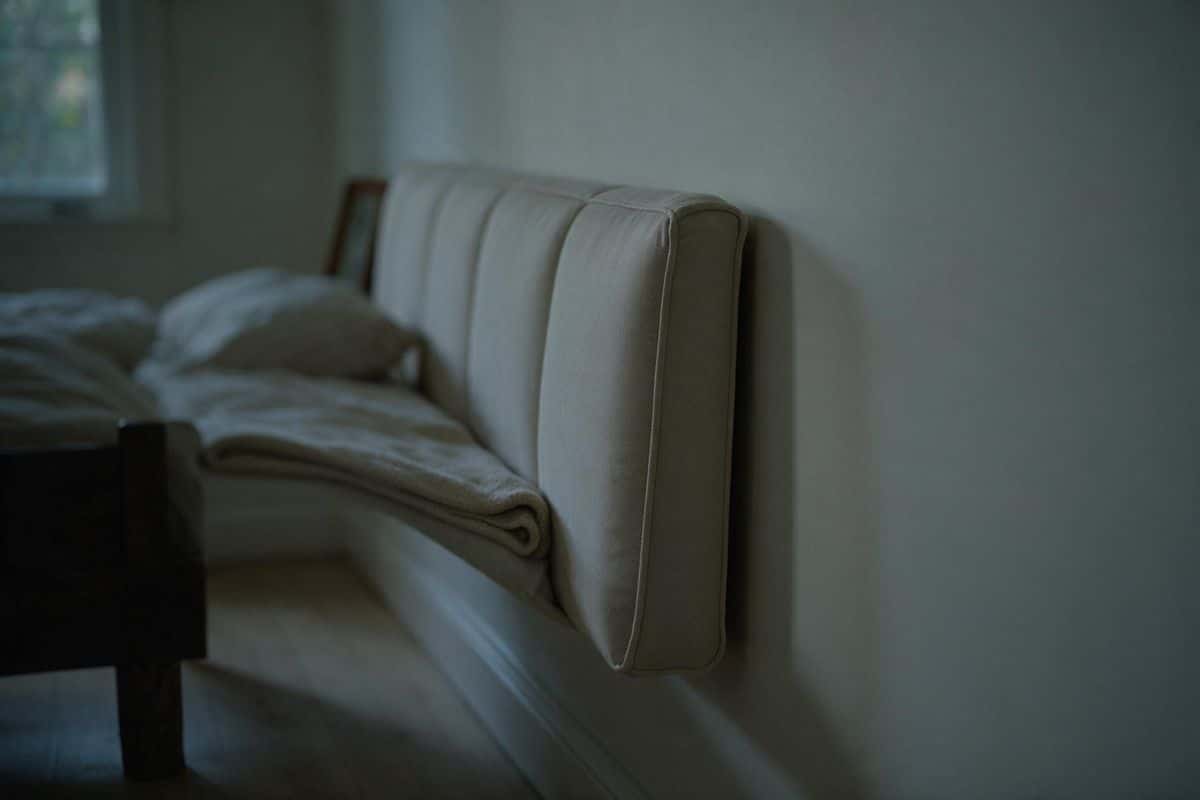
Nobody checks this one, because nothing is leaking. Two adults asleep with the door shut are a humidifier: breath and skin load a small room for eight hours straight. Building-science guidance on condensation puts an adult at roughly a pint of water vapor overnight, an order of magnitude rather than a measurement of your room.
That air then finds the coldest surface in the room. Air at 68 °F and 60 percent relative humidity has a dew point near 54 °F, and any surface below 54 °F grows a film of water. An exterior wall behind a solid headboard runs colder than the rest of the room for two reasons at once: the headboard blocks the air that would warm it, and it traps the moisture reaching that face. Mold takes the film. Springtails take the mold.
Three checks separate condensation from a leak, and they take a day:
- A hygrometer on the nightstand, a second one in the hallway. Bedroom higher at dawn, both converging by noon, means the room makes its own water.
- An infrared thermometer, the kind sold for cooking, on the wall face and then on the room air. A wall at or below the dew point condenses.
- Pull the bed four inches off the wall for a week, door open by day. If the damp and the springtails fade together, airflow was the missing part.
Sealing does not work. Paint, a mold-resistant coating, caulk along the baseboard: none of it moves the dew point, and the wall condenses behind the new finish. The levers are airflow and the moisture in the air, with a dehumidifier last. Bringing indoor humidity down, room by room covers that sequence.
The wall you share with the bathroom
The wet side of that wall is tiled and looks fine. The bedroom side is drywall and painted trim, and it shows the problem first. A weeping valve, a shower pan flange or a supply joint runs down the framing inside the cavity and collects on the bottom plate, which is why the sightings line up along the floor rather than at eye level.
Test it on a cycle, not at random. Run the shower ten minutes with the door shut, then put your palm on the baseboard and the bottom six inches of drywall at 30 minutes and again at 90. Damp on that schedule and dry the rest of the day is a plumbing answer, and a dehumidifier will lose to it. The bathroom side has habits worth fixing too: bathroom moisture and drain habits.
The plant, the drying rack, the humidifier
Potting mix is normal springtail habitat, and a few in a pot are not a finding. Dozens crossing open floor are: that mix is saturated rather than damp. Let the top inch dry between waterings and empty the saucer within half an hour. Two habits load the air the same way, an ultrasonic humidifier run all night and laundry drying behind a closed door.
When it is coming from above
Springtails on a ceiling, on the top of a wall, or around a light fixture point up rather than down. Water runs along framing and the roof deck before it shows, so the stain sits downhill from where it gets in. Timing splits the candidates: worse a day after rain reads as roof or flashing, worse in cold weather with no rain reads as the attic, where a bath fan ducted indoors soaks the sheathing over that bedroom.
What it is not: bites, bed bugs, and fleas
Springtails do not bite and have no reason to be in bedding. A mattress slept in every night is one of the driest surfaces in the house, the opposite of what they need. One that lands on damp skin stays there because the skin is damp, not because it wants anything.
If something is biting at night, this is not the page: a bed bug is 4 to 5 mm, reddish-brown, flat, and it walks; it never jumps. A flea jumps toward a host. Springtails hop away from you. Any skin reaction is a question for a clinician, not a bug guide.
Two harmless look-alikes share those corners. One that walks steadily instead of hopping is probably a booklouse, reading the same moisture and answering to the same fix; the pale bugs indoors comparison separates them. If yours is brown and clearly bigger, see small brown bugs in the bedroom: those live in closets, not in damp.
What to skip, and when to call someone
No spray dries anything, which is the argument against every product sold for this animal; the long version is in the springtail removal protocol. Powder has the same flaw here: it needs a dry surface to abrade, and they are on the wet one. See why diatomaceous earth specifically fails in a damp bedroom before buying a bag of it. A vacuum clears the cluster and tells you nothing about why it formed.
Make two honest passes with the table above. If the numbers climb with no water found, or the damp sits inside a wall, a ceiling or a slab, call a trade rather than a pest company: a plumber for the shared wall, a roofer for the ceiling, a contractor for a wall that condenses every winter.
FAQ
Can springtails live in my mattress or bedding?
No. They need a surface that stays damp continuously, and a bed that is slept in and aired is one of the driest things in the room. Bedding that genuinely feels damp in the morning is a humidity reading, not evidence of anything living in it.
Why are they only in the bedroom and nowhere else?
Because the water is in that room or in one of its walls. Springtails do not travel far from a damp surface, so a population confined to one room says the moisture is too. That cuts the search to four walls, a ceiling and a floor.
Could they be biting me while I sleep?
No. Springtails have no mouthparts aimed at skin and no interest in people. Waking up with marks is a separate question with several possible answers, medical ones included, and it belongs with a clinician.
I am on the second floor. Can it still be plumbing?
Yes, and often is. Upstairs bedrooms usually share a wall or a floor with a bathroom, and the supply lines, the shower pan and the vent stack run inside that framing. A bath fan ducted into the attic adds a source overhead.
Why do I only see them first thing in the morning?
Because they follow the film of water, and it is thickest at the coldest point of the night. Once the room warms, the surface dries and they retreat into a wall gap, a carpet edge or a pot.
Sources
- Building-science guidance on residential moisture and condensation (dew point, indoor vapor generation from occupants).
- University extension entomology departments, household pest fact sheets on springtail moisture requirements.