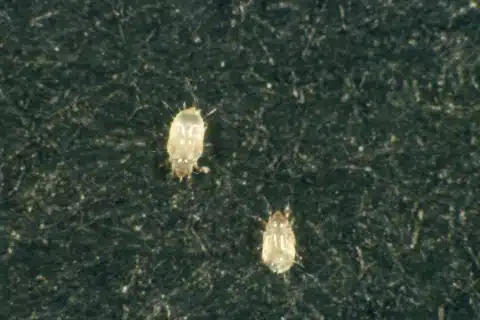
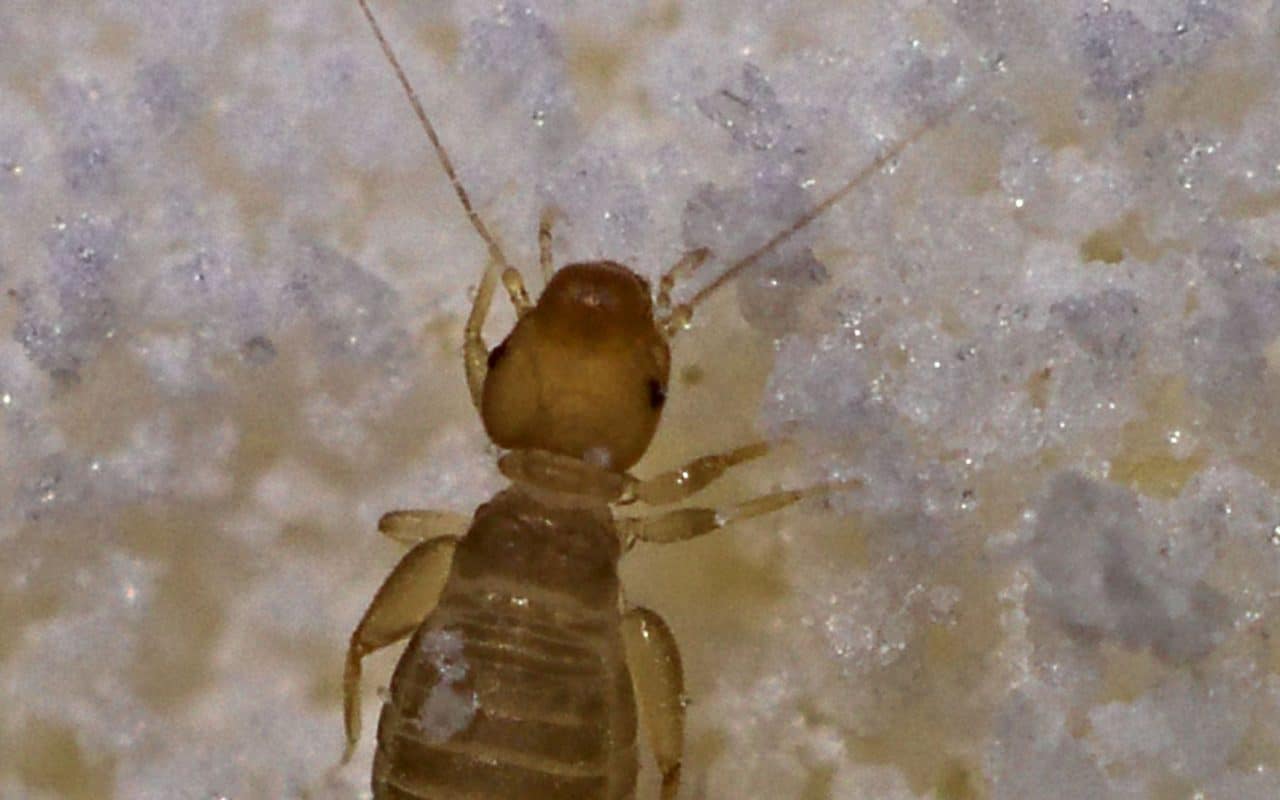
 Harmless — humidity signal
 Short answer
Booklice are soft-bodied insects barely bigger than a grain of pepper, usually pale tan or almost see-through, and they turn up wherever paper, cardboard, or plaster stays damp for too long. Despite the name, they are not lice and cannot bite you or your pets.
- Watch how it moves: booklice walk, sometimes in short, jerky bursts. Springtails, the insect most often confused with them, jump when disturbed.
- Run a dehumidifier or improve airflow in the room where you spotted them. Booklice can’t persist once humidity drops, so numbers usually fall within a couple of weeks.
- For a full room-by-room fix, start with our moisture control guide — it’s the actual solution here, not a spray or trap.
Identification
Booklice (Liposcelis spp., most commonly Liposcelis bostrychophila indoors) are among the smallest insects you’re likely to find in a house. Adults measure just 1 to 2mm, roughly the size of the period at the end of this sentence. Their bodies are soft, pale tan to nearly translucent, with no hard shell or obvious segmentation you’d notice at a glance. Most of the species found indoors have no wings at all, which sets them apart from a few outdoor relatives that do fly.
They favor anywhere starch and moisture meet: the paste behind old wallpaper, the glue binding a paperback left in a damp box, stacked cardboard in a basement, even the crumbs at the bottom of an opened cereal box. What draws them in isn’t the paper itself but the microscopic mold that grows on it once humidity climbs. Bathrooms, basements, and any room with a slow leak or weak ventilation are the usual hotspots, and numbers tend to rise in summer or during any stretch of muggy weather, roughly once indoor humidity holds above 60 to 70 percent.
The name is the confusing part. “Booklice” suggests parasites, but these insects don’t live on people or animals, don’t feed on blood, and don’t bite. They’re closer in habit to a tiny paper-mold scavenger than to an actual louse. The name stuck because early entomologists kept finding them chewing through old book bindings, not because they act like lice in any other way.
Look-alikes
Springtails are the most common mix-up, and for good reason: both are tiny, pale, and show up in the same damp corners. The giveaway is movement. Springtails carry a forked, tail-like structure (a furcula) tucked under their body that flicks them into the air when startled, so you’ll often catch them hopping off a wet surface. Booklice have no such structure. They walk, and when rushed, they scurry rather than leap. For a side-by-side on other small household bugs, our identification hub covers the rest of the usual suspects.
Very young bed bugs and certain mites get mentioned too, mostly because size alone isn’t much to go on under bad lighting. Location does most of the work here: bed bugs cluster near mattress seams and feed on blood, while booklice stick to paper, cardboard, and damp walls and don’t feed on anything living. If what you’re looking at is marching slowly across a damp book cover or a stack of newspapers, booklice is by far the more likely answer.
The shortcut: run a dehumidifier in the room for a week and check back. If the insects thin out, that’s a good sign it was booklice and a humidity problem, not something that needs direct treatment.
Booklice vs bed bugs
This is the comparison worth getting right, because the two answers lead to completely different weeks. A booklouse means running a dehumidifier. A bed bug means a treatment plan. Four checks settle it, and none of them needs a microscope.
- Where it was. Booklice are on damp paper, cardboard, plaster, window reveals and the back of a bookcase. Bed bugs stay within a few feet of where someone sleeps: mattress seams, the bed frame, the headboard join.
- Shape from above. A booklouse is a soft, pale, slightly elongated speck, 1 to 2 mm, with long thread-like antennae for its size. An adult bed bug is 4 to 5 mm, oval and flat like an apple seed, with a hard reddish-brown shell and short antennae. Even an unfed bed bug nymph, at 1.5 mm, is visibly rounder and firmer than a booklouse.
- Colour after a meal. Bed bugs that have fed swell and darken to a deep red-brown. Booklice never change colour; they have nothing to fill up on.
- What it leaves. Bed bugs leave dark ink-dot faecal spots on fabric that smear when wiped with a damp cloth, plus shed skins along seams. Booklice leave a faint dusty film on paper and nothing that stains.
If bites are involved, stop here. Booklice cannot bite. If someone in the house is waking with new bites in a line or a cluster, that is not this insect, and no amount of dehumidifying will help. Get the bedroom inspected properly.
Are booklice harmful?
Not to people, not to pets, and not to the house. They have no biting mouthparts that can break skin, carry no disease, and cannot chew structural material — they graze the microscopic mould film on a surface, which is why a heavily grazed book stays perfectly readable while looking faintly dusty.
The two real costs are worth naming, though. Stored food is one: booklice in an opened box of flour, cereal or dried fruit make it unappetising and can carry mould spores through it, so that package goes in the bin rather than through a sieve. The other is what their presence is telling you. A booklouse population is a humidity reading with legs, and the damp that fed it is the thing that will eventually lift wallpaper, warp a skirting board or grow something worse behind a bookcase. Treat the count as an early warning and the insect stops mattering.
FAQ
Are booklice dangerous, or are they actually lice?
No to both. Booklice aren’t related to lice and don’t bite, sting, or transmit disease. They can’t live on skin or hair and have no interest in humans or pets — the name is just an old label that stuck.
Do booklice damage books, wallpaper, or food?
Not in any structural sense. They feed on microscopic mold and mildew growing on paper, glue, or starchy food residue, not on the material itself, so you won’t find chew marks or holes worth worrying about. Heavily affected paper may look faintly dusty from droppings, but the paper stays intact.
How do I get rid of booklice?
Lower the humidity. No source publishes a humidity threshold below which booklice stop surviving. The mold they feed on struggles under about 50 percent relative humidity, so treat that figure as a target to aim for, not a switch that flips: a dehumidifier, better ventilation, and fixing any damp spots do more than any spray. Our moisture control guide walks through room-by-room fixes, and it’s worth checking the bathroom specifically if that’s where you’re seeing them.
Sources
- University extension entomology departments
- Cooperative Extension Service household pest fact sheets
- Standard urban entomology references used in pest management education