 Food contamination
 Short answer
Small reddish-brown beetles turning up in a bag of rice, flour, or dried beans are more often flour beetles than true weevils, though whole grains like rice can go either way, and the fix barely changes depending on which one you have. The pantry bug hub sorts all six that turn up in a cabinet. Here is the fast version.
- Check every dry good in the pantry, not just the one package where you first spotted them.
- Bag and toss any infested package straight into the outdoor trash can.
- Vacuum and wipe down shelves, corners, and screw holes where crumbs and eggs can hide.
- Freeze anything borderline for at least 4 days before it goes back on the shelf, then switch to airtight, gasket-sealed containers going forward, since the original packaging will not keep them out next time.
Identifying weevils in flour
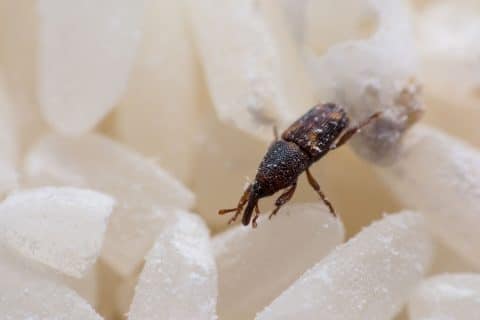
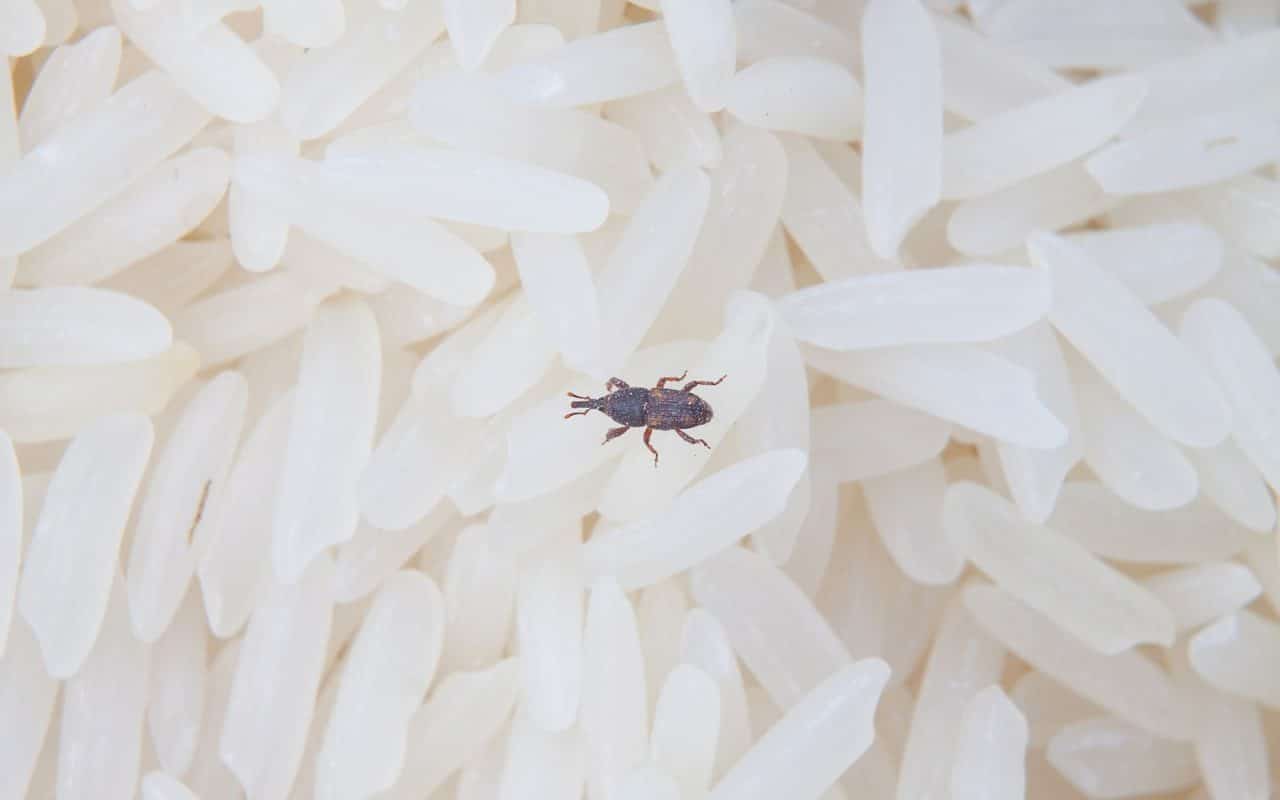
The insects people call weevils in flour are usually one of two look-alikes: a true grain weevil with a long snout, or a flour beetle without one. True grain weevils come in two sizes: the rice weevil (Sitophilus oryzae) runs about 2.5 to 3.5mm long, roughly 1/10 to 1/8 inch, while the granary weevil (Sitophilus granarius) is the bigger of the two at about 3 to 5mm, up to 3/16 inch. Both are oval and reddish-brown to nearly black, with a narrow snout stretching out from the head that ends in tiny chewing mouthparts. That snout is the one feature that actually makes something a weevil rather than just weevil-shaped. The granary weevil cannot fly at all: it has no functional wings under its wing covers, so it stays roughly where it is. The rice weevil does have them and does fly, which is why Kentucky’s pantry-pest fact sheet notes adults turning up some distance from the infested package. If you have rice weevils, the source may be two shelves over or in the garage, not in the container you found them in. Most infestations trace back to eggs or larvae that were already inside a package before it ever reached the shelf, not something that wandered in at home.
Look-alikes
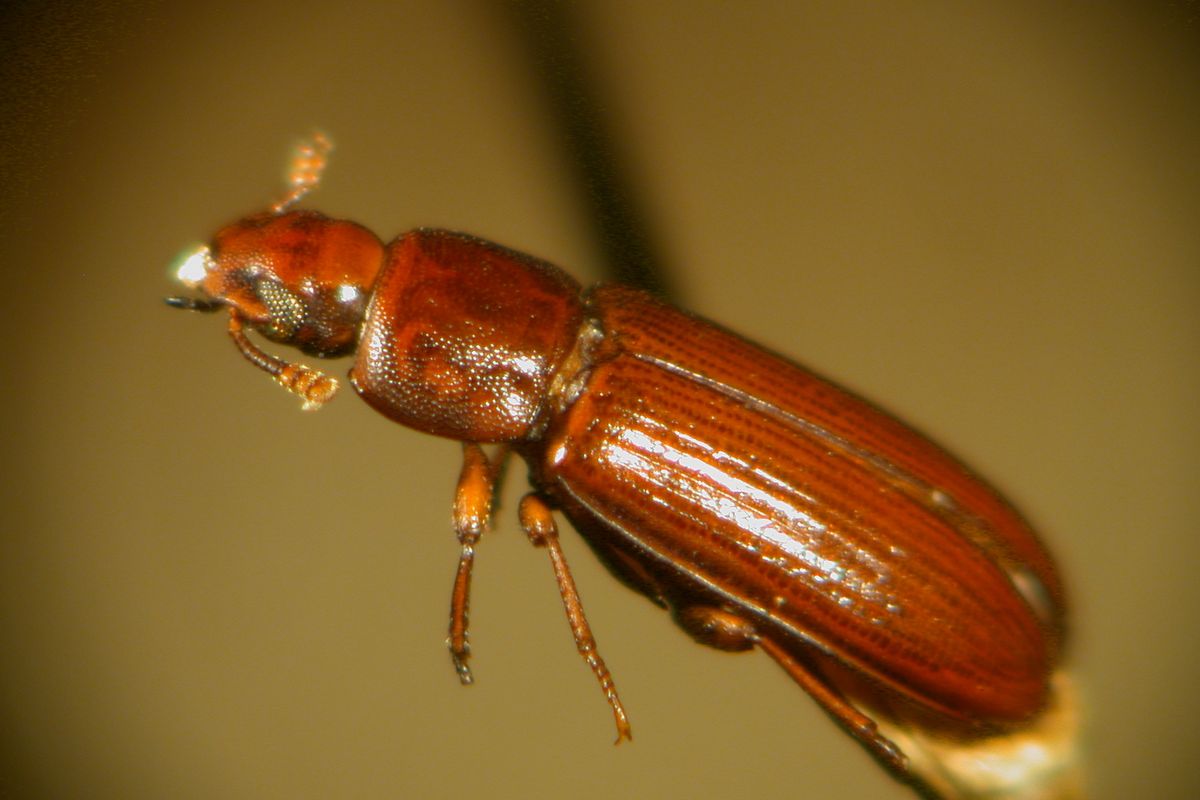
The bug people usually find in a bag of flour or cereal is not a true weevil at all. It is the red flour beetle or the confused flour beetle, a flattened, reddish-brown beetle roughly the same size as a grain weevil but with a plain rounded head and no snout whatsoever. Flour beetles favor processed grain products, flour, cereal, that kind of thing, while true weevils lean toward whole grains like rice, wheat berries, and dried corn, so the flour beetle is genuinely the more common culprit in a flour canister even though people reach for the word “weevil” out of habit. Telling them apart matters for accuracy, but not much for what you do next: inspect, freeze, or discard either way.
The shortcut: if you see loose silk webbing clumping the food into little clumps, that is a pantry moth, not a weevil or flour beetle. Weevils and flour beetles leave a dry, dusty, frass-like texture behind, plus small crawling adults, and no webbing at all.
“Weevil bugs”: which one you actually have
“Weevil bugs” is a catch-all, and it covers three very different situations that need three different answers. Sorting yours takes about ten seconds with a phone camera and a pinch-zoom.
- A snout, in dry goods. A true stored-product weevil: rice, granary or maize weevil. It develops inside a whole grain, so the damage you can see is a neat round exit hole. Whole grains, rice and pasta are the usual home. This page and the rice weevil guide cover it.
- No snout, in flour or cereal. A flour beetle. Flattened, reddish-brown, fast, and it feeds on already-broken grain rather than boring into it. The flour beetle guide covers the difference in detail, and the fix is the same as the one above.
- A snout, but outdoors or on a windowsill in autumn. Almost certainly not a pantry insect at all. Several outdoor weevils — the black vine weevil is the one people meet most — wander indoors when the weather turns, feed on nothing in the house, and die within days. Throwing out the pantry would achieve nothing. Sweep them up and check the door seals.
For the first two, the routine does not change with the species: find every open package, bag what is infested and put it in the outdoor bin, vacuum the shelf including the screw holes, freeze anything borderline, and move the survivors into gasket-sealed containers. The full removal protocol runs it in order with timings, and the container comparison covers which seals actually hold.
FAQ
Do grain weevils or flour beetles bite?
No. Neither the true grain weevil nor the flour beetles they get confused with bite or sting, and extension factsheets record no disease associated with them. UC IPM does add a qualified caution that pantry pests can introduce microbes that go on to produce mycotoxins in food stored warm and humid, which is why the guidance is to discard an infested package rather than sift it.
Is it safe to just sift them out and use the flour anyway?
General food-safety guidance treats this as a quality and comfort question more than a hazard, so the call is really yours to make. Some people sift the flour and move on, others would rather not. If you are unsure, the simpler option is to discard the package.
How long should I freeze pantry goods to clear an infestation?
Freeze at 0°F (-18°C) for at least 4 days, and lean toward longer if you can manage it. Home freezers often run warmer than that, so 4 days is a floor, not a guarantee. A full week is safer than cutting it close.
Sources
- University extension entomology and integrated pest management (IPM) fact sheets