Short answer
The beetle in your flour is probably not a weevil. Weevils carry a long snout out front. Flour beetles, Tribolium castaneum and Tribolium confusum, have a blunt rounded head and nothing in front of it. That one feature tells you where the insect came from, what it can chew, and how much of the cabinet you have to empty.
- Look at the head in profile. A downward-curving snout means a true weevil, and our identification guide to weevils in flour covers that insect.
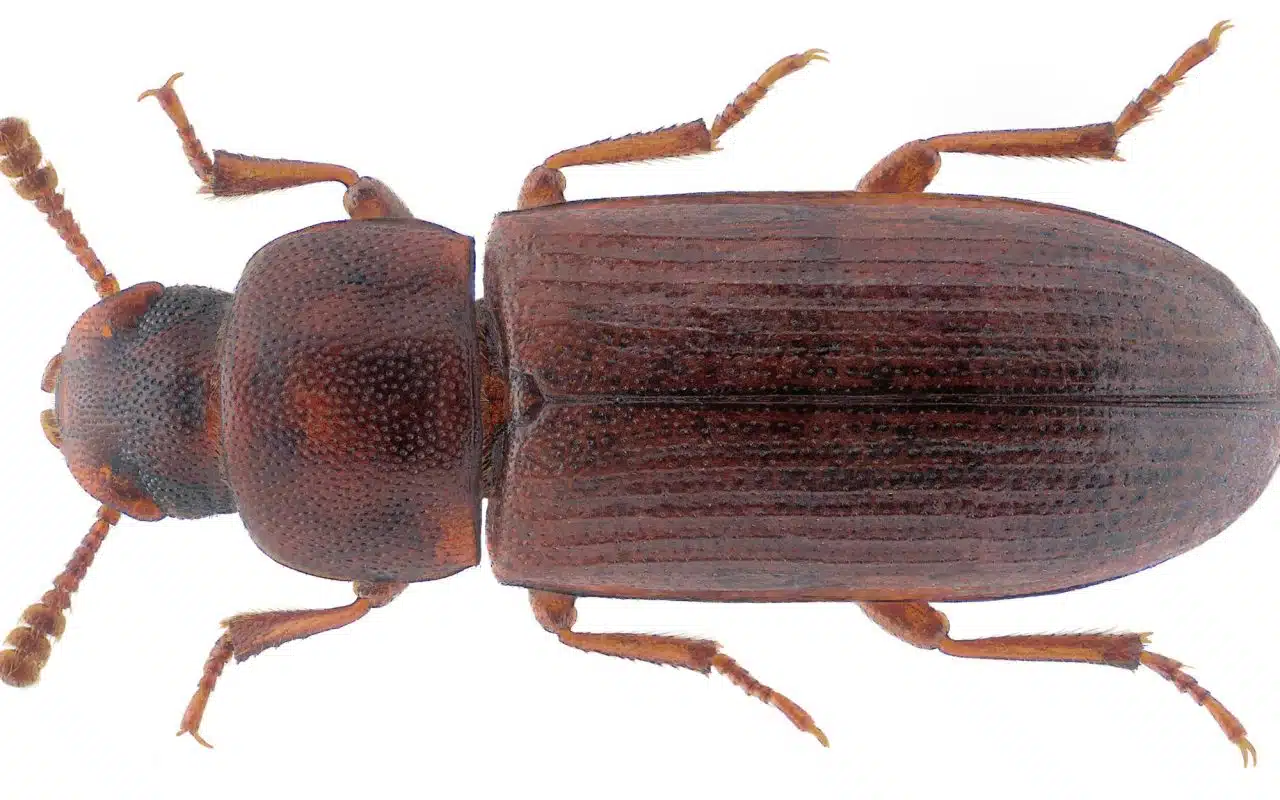
- No snout means a flour beetle: flat, oval, shiny reddish-brown, about 3.5 mm long, or roughly 1/7 inch.
- Flour beetles cannot chew into a sound kernel. They live in milled products and in the broken bits and dust at the bottom of a bag. Start there.
No snout, no weevil
Every true weevil in a kitchen belongs to the genus Sitophilus, and they all carry the same tool: a narrow rostrum that juts forward from the head and ends in very small jaws. At close range it is not subtle. Tip the insect on its side, hold a phone an inch away, and either the snout is there or it is not.
Flour beetles have no rostrum. The head is short and blunt and runs straight into the body. Both species measure about 3.5 mm, call it 1/7 inch, with no size difference between them you could use at a kitchen counter. The body is flat and oval, a reddish brown that reads almost mahogany in good light.
Which one you have follows from what the package was. Milled products, flour and cake mix and cornmeal, are flour beetle country. Unbroken whole grain like rice or wheat berries is where weevils show up, because a weevil larva develops inside an intact kernel and a flour beetle larva has no way in. The direction is solid; the proportion is not. No extension source puts a number on how often each insect is the one in a home flour bin, and neither will we.
Red flour beetle vs. confused flour beetle
These two are separated by their antennae and by very little else. On the red flour beetle the last few antennal segments widen abruptly into a three-segmented club. On the confused flour beetle the antenna thickens gradually and the club counts four segments. Kentucky’s ENTFACT-135 adds a second character: the confused flour beetle has an enlarged, notched head margin with a ridge over the eye, while the red flour beetle’s runs nearly continuous, with no ridge.
| Feature | Red flour beetle (T. castaneum) | Confused flour beetle (T. confusum) |
|---|---|---|
| Length | About 3.5 mm (1/7 in) | About 3.5 mm (1/7 in) |
| Antennal club | Widens abruptly, three segments | Widens gradually, four segments |
| Head margin at the eye | Nearly continuous, no ridge | Enlarged and notched, with a ridge |
| Sides of the thorax | Curved | Straighter |
| Flies? | Sources contradict each other, see below | |
Flight is where it gets awkward, and most sites quietly pick a side. Purdue Extension’s E-224 says both have well-developed wings but only the red flour beetle has been observed to fly, weakly at that. Kentucky’s ENTFACT-612 says the reverse: confused flour beetles fly and come to lights, red flour beetles walk toward light and apparently do not fly. Two extension publications, two opposite answers, and we will not pretend one of them settles it. So do not name your species by watching whether it takes off. Use the antennae.
You will need magnification: the whole distinction is a few tenths of a millimeter of antenna. A 10x hand lens is enough, and so is a phone in macro mode if you chill the beetle for a minute first so it holds still.
What they eat decides what you throw out

Flour beetles are secondary feeders. ENTFACT-135 describes them living on dust, fines and dockage, the powder and fragments rather than the grain itself, and rates them bigger contaminants than eaters. ENTFACT-612 is blunter: flour beetles cannot attack whole or undamaged grains. What they will take is broad, though: flour, meal and cereal, but also beans, shelled nuts, dried fruit, spices and dry pet food.
So the triage is narrower than emptying the cabinet. Milled and broken products get checked first and hardest, and anything holding live adults or larvae goes. A sealed sack of intact rice is not what they are breeding in, but every sack of grain has fines at the bottom, and fines are perfectly good flour beetle habitat. You will not spot the eggs either: ENTFACT-135 notes they are coated in a sticky fluid that flour sticks to, which camouflages them against the food they were laid in.
A sharp, off odor is a signal, not a coincidence: crowded flour beetles release quinones. ENTFACT-135 reports that large numbers of them, with their cast skins and droppings, give grain an extremely pungent odor, and Purdue notes the same chemicals can turn infested feed pink. Flour that smells wrong has been carrying a population for a while.
The look-alikes worth ruling out
Every pantry bug that turns up in a cabinet is laid out side by side, which is the faster way to rule one in. One insect gets mistaken for a flour beetle more than any other: the sawtoothed grain beetle, Oryzaephilus surinamensis. It is slimmer, a little smaller at roughly 1/10 inch, and carries something nothing else on the shelf has: six saw-like teeth along each edge of the plate behind the head. Penn State Extension calls that the most descriptive characteristic of the species, and a hand lens will show it. Penn State also notes the adults cannot fly, so this one came in with something you bought.
Two others share the shelf. The drugstore beetle, hunched, with grooves running lengthwise down the wing covers, and the cigarette beetle, the one that gets into paprika and dry dog food, are rounder and more humped than a flour beetle, which is flat in profile. If your find is spinning silk and clumping the food together, stop reading about beetles: that is a pantry moth, whose larvae leave webbing no beetle produces. When nothing matches, our walk-through of the insects that turn up in kitchens sorts the rest.
Why there is a flour beetle in your bedroom
People find these beetles on a nightstand, on a windowsill, walking across a pillow. It feels wrong, and it is why a lot of readers land here at 2 a.m. convinced they have bed bugs. They do not. A flour beetle has hard shiny wing covers and the compact build of a beetle; a bed bug is soft, wingless and flattened side to side. Flour beetles also do not bite people.
What it does mean is that the source may not be the kitchen. ENTFACT-612 describes an infestation spreading as active adults leave the food to hunt for new sources, and tells you to look past the pantry at decorative items, dried arrangements and bird seed. In a bedroom the usual culprits are a tub of protein powder, a bag of dry pet food in a closet, a forgotten box of granola bars in a drawer. Find the package feeding them and the wandering stops. Still unsure? We keep a side-by-side of the small brown bugs that show up in bedrooms.
Clearing them out
The removal work is identical either way, which is the one convenient thing about the confusion. Find every infested package, bag it, put it in the outdoor trash, and freeze anything borderline at 0°F (-18°C) for at least four days, a full week if you can, since home freezers often run warmer than the dial says. The rest of the sequence, shelf by shelf, is in our step-by-step pantry protocol for flour weevils and flour beetles.
After that it is a storage problem, not a spraying problem. Paper and cardboard will not keep these beetles out, which is why our notes on which airtight containers actually seal against pantry insects and our guide to keeping pantry moths and flour weevils out matter more than anything sold as a treatment.
FAQ
How big is a flour beetle?
About 3.5 mm long, roughly 1/7 inch. Red and confused flour beetles are the same size, so length will never tell you which one you have. Shorter than a grain of long-grain rice, and much flatter.
Can flour beetles fly?
Both species have full wings under the wing covers, but extension sources disagree about which one uses them. Purdue Extension says only the red flour beetle has been seen flying, and weakly. Kentucky’s ENTFACT-612 says the confused flour beetle is the flier. Either way, most of what you see is walking.
What do flour beetle larvae look like?
Yellowish-white worms, under 0.3 inch long when full grown according to ENTFACT-135, with a dark head and a pair of dark points at the tip of the abdomen. They stay down in the food and are easy to miss. No silk, though, so if you see webbing, read up on pantry moth larvae and why they crawl away from the food instead.
Is flour with flour beetles in it safe to eat?
General food-safety guidance treats this as a quality question rather than a hazard, so the call is yours. The beetles do not bite or carry disease. But a heavy population leaves quinones, cast skins and droppings that give flour a pungent odor and can discolor it. If it smells off, that is not your imagination.
How did they get into a package I never opened?
Usually one of two ways: the eggs or larvae were in the product before it reached the store, or adults from another package in the cabinet walked in through a fold or a paper seam. Bags and boxes are not insect-proof, and Purdue Extension reports adults can live more than three years, so one overlooked package keeps reseeding the shelf.
Sources
- University of California Statewide Integrated Pest Management Program, Pest Notes: Pantry Pests, UC ANR Publication 7452.
- University of Kentucky Department of Entomology, ENTFACT-135: Insect Pests of Stored Grain, Flour Beetles, Doug Johnson.
- University of Kentucky Department of Entomology, ENTFACT-612: Stored Product Pests in the Pantry, Lee Townsend.
- Purdue Extension Entomology, E-224: Red and Confused Flour Beetles, Linda J. Mason.
- Penn State Extension, Sawtoothed and Merchant Grain Beetle.