Short answer
The bag was never breached. A female rice weevil bores a hole into a single grain, lays one egg inside, and seals the hole behind her. The larva spends its whole life in that grain. The adult you are looking at did not get into the rice — it got out.
- Throw the package out in an outdoor trash can, then check every other whole seed in the house: the adults fly, like most insects that turn up in a kitchen cabinet.
- Freeze anything you keep at 0°F for at least four days.
- Store the rest in containers with a real gasket seal. A factory bag is not a barrier.
Bugs in rice: what you are actually looking at
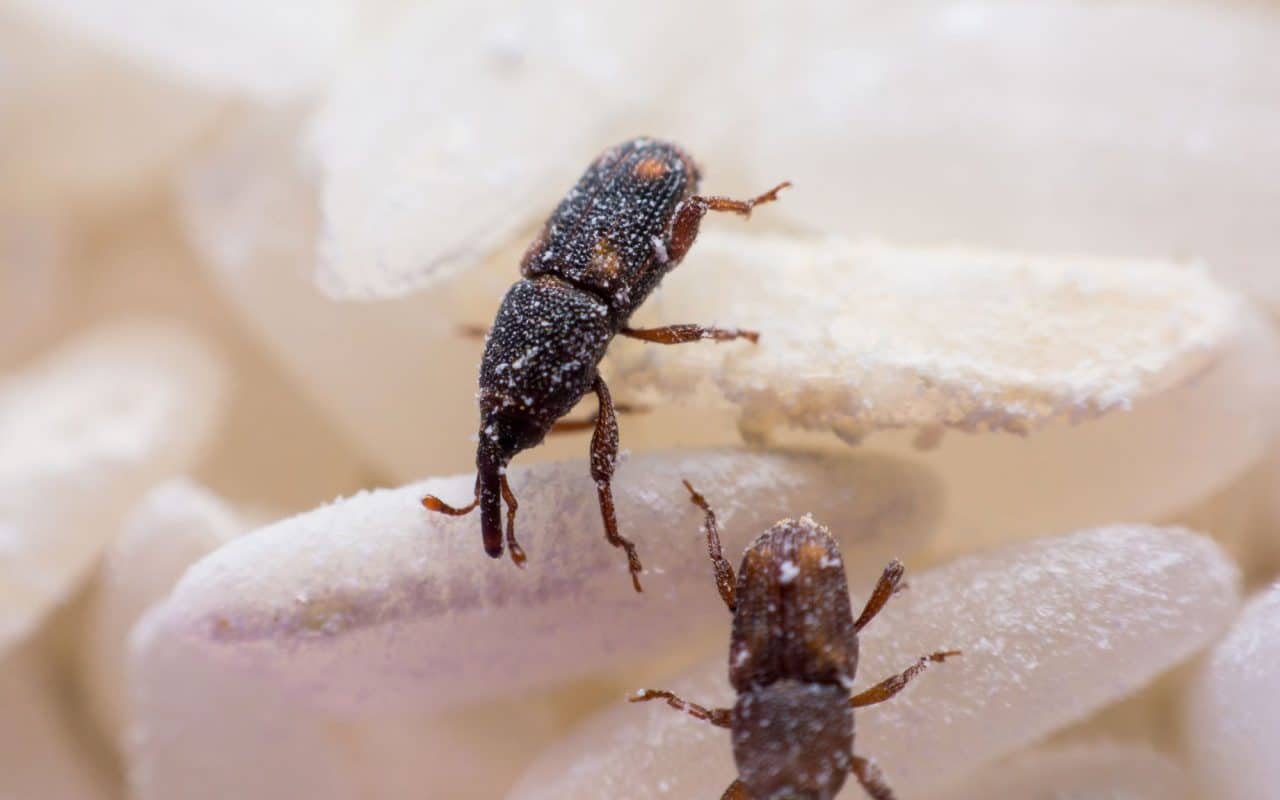
Tip the bag into a white bowl and it gets easier. The full rundown of pantry bugs sorts the six that turn up in a kitchen cabinet. A rice weevil (Sitophilus oryzae) is hard-shelled, dark reddish brown to nearly black, pitted all over as though someone had gone at it with a needle. USDA’s Agriculture Handbook No. 500 gives an average length of about three thirty-seconds of an inch, Iowa State rounds to an eighth: call it 2.5 to 3.5 mm.
Two features settle it. First the snout, a long narrow rostrum with a pair of jaws at the tip, which is the thing that makes a beetle a weevil rather than weevil-shaped. Then four faint reddish or yellowish spots on the wing covers, one toward each corner, subtle enough that you may need a phone camera.
No snout means something else, usually a flour beetle: plain rounded head, processed food. Our page on how true grain weevils differ from the flour beetles they get confused with covers that split. Webbing instead of dry dust means a pantry moth. Weevils leave no silk.
How they got into a sealed bag
This is the part almost nobody explains, and it is the whole answer.
Before laying, the female uses the mandibles at the end of her snout to bore a small hole into a grain kernel. She turns around, deposits a single egg through the hole, and covers it with a gelatinous fluid that hardens and seals the opening. From the outside it is now an ordinary kernel with a nearly invisible scab on it. Handbook No. 500 sets this sequence out under the granary weevil and notes that the rice weevil’s early stages are almost identical in habit.
Everything after that happens inside the kernel. The egg hatches into a small white legless grub that burrows through the starch, feeds, and pupates in there. Weeks later a fully formed adult chews out through the seed coat. Iowa State puts it plainly: there is generally no external evidence of any of this until about a month in. In hot weather the whole run takes as few as 26 days.
Line that up against how rice reaches you — harvested, milled, packed, trucked, warehoused, shelved, most of it somewhere warm and all of it far longer than 26 days. A bag can be filled with grain that looks flawless and already carries eggs. Nothing had to get through the packaging, because nothing needed to.
The exception worth knowing: an unopened bag with intact seams almost always means the eggs traveled with the grain. Once adults are loose in a cabinet, thin film is no defense. UC IPM is blunt that plastic bags are not adequate storage. Sealing stops the next round, but it cannot undo an egg laid at the mill.
What is happening inside the grain
Search for rice weevil larvae and you find almost no photographs of one in place. There is a reason: the larva has no cause to come out. It is a small white legless grub that hatches surrounded by food in a sealed chamber, hollows the kernel out, and pupates in the cavity it made. Compare pantry moth larvae, which crawl away from the food to pupate and end up on ceilings. Moth infestations are loud. Weevil infestations are silent.
So the signs are indirect. Kernels with a small round hole punched through them. Fine pale dust at the bottom of the bag, frass and chewed starch. Grains that feel light because they are shells. Adults last, not first.
And the arithmetic is worth sitting with. Handbook No. 500 gives each female 300 to 400 eggs across her adult life, one per kernel, so 300 to 400 infested grains in a bag you cannot inspect. By the time the first beetle shows up on the counter, the next generation is already sealed in.
Do weevils fly?
The rice weevil does. Handbook No. 500 is specific about the anatomy: it has fully developed wings beneath the wing covers. The granary weevil (Sitophilus granarius), its constant companion in stored grain, has none under there at all and can only walk.
That difference decides what a cabinet infestation can do. A flightless weevil stays roughly where it is; a rice weevil leaves the package it emerged from and turns up, as Kentucky’s pantry-pest fact sheet notes, some distance from the infested article. It has time, too: Handbook No. 500 puts average adult life at 4 to 5 months, Kentucky at 6 to 8. The figures disagree, and neither source is careless. Lab averages and household observation rarely land on the same number. Either way, months.
So one beetle on the counter tells you nothing about where it came from. The source may be two shelves over, a sack of birdseed in the garage, or decorative corn in a basket, which is why basement and garage storage deserves its own pass when a pantry problem will not clear.
Rice weevil or granary weevil?
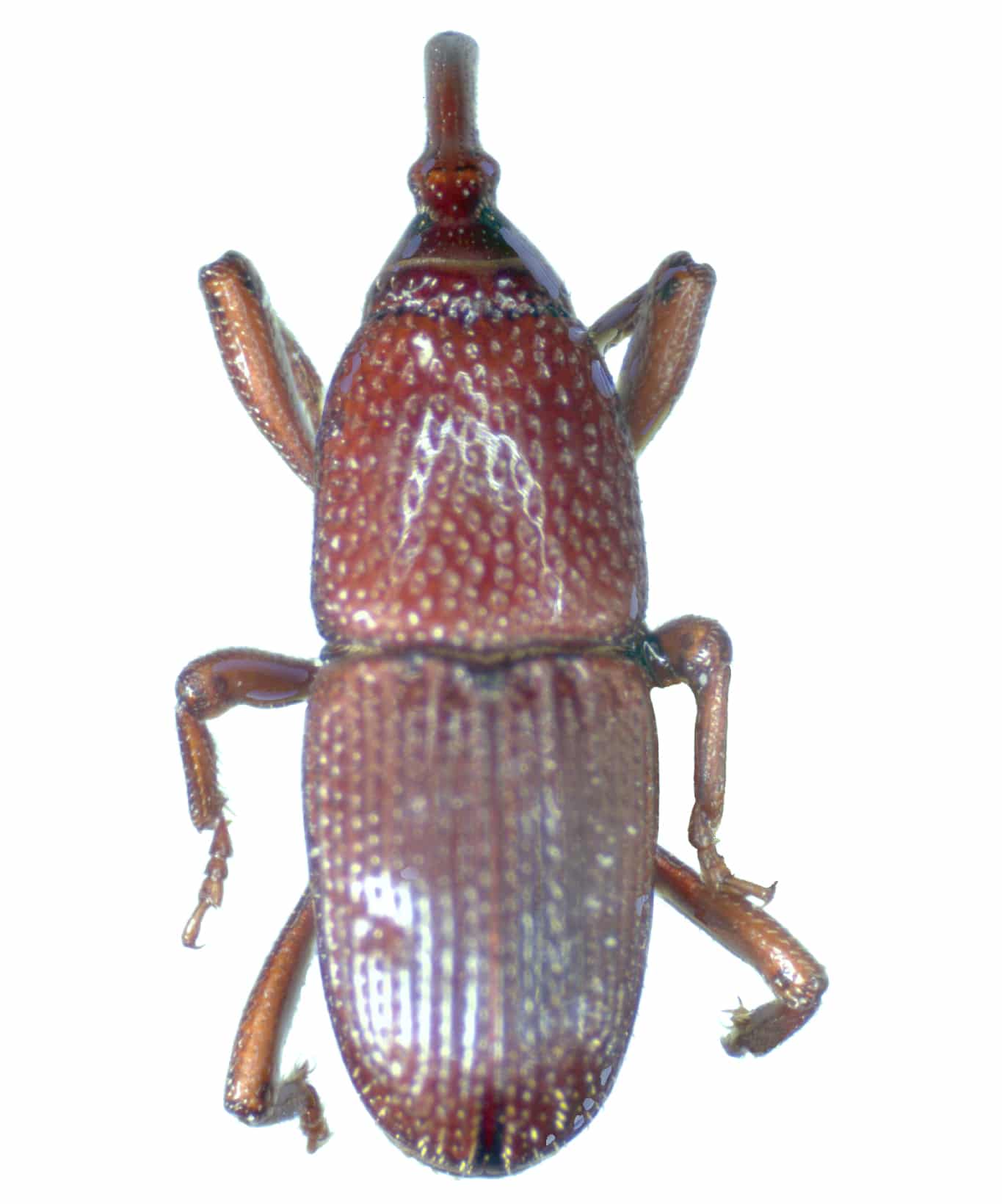
You do not need to tell them apart to fix the problem. Every line below comes from the same USDA handbook.
| Feature | Rice weevil (Sitophilus oryzae) | Granary weevil (Sitophilus granarius) |
|---|---|---|
| Length | Averages about 3/32 in (2.5–3.5 mm) | Not more than 3/16 in, often smaller — the larger of the two |
| Wings under the wing covers | Fully developed | Absent |
| Flies? | Yes | No |
| Markings | Four light reddish or yellowish spots on the back | Uniformly colored, no spots |
| Thorax under a lens | Densely pitted, irregular punctures, smooth strip down the middle | Marked with lengthwise punctures |
| Average adult life | 4 to 5 months | 7 to 8 months |
| Eggs per female | 300 to 400 | 50 to 250 |
What to do with the rice, and with the rest of the cabinet
The package goes into a sealed bag and into an outdoor trash can. Then work outward, because the adults have had weeks. Every whole seed counts — popcorn, dried beans, saved garden seed, birdseed, decorative corn, old grain-based rodent bait, all of which Iowa State lists among the sources people overlook.
For what you keep, cold or heat clears it. Freeze at 0°F for at least four days. That floor deserves a footnote: Iowa State gives three days at 0°F for grain, Kentucky gives four, and the safe reading is the longer figure plus margin, since a packed home freezer runs warmer than its dial claims. The heat alternative, from Iowa State, is 140°F for 15 minutes.
Then strip the shelves and vacuum, crevice tool first: corners, shelf-pin holes, the front lip where dust collects. Soap and water afterward. Iowa State is direct that bleach and ammonia do nothing to insect pests, so that step is cleaning, not control. Skip insecticide, which UC IPM does not recommend for any pantry pest. The full sequence is in our step-by-step pantry protocol for grain weevils, and the seasonal prevention checklist puts the cabinet sweep on the calendar.
The habit that causes repeats: topping up an old container from a new bag. If the old lot is carrying eggs, the fresh grain is infested the day you pour it in. Empty and wash the container first, every time.
After that it is storage. Weevils cannot lay into glass, and an adult that emerges inside a sealed jar dies there instead of finding the next box. That one change ends the cycle. It is the same discipline that keeps pantry moths and flour weevils out of a cabinet, and the same logic as keeping insects out of a house at all.
FAQ
Is it safe to eat rice that had weevils in it?
Iowa State is clear that these weevils are harmless to people: they cannot bite or sting, and they do not carry disease. The damage is to the grain, so this is a quality question, not a hazard. The call is yours.
Do rice weevils bite?
No. The jaws at the end of that snout are built for boring into seeds, not skin. They do not sting either, and they will not touch furniture, fabric, or the house itself.
I keep finding them and there is no rice in the house. Where are they from?
Something else is holding whole seeds. Iowa State’s list runs to popcorn, dried beans, saved garden seed, seed decorations, decorative corn, and forgotten grain-based mouse bait. Birdseed is the one people miss.
How long does an infestation take to become visible?
About a month, and that is the trap. Iowa State notes there is no external sign until the adult chews out of the seed; Handbook No. 500 gives 26 days as the fastest egg-to-adult run in hot weather. Whatever you spot today started weeks ago.
Are the little brown bugs in my flour the same insect?
Usually not. True weevils need an intact kernel for the larva to develop inside, so they go after whole grains. What turns up in a flour canister is more often a flour beetle: no snout, plain rounded head.
Sources
- U.S. Department of Agriculture, Agricultural Research Service, Stored Grain Insects, Agriculture Handbook No. 500 — grain weevils section (granary weevil, rice weevil).
- Iowa State University Extension and Outreach, Yard and Garden, Rice Weevil and Granary Weevil.
- University of Kentucky, Martin-Gatton College of Agriculture, Food and Environment, ENTFACT-612: Stored Product Pests in the Pantry.
- University of California Statewide Integrated Pest Management Program, Pest Notes: Pantry Pests, UC ANR Publication 7452.