Short answer
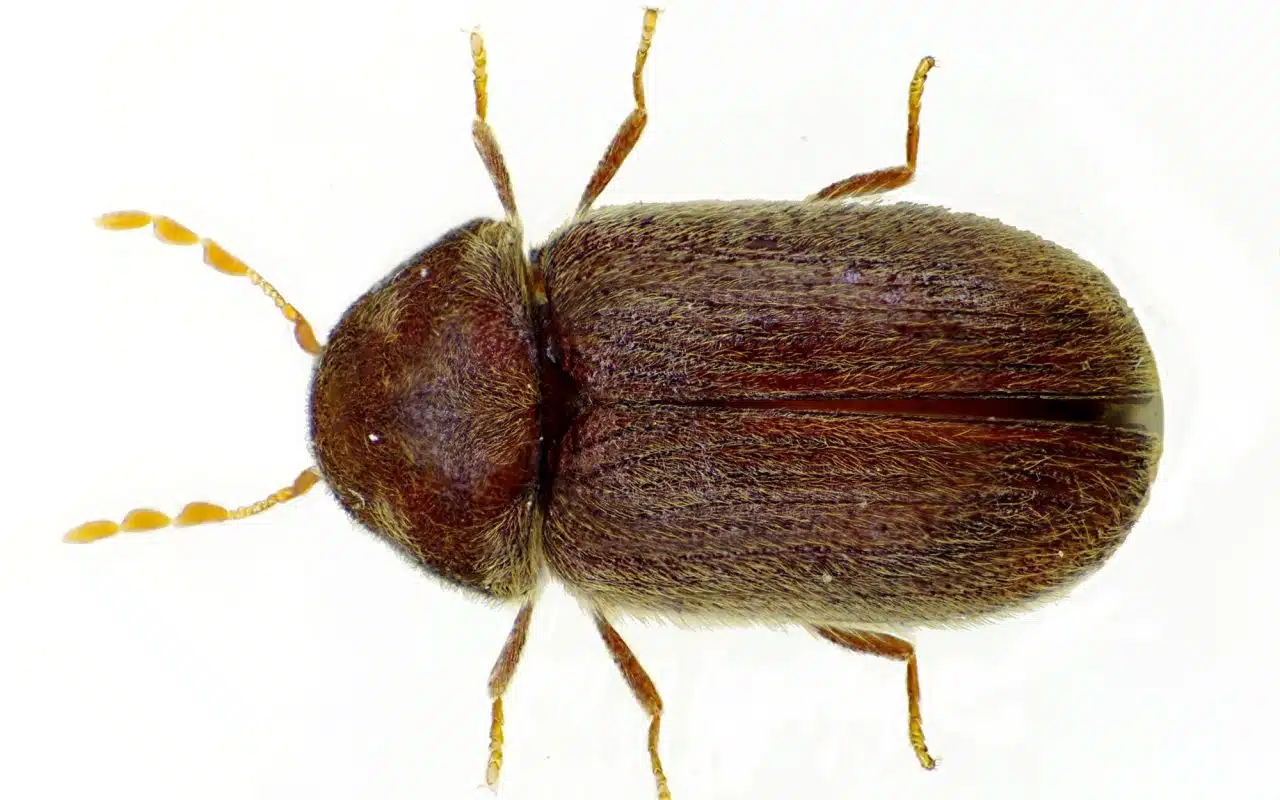
Small brown beetles in a pantry are almost always one of two close relatives. Both are oval, reddish-brown, and carry the head so far under the body that the beetle looks headless from above. One detail separates them, and the fix is the same either way.
- Check the wing covers under a phone macro lens: lengthwise grooves with rows of tiny pits mean a drugstore beetle, a smooth surface means a cigarette beetle.
- Find the package they came out of, throw it away, vacuum the shelf.
- Move what survives into rigid containers with tight-fitting lids. Bags and cardboard are not a barrier.
Tiny brown beetles in the kitchen: sort by shape first
You don’t need a name yet, but the six pantry bugs side by side will get you there. Put the beetle on white paper, bring a phone camera close, and answer one question: what is the outline?
| What you see | What it is | What to do |
|---|---|---|
| Oval and humped, no head visible from above, flies to lamps | Drugstore or cigarette beetle | Read the next section |
| A curved snout longer than the head | A weevil | See our flour weevil identification guide |
| Flat oval, shiny, no hump, no snout | Red or confused flour beetle | Flour and meal, not spices |
| Flat and narrow, six sawlike teeth each side behind the head | Sawtoothed grain beetle | Same cleanout, different insect |
| Caterpillars and silk webbing in a box, moths at the ceiling | Indianmeal moth | See our pantry moth identification page |
A smooth hump with no head showing puts you in the right article. Anything else, and our guide to the insects that turn up in kitchens covers it.
Drugstore beetle or cigarette beetle? Two details settle it
These two overlap in size, color, shape and diet, and they raid the same cupboards. UC IPM puts it plainly: the easiest way to separate them is the wing covers.
| Feature | Drugstore beetle (Stegobium paniceum) | Cigarette beetle (Lasioderma serricorne) |
|---|---|---|
| Wing covers | Lengthwise grooves with rows of tiny punctures, like faint stitching | Smooth, no grooves and no rows of pits |
| Antennae | End in a club of three segments | Saw-toothed along the whole length |
| Length | About 1/8 inch (2 to 3.5 mm) | About 1/8 inch (2 to 3 mm) |
| Outline from above | Slightly more elongated | Slightly rounder, almost globular |
| Surface | Finely hairy | Finely hairy |
That test works at kitchen-table magnification. A phone macro lens or a jeweler’s loupe is enough, and the antennae confirm it if the beetle holds still.
Two tests that don’t work: size and shine. The length ranges overlap almost completely and no extension source reports a usable difference, so no beetle is ever too big to be a cigarette beetle. Both species are finely hairy, so the popular glossy-versus-fuzzy test separates nothing.
The drugstore beetle eats almost anything dry
This one got its name on pharmacy shelves, where it worked through nearly every dried drug within reach. UC IPM calls it such a general feeder that it “has been said to eat anything except cast iron.” In a house that means dry pet food, cereal, spices, baking mixes and pasta, plus paper, book bindings and dried plant material. An infestation sometimes starts in a box of stored papers rather than the kitchen.
UC IPM traces most pantry infestations to a package that arrived infested: one damaged at the store, or opened and forgotten at the back of a shelf. Eggs go into almost any dry organic material, the grubs tunnel through it, and pupation happens in a cocoon inside the food. The cycle can run in under two months, which is how one overlooked jar keeps producing adults for weeks. More on our drugstore beetle identification page.
The cigarette beetle prefers spices, dried flowers and pet food

The name comes from cured tobacco, which matters less in a modern house than the rest of the menu: dried herbs and spices, nuts, cereal, dried fruit, seeds, even dried fish and meats. Indoors, UC IPM finds it most often in pet food, cereal, nuts and candy, and less predictably in dried pepper arrangements and wreaths. Suspect this one when the beetles are coming out of the spice rack rather than the flour bin.
That last category is the one people miss. Potpourri, a wreath over the door, a jar of paprika opened two years ago: none of it gets inspected during a cleanout, and any of it can feed a population indefinitely. UC IPM also calls the cigarette beetle the more common of the two indoors, even though the drugstore beetle is the name more people search for. Our cigarette beetle identification page has the full description.
The larvae do the damage, not the adults you see
The beetle crossing your counter is a symptom. It fed as a larva inside a package, pupated there, and chewed its way out.
UC IPM describes the cigarette beetle larva as a yellowish-white grub covered in long silky hairs, about 1/6 inch when fully grown, pupating in a cell of food particles cemented with its own secretion; egg to adult takes about six weeks there. The drugstore beetle larva is a small white grub that tunnels through whatever it hatched in, and the same source gives fewer than two months for its cycle. Neither shows from outside a sealed package. What you get instead: pinholes in cardboard or foil, fine powder under a bag, adults at the window.
Do drugstore beetles and cigarette beetles bite?
No. Neither species bites or stings. Their mouthparts chew dry plant and animal material and cannot break human skin. If something is biting you at night, look elsewhere.
The harm here is to food. Clemson’s pantry pest factsheet records no disease associated with these insects, while treating an infested product as unfit to eat. UC IPM adds a qualified caution: pantry pests can introduce microbes that go on to produce mycotoxins, particularly where food has sat in warm, humid storage. That is why extension guidance says throw the package out rather than sift it. Not an emergency, just a reason not to salvage.
Found one in the bedroom? It is not a bed bug
Quickly, because this is a two-in-the-morning search: an adult bed bug is about the size of an apple seed, flat as paper before it feeds, has no hard wing covers and cannot fly. A drugstore or cigarette beetle is much smaller, hard-shelled, domed like a tiny helmet, and flies straight at lamps. If you watched it fly, it wasn’t a bed bug.
So why is a pantry beetle in a bedroom? Usually a wreath or dried arrangement in the room, a stack of old paper, or a snack in a nightstand drawer. Failing that, it flew in from the kitchen. For the other suspects, we compare the pair people mix up most in carpet beetle versus bed bug, plus a wider sorting guide to small brown bugs found in bedrooms.
How to get rid of drugstore beetles and cigarette beetles
This is written around the drugstore beetle, since that is what most people search for. None of it changes for the cigarette beetle.
Find the source before you clean anything, because one package is producing the beetles. Open everything dry: flour, cereal, rice, pasta, baking mixes, spices, nuts, dried fruit, dry pet food, birdseed, and the decorative dried things nobody checks. Look for pinholes and for fine powder that shouldn’t be there. Clemson adds the step most people skip, the garage: a bag of dog food out there can be the origin.
Seal the package in a bag and put it in an outdoor trash can that day. Then strip the shelf, vacuum the corners and crevices to lift eggs and pupae, and wash the surfaces with soap and water. Never tip an old lot of flour into a new one: eggs in the old material infest the new one within days. Our pantry beetle and weevil removal protocol has the full step-by-step, and our pantry prevention guide covers what stops it recurring.
Freezing salvages what you don’t want to throw out: 0°F (−18°C) for at least four days, a week if you want margin. Worth the freezer space for spices and specialty flours.
One thing not to bother with: insecticides. UC IPM says flatly that they aren’t recommended for any pantry pest, and Clemson calls spraying a last resort that should never go near food. Removing the package is what ends it.
FAQ
What do drugstore beetles eat?
Almost anything dry and organic: dry pet food, cereal, spices, baking mixes, and also paper, book bindings and dried plant material. That range is why the problem sometimes starts outside the kitchen.
Why do I keep finding these beetles in the bathroom?
They aren’t breeding there. Adults fly toward light, end up in rooms with nothing to eat, and a dead one is easy to spot against white porcelain. The source is a dry food package somewhere else.
Can I still use flour or spices from a package that had beetles in it?
Extension guidance says discard it. Sifting removes the adults you can see, not the eggs and larvae you can’t. Freezing at 0°F for at least four days kills the stages present, but it doesn’t remove what they left behind.
Do pheromone traps get rid of them?
No, they monitor. Multi-species pantry traps do catch cigarette beetles, but a trap that keeps filling just means a package was missed. Traps sold for pantry moths won’t attract beetles at all, so read what the label lists.
Will they spread to the rest of the house?
Adults fly, so they move between rooms easily, but a population only builds where there is dry food to lay eggs in. Remove the source and seal the food. Our house-wide bug prevention guide has the habits that keep dry storage unattractive.
Sources
- University of California Statewide Integrated Pest Management Program, Pest Notes: Pantry Pests, UC ANR Publication 7452.
- Clemson Cooperative Extension, Home & Garden Information Center, Pantry Pests, Factsheet HGIC 2439.
- Penn State Extension, Drugstore Beetles.
- Penn State Extension, Cigarette Beetles.