Short answer
A bed bug is flat, wingless, and lives within a few feet of where you sleep. A carpet beetle is domed, flies well, and lives wherever there’s wool, fur or feathers. They aren’t related, and neither one turns into the other.
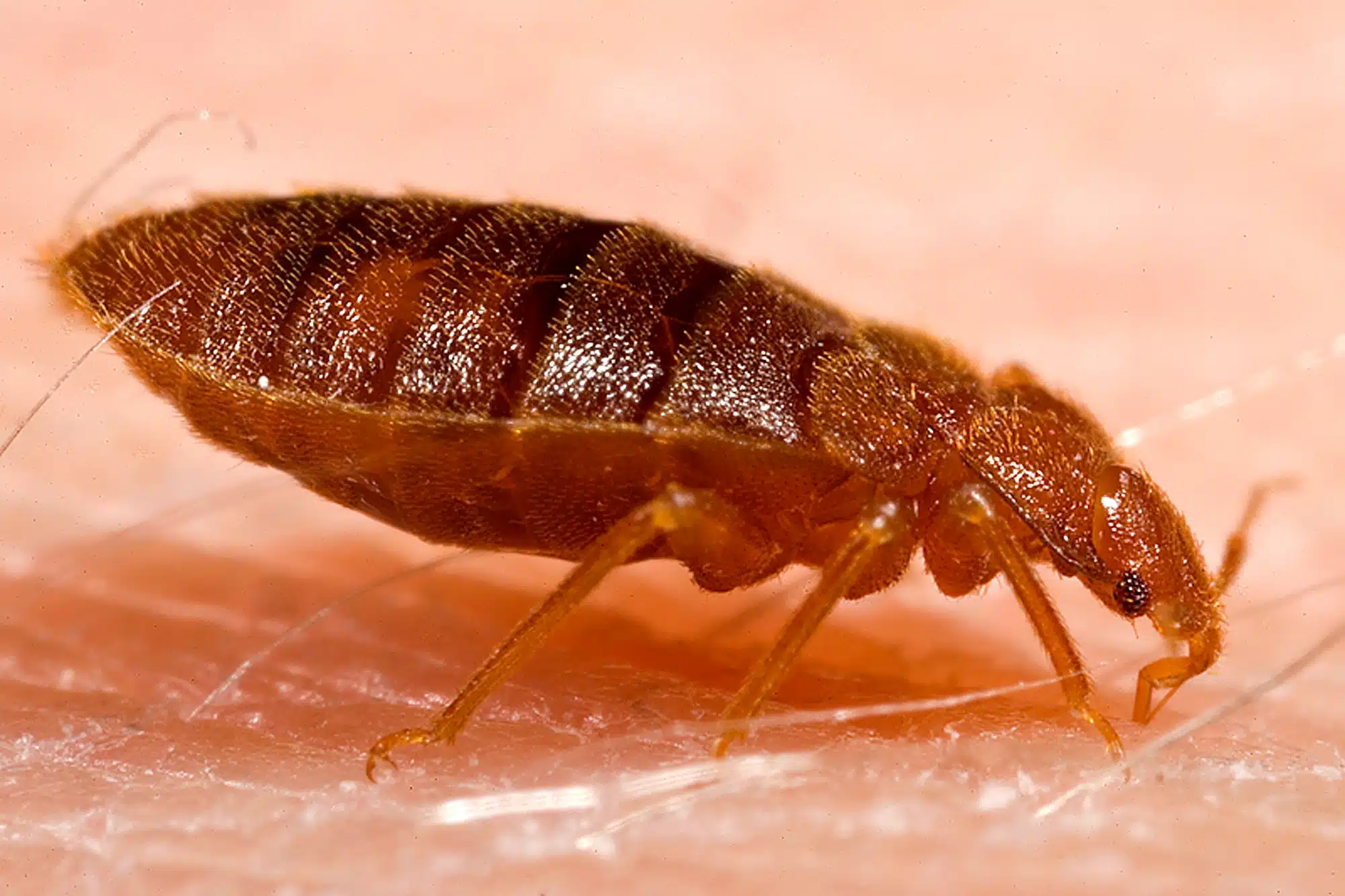
- Look at the insect from the side, not from above. A bed bug is a wafer. A carpet beetle is a dome.
- Bed bugs never eat fabric. Holes chewed in a wool sweater rule them out completely.
- The young stages settle it: a bed bug nymph is a pale copy of the adult, while a carpet beetle larva looks like a different animal entirely.
One difference explains all the others
A bed bug is built to disappear into a crack. Its body is flattened from top to bottom, which is how an adult slides into the gap behind a headboard bolt or into the piping of a mattress seam and stays invisible from six inches away. It has no working wings. It doesn’t need any, because its food source lies down in the same room every night.
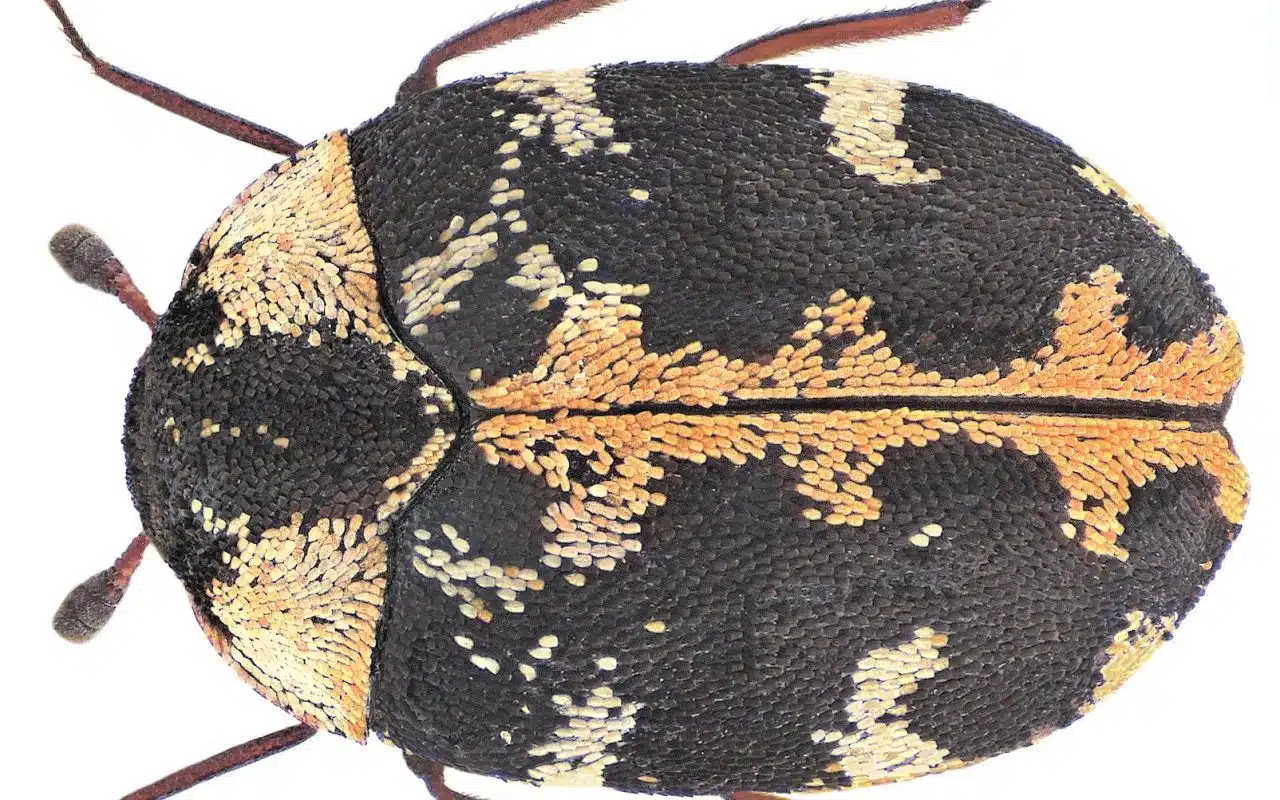
A carpet beetle is a beetle in the ordinary sense of the word: hard rounded wing cases over a domed back, with a functional pair of wings folded underneath. It flies, it heads for light, and the adult spends as much of its life as it can outdoors on flowers. What its larvae eat, the keratin in wool and fur and feathers, doesn’t move. Nothing about the insect is built for hiding next to a sleeping person.
So hold whatever you found at eye level and look at its profile. That’s the whole test. One is a wafer with legs, the other is a small dome. Almost everything below follows from that single difference in build.
Size is a clue, and it points the other way
Most people expect the bed bug to be the smaller of the two, because it’s the one that sounds like it ought to be hard to spot. It isn’t. An adult bed bug runs about 5 to 9mm, roughly the length of an apple seed, brown and oval and perfectly visible once you know where to look. The varied carpet beetle, the mottled one that collects on windowsills in spring, is 2 to 3mm. The black carpet beetle reaches 3 to 5mm.
A speck you can barely resolve without a lens is therefore far more likely to be a carpet beetle. That’s useful, but it only works in one direction. A newly hatched bed bug is about 1.6mm and nearly colorless, so “very small” doesn’t clear a room. Size supports a conclusion. It doesn’t reach one on its own.
The young ones are the real test
If you only run one check, run this one. The adults have some superficial overlap in color and shape at a glance. The immature stages have none at all.
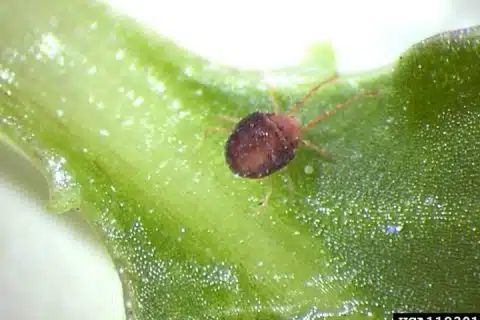
A bed bug nymph is a smaller version of the adult. Same flat oval outline, same six legs, same proportions, just paler. It hatches nearly translucent and darkens through five molts on its way to adult size. Set a nymph next to an adult and you’d say they were the same insect photographed at two sizes, which is what they are.
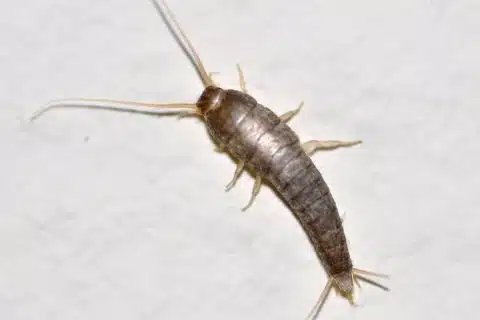
A carpet beetle larva looks like it belongs to a different order of insect than the beetle it becomes. It’s 2 to 5mm, brown, tapered at one end, covered in stiff bristles, often trailing tufts of longer hairs off the rear. It never flies. It creeps along carpet edges and closet floors, and nobody looking at one would guess it turns into a small round speckled beetle.
The rule that comes out of this is short. If the small one looks like a scaled-down version of the big one, you have bed bugs. If the two look like unrelated animals, they’re carpet beetles.
Five checks, side by side
Diet is the cleanest difference of all, since one drinks blood and the other eats fiber, but you can’t watch either of them eat. These five you can actually see for yourself.
| What you check | Bed bug | Carpet beetle |
|---|---|---|
| The body in profile | Flat, wafer-like, no depth to it | Rounded, hard domed shell |
| Wings | None that work. It crawls, and that’s all | Flies well, and heads for windows and light |
| The immature stage | A pale miniature of the adult, same outline | A bristly brown larva that resembles nothing about the adult |
| What it leaves behind | Dark ink-like spotting, smooth flat cast skins, sometimes blood smears on sheets. No fabric damage | Hollow bristly husks, loose bristles in carpet pile, irregular holes eaten in wool and fur |
| Where you find it | Mattress seams, box spring, bed frame, headboard. Within a few feet of the bed | Closet floors, carpet edges, under furniture, stored wool, windowsills |
Both leave shed skins, and that’s where people go wrong
Here’s the overlap that sends people down the wrong path. Both insects molt, and both leave the empty skin behind, so “I found shed skins” decides nothing by itself. What the husks look like, and where they sit, decides everything.
A carpet beetle husk is hollow, brown and bristly, and it holds the shape of the larva that left it. In an established population the husks outnumber the live larvae by a wide margin, which is why pest professionals look for them first. They collect where nothing disturbs them: the edge of a carpet, the floor of a closet, under a piece of furniture that hasn’t moved in years.
A bed bug’s cast skin is smooth, flat and amber, with the same outline as the insect. It turns up in mattress seams, in the folds of a box spring, in the joints of a bed frame, and usually near dark spotting. That spotting is digested blood. On fabric it bleeds outward slightly the way ink does on paper, which is what separates it from ordinary dirt.
Then there’s the check that rules one of them out on the spot. Bed bugs do not damage fabric, at any stage, under any circumstances. Irregular holes eaten through a wool coat, a rug, a felt hat or the pile of a carpet come from a fabric pest, and a carpet beetle is the likeliest one. A clothes moth is the other candidate, and the carpet beetle identification page sets those two side by side.
Marks on skin can’t sort this out. Reactions vary far too much between people to work as identification, and we don’t try to read them here. If a rash is what brought you to this page, that’s a question for a doctor. The insect half of it, and why carpet beetle bristles produce something people call a bite, is covered in do carpet beetles bite?
If the checks point to bed bugs
Three things are worth knowing before you do anything, because the instinctive responses tend to make the situation worse.
- Don’t throw the mattress out yet. It’s expensive, it rarely fixes anything on its own since the insects also occupy the frame and nearby furniture, and dragging an infested mattress through a building is a good way to seed the rest of it.
- Don’t move to the couch. It looks like the obvious way to stop being bitten, and it’s the standard way one infested room becomes two. Bed bugs follow the sleeper.
- Skip the aerosol foggers. University extension entomologists have been consistent about this for years: total-release foggers don’t reach into the cracks where bed bugs actually sit, and they can drive them deeper into wall voids and adjoining rooms.
Confirmation is worth paying for here. A licensed pest control company can tell you in a single visit whether what you have is bed bugs, and that answer changes the cost of everything that comes after it.
If the checks point to carpet beetles
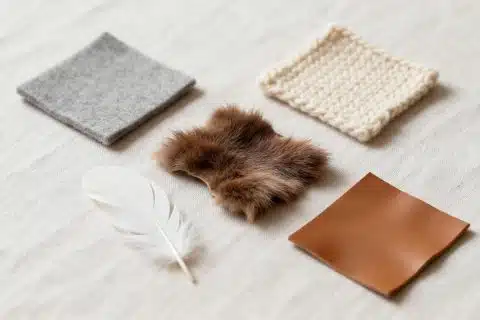
Then the problem is fabric rather than the bedroom, and it’s yours to solve without paying anyone. The work is inspection, heat and slow vacuuming in a particular order. The step people skip is finding the keratin that’s feeding the larvae in the first place, which is usually a stored wool item, a rug nobody lifts, or a bird or rodent nest in a soffit or dryer vent. The removal protocol works through it in sequence.
FAQ
Do carpet beetles turn into bed bugs?
No. They belong to different orders of insect, beetles on one side and true bugs on the other, and neither becomes the other at any point. A carpet beetle never starts feeding on blood, at any stage of its life.
Can a house have both at once?
Yes, and it isn’t rare. They use completely different resources and never compete, so nothing about one keeps the other out. If you find bristly husks along a closet floor and dark spotting in a mattress seam, treat them as two separate problems with two separate solutions.
Do bed bugs fly or jump?
Neither. They crawl, and that’s the only way they move. An insect that flew at you or jumped away from you is not a bed bug. Adult carpet beetles fly well, which is exactly why they end up on windowsills.
Are carpet beetles ever in the mattress itself?
Rarely. Most mattresses contain no keratin at all, so there’s nothing in one for a larva to eat. Bristles and debris can work their way into the seams from bedding, a feather pillow or a wool topper, but the larvae aren’t feeding there. Look around the bed rather than in it.
Which one is bigger?
The adult bed bug, at 5 to 9mm, against 2 to 3mm for a varied carpet beetle and 3 to 5mm for a black carpet beetle. But a bed bug nymph starts at around 1.6mm, so finding something very small doesn’t rule bed bugs out on its own.
Sources
- University of California Statewide IPM Program, Pest Notes: Bed Bugs.
- Penn State Extension, Biology, Habitat, and Management of Bed Bugs.
- University of Kentucky Entomology, Carpet Beetles, ENTFACT-601.
- University of California Statewide IPM Program, Pest Notes: Carpet Beetles.