Short answer
The black carpet beetle (Attagenus unicolor) is the plain one: a small, solid dark beetle with no pattern at all. The surprise is the larva, which grows two to three times longer than the adult it turns into.
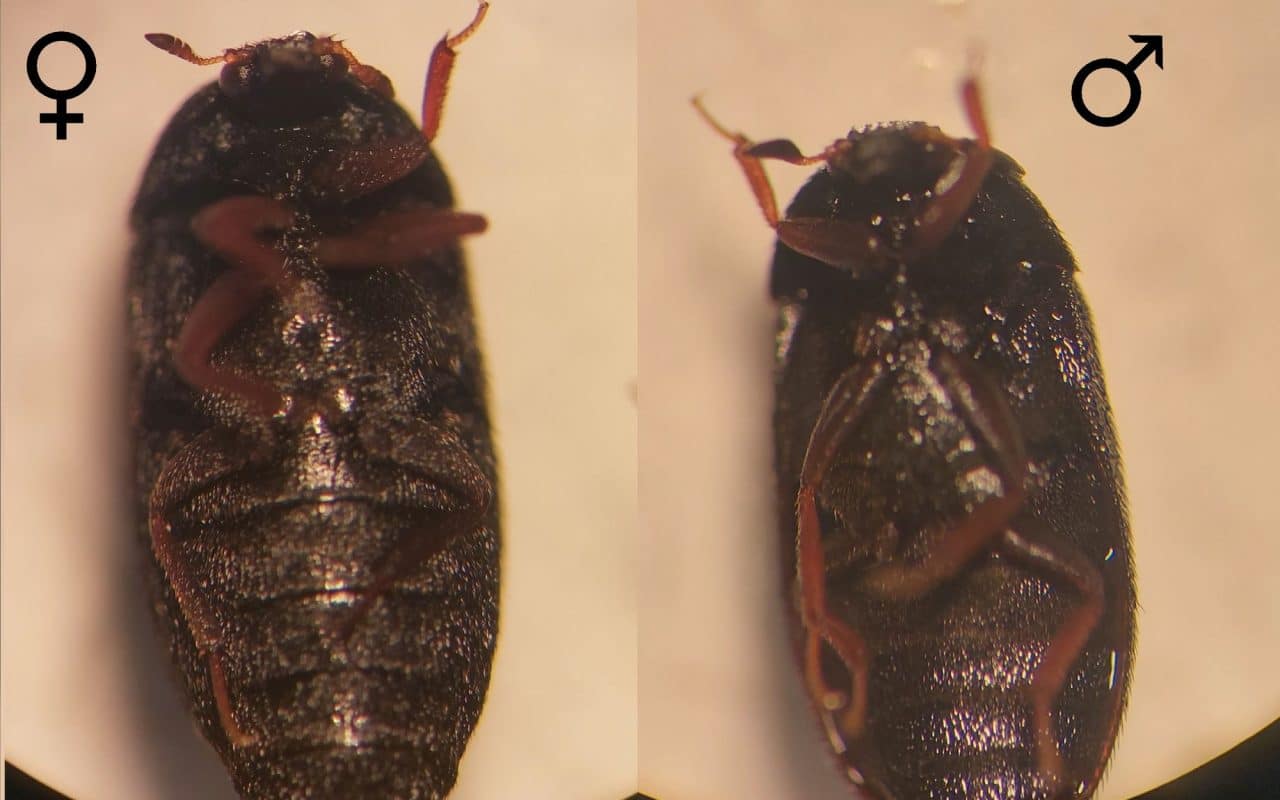
- The adult is 3 to 5 millimeters, an eighth to three-sixteenths of an inch, shiny black to dark brown with brownish legs. No mottling, no white or orange flecks.
- The larva reaches about half an inch, roughly 12 millimeters. It is smooth and shiny rather than fuzzy, shaped like a carrot, and it drags a long tuft of golden hairs behind it.
- It eats wool, hair and feathers like its relatives, and it also gets into dry food: cereal, flour, pet food, birdseed. Start on the removal protocol once you have found it.
The adult is the plain one
“Carpet beetle” covers several species that get grouped together because their larvae do the same damage. The one in every photograph is the varied carpet beetle, a 2 to 3 millimeter oval speckled in black, white and yellow-orange scales. The black carpet beetle has none of that. It is solid black to dark brown, faintly glossy, unmarked, with legs a shade browner than the body, and it runs slightly larger at 3 to 5 millimeters. On a windowsill it reads as a small dark seed that turns out to have legs.
The adult does no damage indoors. It feeds on pollen and nectar, outdoors, on flowering shrubs, and it flies well and heads for light. That is the whole reason it ends up on your windowsill: it is on its way out. So a beetle at the glass in spring has one of two histories, and the difference matters. Either it grew up in the house and is leaving, or it flew in from the yard, or came in on cut flowers, and never had a larval stage indoors at all.
You can usually tell which. One beetle, in April, on the sill of an open window next to a flowering shrub, proves nothing. Several over a few weeks, or one in an interior room with no window nearby, means larvae somewhere in the house. If the beetle is what brought you here and you want to see both stages side by side, the carpet beetle identification page has them with the look-alikes.
The larva is bigger than the beetle it becomes
This is the part that throws people. A black carpet beetle larva reaches roughly 12 millimeters, close to half an inch, while the beetle it turns into is 3 to 5. Nothing about the larva suggests a small round beetle is coming. Most people who find one assume they have a worm, a tiny caterpillar, or something that got in with the groceries.
The shape is the reliable part. It tapers from the head end toward the rear, like a carrot or a short cigar, and it ends in a tuft of long, curled, golden-brown hairs that can run nearly as long as the body. The body itself is smooth, shiny and hard-looking, covered in short stiff hairs rather than the dense bristly coat of a varied carpet beetle larva. Color runs golden to chocolate brown and darkens as it grows. If you have found something along a carpet edge that looks like a grain of rice with a paintbrush stuck to one end, that is Attagenus.
You will probably find the shed skins first. A larva molts somewhere between five and eleven times, and as many as twenty when it is cold or underfed, and every molt leaves a hollow husk that holds its shape. In a settled population the husks outnumber the insects by a wide margin. Carpet beetle larvae covers what both species look like and where to search for them.
Black carpet beetle or varied carpet beetle?
| What you are looking at | Black carpet beetle | Varied carpet beetle |
|---|---|---|
| Adult color | Solid black to dark brown, unmarked | Mottled black, white and yellow-orange scales |
| Adult length | 3 to 5 mm | 2 to 3 mm |
| Larva length | Up to about 12 mm, half an inch | 4 to 5 mm |
| Larva shape | Long, smooth, shiny, tapering to a long golden tail tuft | Short, fat, densely bristly, widest at the rear |
| Turns up in dry food | Often: grain, flour, cereal, pet food, birdseed | Rarely |
The larvae are easier to tell apart than the adults, which is lucky, because the larvae are what you actually find. Long and sleek with a tail is the black one. Short, fat and hairy is the varied one.
What it eats, and why the pantry belongs in this article

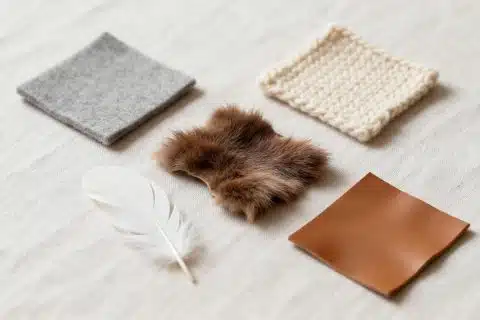
Everything of animal origin is on the menu: wool, hair, fur, feathers, leather, silk, taxidermy, and the dead insects that collect in light fixtures and window channels. Clean cotton and synthetics are not, because there is no keratin in them, but a blend that has been soiled with sweat, body oil, milk, beer or fruit juice gets grazed anyway. That is why the holes in a part-wool sweater turn up at the collar and under the arms.
Where this species parts company with its relatives is dry plant food. Black carpet beetle larvae live perfectly well in cereal, grain, flour, spices, pet food and birdseed. In California and other dry regions, UC IPM rates it as a more serious stored-product pest than a fabric pest, which is not something anyone says about the varied carpet beetle.
The practical consequence is worth stating plainly. If the larvae are in the kitchen rather than the closet, you are almost certainly dealing with Attagenus, and the job is a pantry job: everything infested goes out, everything else goes into sealed containers, and the shelves get emptied and wiped. The routine in how to prevent pantry moths and flour weevils works for this beetle without modification.
Check the pet food before you check the carpet. A bag of kibble or birdseed that has been open in a garage or utility room since last year will keep producing beetles no matter how carefully you vacuum the bedroom. It is the reservoir people find last.
Why it takes a year to be sure it is gone
The numbers explain more than any amount of advice does. A female lays around 90 eggs. They hatch in 9 to 16 days. Then the larva feeds for anywhere between 166 and 330 days before it pupates, and pupation itself takes another 8 to 14. Nearly the entire life of this insect is spent as the larva, eating. The carpet beetle life cycle sets those numbers next to the varied carpet beetle’s, stage by stage.
So the larva you found this morning has been in the house since some point last year, and any larva you miss today will still be feeding at Christmas. If a product is going to be part of the plan, carpet beetle sprays and insecticides explains why one pass is never enough. That changes how you read the result of a cleanup. Not seeing larvae next week means nothing, because you were never going to see them anyway. The honest test is whether small dark beetles turn up at the windows next spring. If they do, something indoors is still feeding them, and it is usually the thing nobody lifted: the rug pad, the vent, the ceiling fixture full of dead flies, the bird nest in the soffit.
What to do about it
Heat does the killing. A hot wash followed by a hot dryer finishes every stage, eggs included, on anything launderable. Anything that cannot be washed goes in the freezer for several days instead. Vacuuming handles the rest, provided you work the carpet edges, baseboards, upholstery seams and closet floors rather than the open middle of the room, and empty the canister outside.
The step people skip is finding the food supply. Clean what you can see and the population comes back from what you did not reach. The full removal protocol puts inspection first, then laundering, freezing and trap monitoring, in that order, and the inspection is the part that decides whether this is over.
FAQ
Is a black carpet beetle worse than a varied carpet beetle?
Its larva is bigger and eats more, and it adds dry food to a menu the varied carpet beetle keeps to fabric and lint. That makes it a broader nuisance rather than a more dangerous one. Neither bites, neither carries disease, and the control measures are identical.
I found a long golden larva with a tail. Is that a black carpet beetle?
Very likely. The trailing tuft of long golden hairs is the giveaway, and nothing else that turns up in a carpet edge or a bag of flour has one. A clothes moth larva is pale, smooth and spins silk. A mealworm is evenly cylindrical, segmented and has no tuft at all.
Do black carpet beetles bite?
No. There is no piercing mouthpart at any stage, and neither the adult nor the larva has any interest in people. Itchy welts blamed on carpet beetles are a contact reaction to the larvae’s bristles and shed skins, which is a different thing entirely.
Where did they come from?
Adults fly in from flowering shrubs in the yard, or arrive on cut flowers. Larvae usually come in with something: a secondhand rug, a stored wool item, a bag of birdseed, a box out of a relative’s attic. A bird or rodent nest in a soffit, vent or chimney is the other common source, and it is the one that keeps producing beetles for years.
How long does a black carpet beetle live?
From egg to adult takes roughly six months to well over a year, depending on temperature and how good the food is. Almost all of it is the larval stage, which runs 166 to 330 days. The adult stage is short and mostly spent outdoors on flowers.
Sources
- University of California Statewide IPM Program, Pest Notes: Carpet Beetles.
- Penn State Extension, Black Carpet Beetle fact sheet.
- University of Missouri Extension, Carpet Beetles and Clothes Moths, G7372.
- Purdue University Extension, Clothes Moths and Carpet Beetles, E-18.