Short answer
A carpet beetle spends months, often more than a year, as a larva, and only a few weeks as a beetle. The larva eats wool, hair and feathers. The adult eats pollen, outdoors, and damages nothing in your house.
- Egg to adult takes nine months to two years, depending on temperature, humidity and how good the food is.
- Almost all of that is the larval stage. The beetle you find on the windowsill is at the end of the story, not the start of it.
- Which is why a cleanup cannot be judged in a week. The honest test is whether beetles appear at your windows next spring. Start with the removal protocol.
The stage you see is the one that does nothing
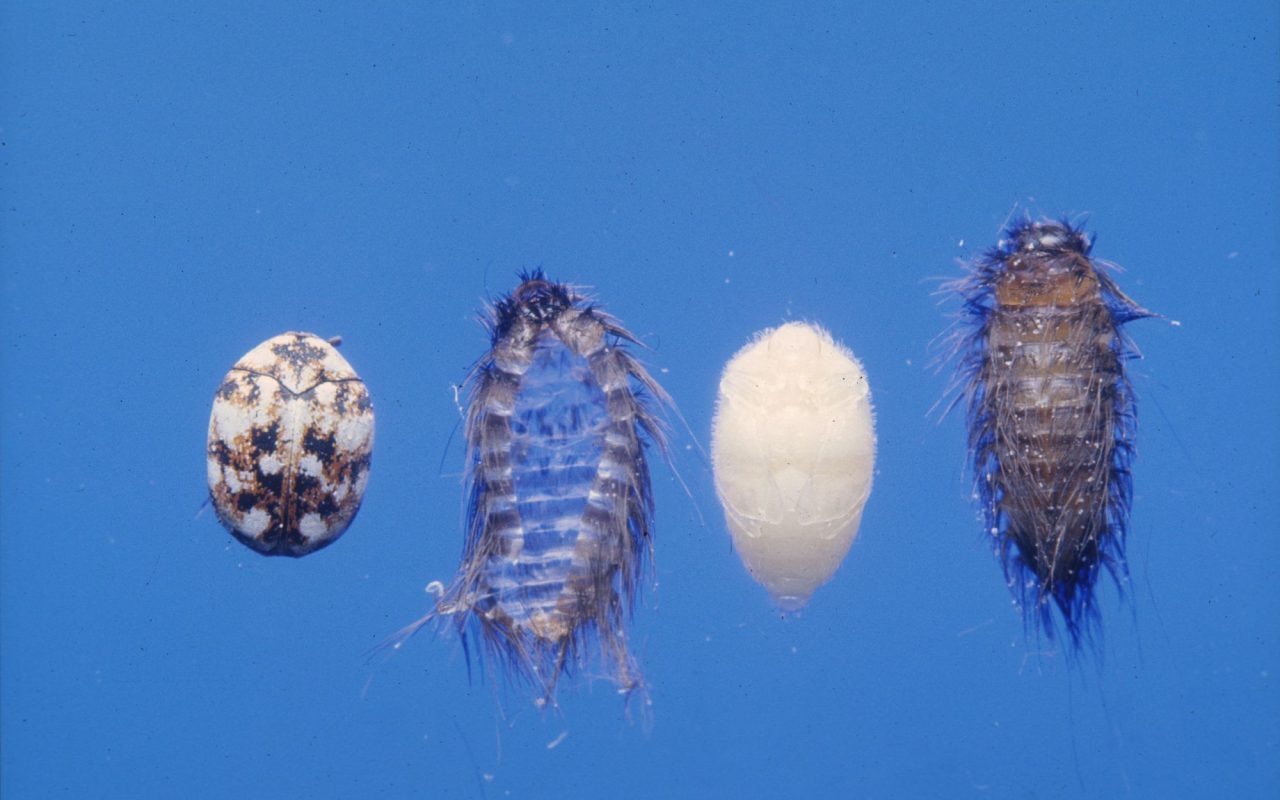
Most people meet a carpet beetle as an adult, on a windowsill, in spring. It is a small oval beetle, either speckled black and white and orange (the varied carpet beetle, Anthrenus verbasci) or plain dark and unmarked (the black carpet beetle, Attagenus unicolor). Either way, that beetle is not eating anything of yours.
Adult carpet beetles feed on pollen and nectar. They live outdoors on flowering plants, and UC IPM lists crape myrtle, spiraea and buckwheat among the ones they favor. The University of Missouri puts it flatly: adults may live from two weeks to several months, but never damage household goods in that stage. They have no reason to. They are looking for flowers and for somewhere to lay eggs.
So a beetle at the glass is usually an insect on its way out of the building, and it tells you something happened months ago rather than something happening now. That single fact reorders everything else about this insect, so it is worth sitting with before looking at the numbers.
The four stages, and how long each one takes
| Stage | Varied carpet beetle | Black carpet beetle |
|---|---|---|
| Eggs per female | About 40 | About 90 |
| Egg to hatching | 10 to 20 days | 9 to 16 days |
| Larva | 220 to 630 days | 166 to 330 days |
| Pupa | 10 to 13 days | 8 to 14 days |
| Adult | 2 to 6 weeks (female), 2 to 4 weeks (male) | 2 weeks to several months |
Read the larva row again. Seven months to twenty months of feeding, against a beetle that is gone in a month. Everything this insect does to a rug, a sweater or a bag of birdseed happens in the row you cannot see.
Those spans are wide because they are not really fixed durations. Warmth, humidity and food quality push them around, which is also why extension services do not agree with each other. Penn State gives the black carpet beetle larva 258 to 639 days; UC IPM gives it 166 to 330. Neither is wrong. A larva in a heated apartment eating wool grows on a different schedule from one in an unheated attic eating lint, and no published figure will tell you which one is under your baseboard. The width of the range is the useful part.
Two of the four stages are out of your reach
Eggs get laid in exactly the places you cannot vacuum: cracks in floorboards, the seam where carpet meets baseboard, inside air ducts, in lint under a radiator, in a bird nest in a soffit. They are less than half a millimeter, pale, and they hatch in a couple of weeks. You will never find one, and no reasonable amount of cleaning will remove them all.
Pupation is just as hidden. A carpet beetle larva pupates inside its own last shed skin, often still tucked in the material it was eating. For a week or two it is neither feeding nor moving, and nothing you spray or vacuum will reach it.
That leaves the larval stage as the only long window where the insect is exposed and reachable. Fortunately it is a very long window, which is the one piece of good news in this whole cycle. What it means practically is that treatment is repetition rather than an event: whatever you do, do it again in a few weeks, because the eggs you could not reach the first time will have hatched into larvae you can. If a product is going into that second pass, carpet beetle sprays and insecticides covers what the labels allow and what they forbid.
The one exception is heat. A hot wash and a hot dryer cycle kills every stage at once, eggs and pupae included, on anything launderable. It is the only routine step that gets past the two hidden stages. Freezing for several days does the same job for items that cannot be washed.
The shed skins outnumber the insects
A growing larva molts somewhere between five and eleven times, and as many as twenty when it is cold or badly fed. Every molt leaves behind a hollow, bristly husk that keeps the shape of the larva. Those husks do not decay, and nothing eats them.
Do the arithmetic and the practical consequence falls out on its own. One larva that lives eighteen months leaves a dozen skins scattered along the route it took. So in any established population, the skins outnumber the live insects by an order of magnitude, and they are the thing you will actually find first: brown, papery, curved, lying along a carpet edge or in the bottom of a closet. Carpet beetle larvae covers what to look for and where.
The skins matter for a second reason. Their bristles are what causes the itchy rash people blame on bites, so a room full of old husks can keep provoking a reaction long after the larvae themselves are gone. That is the whole subject of do carpet beetles bite? and carpet beetle rash.
Indoors, the seasons stop applying
Outdoors, the cycle is tidy. One generation a year, adults emerging in spring, larvae feeding through summer and autumn in bird nests and dead insects, everything more or less synchronized by temperature.
Inside a heated house, that synchrony breaks. There is no winter to slow anything down, so eggs, larvae of six different sizes, pupae and adults all exist at the same time in the same building. This is the reason a single thorough clean so rarely settles the matter. You are not attacking a cohort that is all at the same point in its development; you are attacking a population that is smeared across every stage at once, and whatever fraction you miss is on a different schedule from the fraction you got.
What a year-long cycle does to a cleanup
Here is the part I would want to know if I had just found larvae in a closet. You cannot tell whether you have solved this in a week, or a month, and looking for larvae to reappear is the wrong test. Larvae are slow, hidden and quiet by nature. Not seeing any in October proves nothing, because you were never going to see them in October anyway.
The test that carries information is the emergence. If small beetles turn up at your windows next spring, something indoors fed a larva all the way through, and the food source is still there. If the windowsills stay clear through two springs, it is over. Anything shorter than that is guesswork, which is frustrating but at least it is honest about what the insect is doing.
It also explains the mistake people make most often: cleaning the visible textiles and stopping. A rug gets shampooed, a wardrobe gets emptied, and the population carries on in a wool rug pad, a floor vent full of pet hair, a light fixture full of dead flies, or a nest in the eaves. Those reservoirs feed larvae for years. The removal protocol puts inspection before treatment for this reason, and the identification page is worth a look first if you have not confirmed which insect you are dealing with.
FAQ
How long does a carpet beetle live?
From egg to adult takes nine months to two years. The larval stage accounts for nearly all of it, running 166 to 330 days for the black carpet beetle and 220 to 630 for the varied carpet beetle. The adult stage that follows lasts a few weeks in most cases.
How many generations a year are there?
Outdoors, usually one. Indoors, the question does not really apply: with steady heating there is no synchronized generation at all, and eggs, larvae of every size, pupae and adults are present at the same time.
Do carpet beetle adults lay eggs indoors?
Yes, and that is the only harm they do directly. Are carpet beetles harmful? covers what’s actually at risk, and what isn’t. A female lays around 40 eggs (varied) or 90 (black) directly on or near a food source: wool carpet, a stored sweater, lint under furniture, a bag of pet food. The eggs hatch in about two weeks.
Why do I only see them in spring?
Because spring is when adults emerge and fly toward light. The larvae were there all winter, feeding out of sight along baseboards and in closets. The spring beetles are a report on what was happening months earlier.
Can I speed up the cycle to get it over with?
No, and you would not want to. Warmth and good food shorten the larval stage, which means more generations and more damage, not fewer insects. The lever that works is removing the food source, not changing the timetable.
Sources
- University of California Statewide IPM Program, Pest Notes: Carpet Beetles.
- University of Missouri Extension, Carpet Beetles and Clothes Moths, G7372.
- Penn State Extension, Black Carpet Beetle fact sheet.
- Purdue University Extension, Clothes Moths and Carpet Beetles, E-18.