 Fabric damage
 Short answer
A small brown larva in the carpet and a patterned beetle on the windowsill are common carpet beetle sightings, and they’re usually connected. Here’s the short version.
- Vacuum carpets, closets, and baseboards thoroughly and often
- Launder or dry-clean infested wool, fur, or feather items on a hot setting
- Set out pheromone traps near closets to monitor ongoing activity
Identification
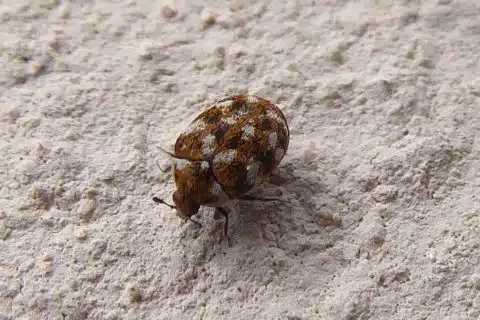
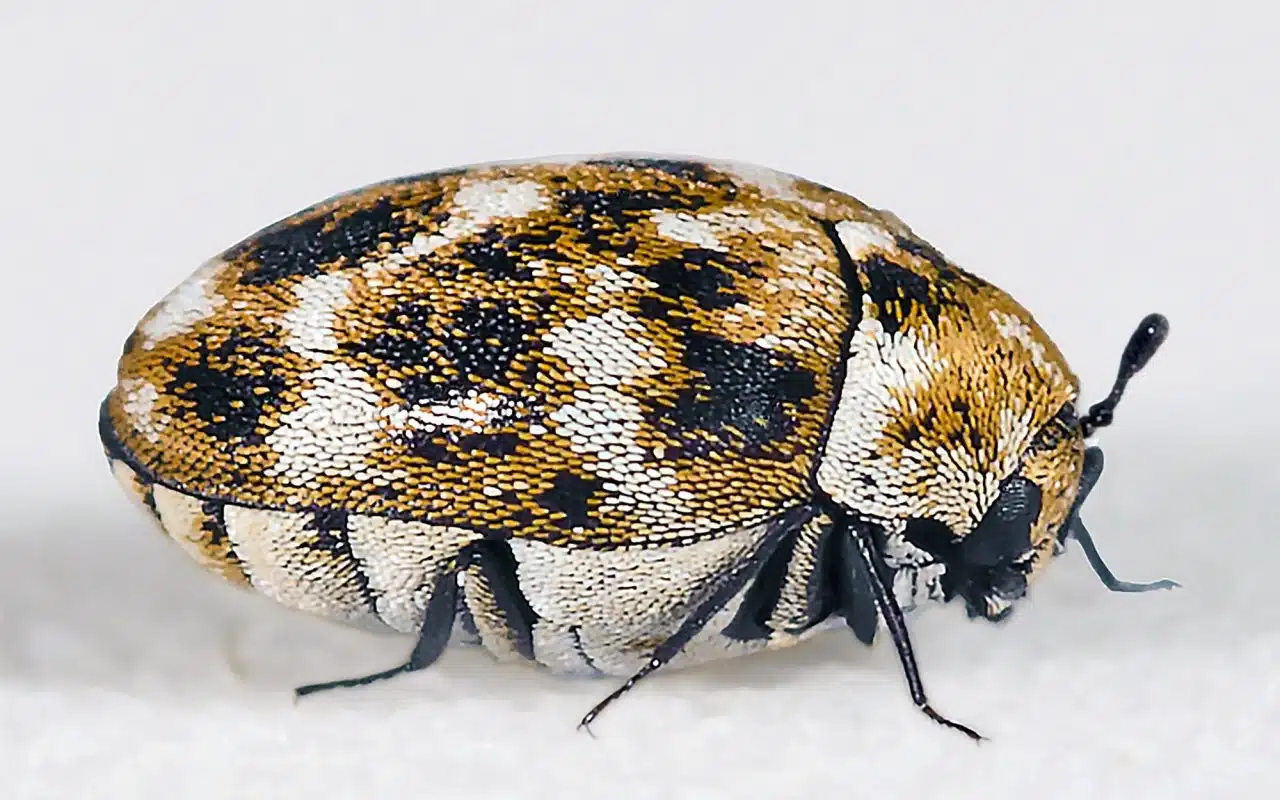
“Carpet beetle” covers a handful of closely related species that get lumped together because the larvae look and behave almost the same. The larva is the one most often photographed: a small, oval, bristly brown “worm” roughly 2 to 5mm long, tapered at one end, sometimes trailing tufts of longer hair-like bristles off the rear. It moves slowly, doesn’t fly, and turns up along carpet edges, on closet floors, under area rugs, and inside stored wool sweaters or fur, feeding and hiding in whatever fabric it lands on. The adult looks nothing like the larva, and which one you spot depends on the species. The varied carpet beetle (Anthrenus verbasci) is a small oval beetle around 2 to 3mm long with a mottled scale pattern of black, white, and yellow-orange across its back, reading as a dark speckled beetle from a distance. The black carpet beetle (Attagenus spp.) runs a bit larger, at 3 to 5mm, and is solid shiny black to dark brown with no pattern at all. Both are strong fliers and drawn to light, which is why adults turn up clustered on windowsills in spring, after they’ve already emerged and mated somewhere nearby. If you’re finding one form, it’s worth checking for the other. Adults at a window in spring don’t automatically mean an indoor infestation on their own, since they wander in from outdoor breeding sites too, but it’s worth checking nearby closets and carpets for larvae to be sure.
Look-alikes

The larva gets confused with clothes moth larvae most often, since both damage wool and both show up in closets. Clothes moth larvae are pale and nearly translucent with a smooth body, and they usually trail a bit of silk webbing or drag around a small case; carpet beetle larvae are visibly bristly and brown, with no silk involved. The mottled adult (varied carpet beetle) sometimes gets mistaken for a tiny ladybug or a stray seed on the windowsill because of its rounded shape and speckled coloring; a closer look shows the black, white, and yellow-orange scale pattern rather than the solid red-and-black shell of a ladybug. People who find one near the bed often take it for a bed bug instead, though the two separate easily once you look at them from the side rather than from above: carpet beetle vs bed bug runs through the checks. The solid black adult (black carpet beetle) is more easily mistaken for other small dark household beetles; size and the complete lack of any pattern are the main tells.
The shortcut: Before you assume a full infestation, check your closet for the one all-wool item you rarely wear. It’s usually the first thing damaged and the fastest way to confirm what you’re actually dealing with.
FAQ
Why do I keep finding carpet beetles on my windowsill?
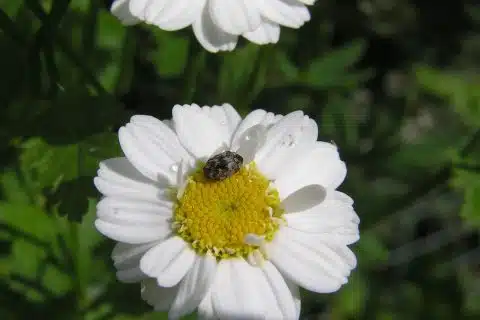
Adult carpet beetles are drawn to light. They typically emerge outdoors in spring, mate, and then wander toward the brightest spot in the house, which is usually a window. A few on the sill doesn’t automatically mean an infestation, but it’s worth checking nearby closets and carpets for larvae. Adults emerge at the end of a cycle that ran for months out of sight, which is why spring beetles are a report on last year; the carpet beetle life cycle explains the timing.
Do carpet beetles bite?
No. Carpet beetles don’t bite people or pets. Both the larva and the adult are fabric and fiber feeders, not blood feeders, and have no interest in human skin. Some people do react to the larvae’s shed bristles with an itchy rash that gets mistaken for bites, which is covered in full in do carpet beetles bite?
What attracts carpet beetles into a house?
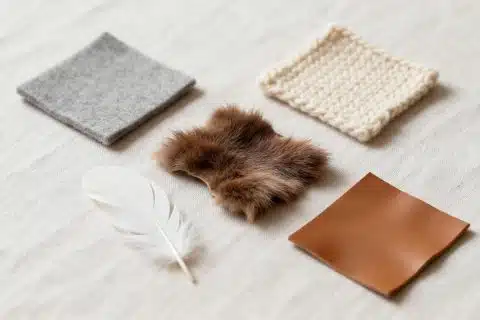
They’re pulled in by anything containing wool, fur, silk, feathers, or leather, plus lint and pet hair that collects in undisturbed spots like closets, baseboards, and under furniture. Natural light also draws the flying adults in through windows and screens.
Sources
- University extension entomology departments
- Cooperative Extension Service household pest fact sheets
- Standard urban entomology references used in pest management education