Short answer
Carpet beetle prevention is not mainly about the closet. The larvae feed on keratin in hair, lint, wool, fur and feathers, and the mat of hair and lint that collects under furniture nobody moves is a bigger food source in most houses than any sweater. Preventing an infestation means vacuuming that mat on a schedule, storing susceptible fabrics in a container with a seal that actually closes, quarantining anything secondhand, and closing the gaps adult beetles fly through.
- Vacuum the floor edges, heating vents, and under heavy furniture every one to two weeks, not just the open middle of the room.
- Store wool, fur, and feathers in a container with a true gasket seal; mothballs only help once the lid already seals on its own.
- Check the entry routes too: adults fly in from flowers and nest overhead long before any larva reaches a closet.
Vacuum the spot a weekly clean skips
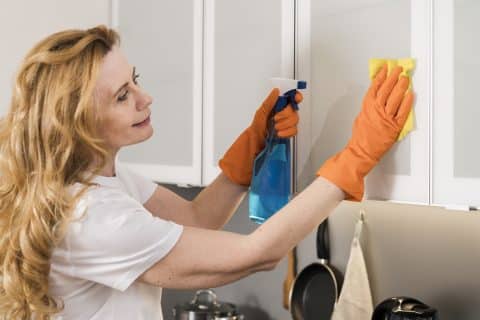
Most people vacuum the middle of a room and call it clean. Carpet beetle larvae are not in the middle of the room. They avoid light and feed where nobody disturbs them: along the baseboard, under a sofa that has not moved in years, inside a floor register, in the gap where carpet meets the tack strip. That mat of hair, lint, skin flakes and dead insects is keratin, and it is the food source that turns a stray adult into a population.
UC Statewide IPM Program is direct about it: clean up accumulations of lint, hair, and dead insects, since those are what feed carpet beetle larvae. Frequent vacuuming removes eggs, larvae and adults together, and the vacuum bag should be emptied or replaced right after, since larvae can keep developing inside a bag left in the closet. University of Kentucky Entomology adds the places people skip: heating vents, under furniture, and closet floors, on top of the obvious open carpet.
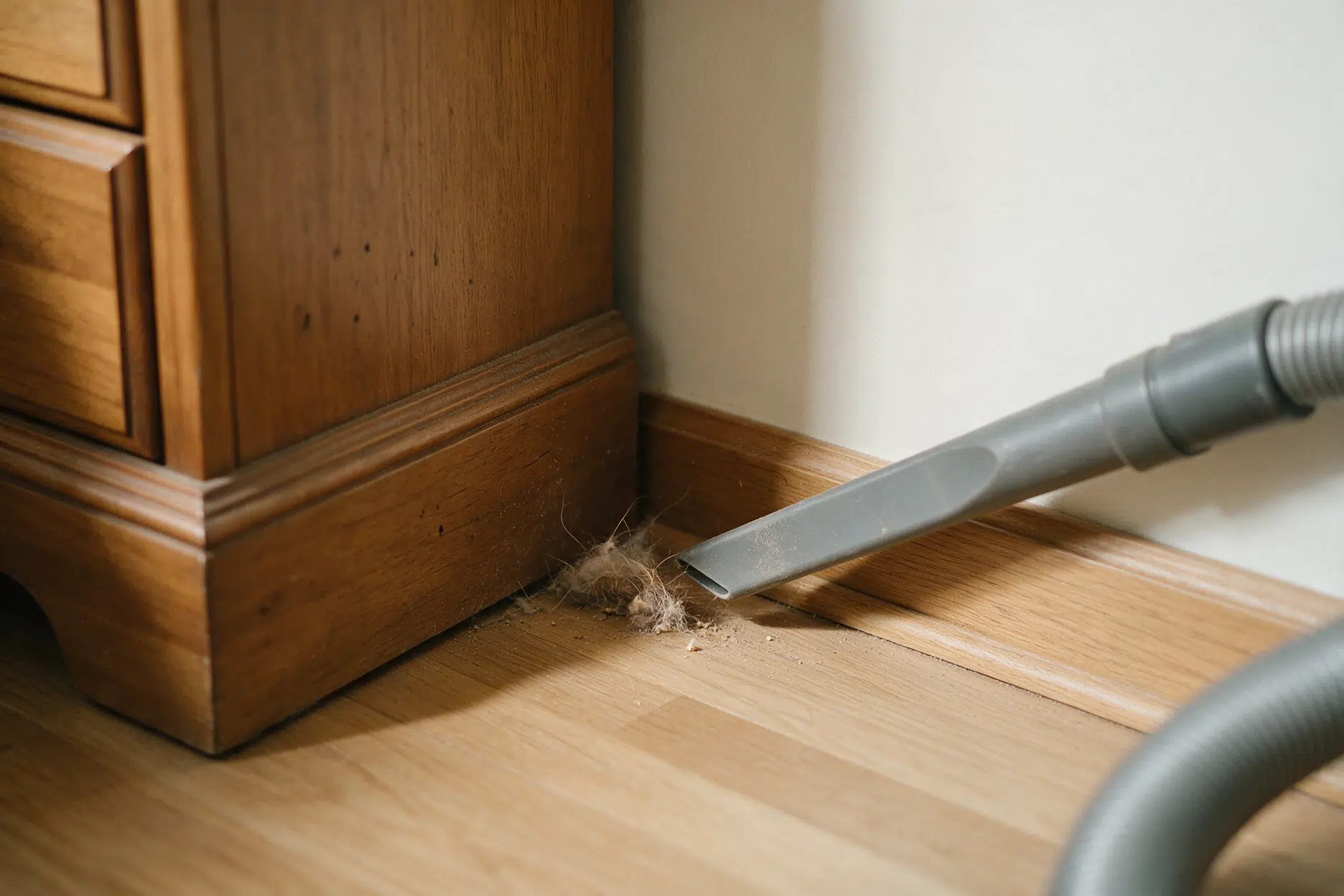
A crevice attachment reaches corners a floor nozzle glides past. Run it along every baseboard in a room that has carpet beetle history, under the couch and the bed frame, and inside the floor vents if the system has them. Larvae hide in exactly these gaps, and a larva that never finds an undisturbed mat to live in cannot complete its development, no matter how much wool is in the house.
Store wool, fur, and feathers with a seal that actually closes
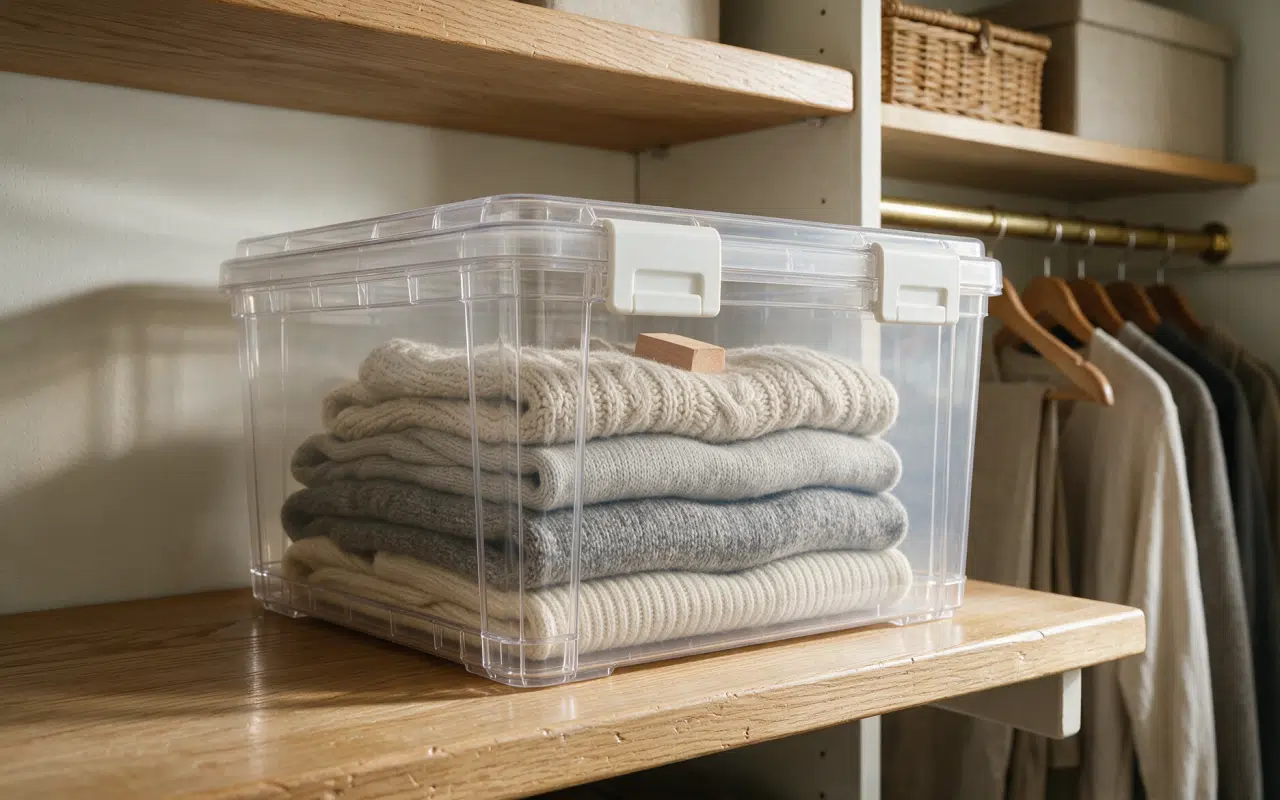
A sweater in a cardboard box is not stored, it is left out. Cardboard does not stop a larva from reaching a seam, and a loosely folded stack on a shelf is inspected by nothing between one winter and the next. UC IPM’s guidance is specific: inspect stored woolens, linens and furs, air them annually in the sun, and keep pest-free items in airtight containers with mothballs or crystals labeled for carpet beetles.
Cedar gets more credit than it earns. UC IPM notes that cedar oil fades as the wood ages, so an older cedar chest protects less than a new one, and tight construction matters more than the type of wood in the first place. University of Kentucky Entomology makes the same point about mothballs and crystals: the fumes only work at a concentration that a loose box cannot hold, so they have to sit inside something that seals, like a large plastic bag nested inside a tight-fitting trunk or tote. A cedar closet with a gap under the door defeats both the cedar and anything else put inside it.
| Storage method | Works when | Fails when |
|---|---|---|
| Clear tote with a gasket or snap-seal lid | Items are clean and dry before they go in | The lid is snapped on one corner at a time and never fully seats |
| Mothballs or crystals | Sealed inside a bag, then inside a tight trunk or tote | Left loose in a drawer or an open closet |
| Cedar chest or closet | Construction is genuinely tight and the wood is recently finished | The wood is old, or the door or lid does not seal |
| Cold storage vault | Valuable furs, through a furrier that offers the service | Used for everyday wool instead of just high-value pieces |
Quarantine anything secondhand before it joins the closet
A thrifted coat, an inherited rug rolled up in a relative’s attic for years, a feather pillow bought secondhand: any of them can carry eggs or larvae that a visual check will not catch, since the eggs are pale and about half a millimeter long. UC IPM’s advice applies to anything coming from outside the house, not just obvious antiques: examine cut flowers, secondhand furniture and rugs for insects before bringing them indoors, since adult beetles frequently ride in this way.
University of Kentucky Entomology’s advice for the items themselves is to dry-clean or launder woolens before they go into storage at all, specifically to remove eggs, larvae and the odors that attract more beetles later. That step comes before the airtight container, not after: a clean, sealed item stays clean, but a contaminated item sealed into a tote just keeps the problem contained to that tote.
The same quarantine habit covers the rest of a seasonal routine. The whole-house prevention checklist walks through the kitchen, closet, bathroom and basement passes that catch this alongside other pests, so a single seasonal pass covers carpet beetles without a separate routine just for them.
Clear the nests that restock the yard every spring
A bird nest in a soffit, an old wasp nest under the eaves, a spider web nobody has swept down in years: all three hold dead insects, feathers, down or dried droppings, which is keratin sitting at a stable temperature with nobody to disturb it. UC IPM lists removing old spider webs and bird, rodent, bee and wasp nests as a direct prevention step, not a cosmetic one, because a nest like that can seed new adults onto the house every year it is left alone.
This is also the reservoir behind the houses that make the least sense: no wool, no fur, no antiques, and carpet beetles every spring regardless. Walk the outside of the house once a year, pull down anything abandoned in a soffit, gutter or porch light fixture, and the supply of adults looking for a way in drops with it.
Seal the gaps adults actually fly through
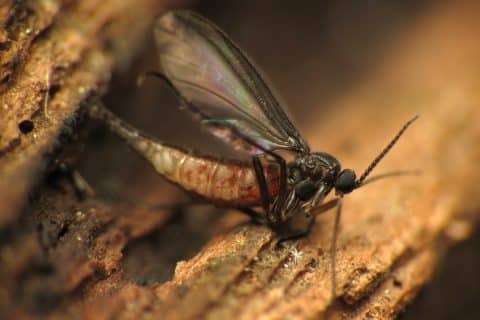
UC IPM’s third prevention point is the window and door check: make sure screens, doors and vents have no gaps or holes, since adults are drawn to light and often congregate on a sunny sill before finding a way past it. The mesh on a standard screen is already finer than an adult carpet beetle, which runs 2 to 3 millimeters for the varied carpet beetle and 3 to 5 for the black carpet beetle. What actually gets them through is the gap: a screen torn loose at one corner, a frame that no longer seats square, a gable vent with nothing behind the louvers.
Sealing the house does not fix an indoor population. An intact screen stops the next adult from flying in. It does nothing for larvae already feeding on a lint mat under the sofa or a nest in the attic. Confirm which problem you actually have before assuming new weatherstripping solved it.
A seasonal prevention schedule
None of this works as a once-a-year deep clean. A larva takes months to develop, so a routine that only runs once catches whatever happens to be visible that day and misses the rest of the cycle entirely.
| When | What to do |
|---|---|
| Every one to two weeks | Vacuum baseboards, under heavy furniture, and heating vents with a crevice attachment, not just open carpet. |
| Before any item goes into long-term storage | Launder or dry-clean it first, then seal it in a container with a true gasket lid. |
| Once a year, in spring | Air stored woolens and furs in the sun, and inspect them for larvae or shed skins. |
| Once a year, outside | Pull down old bird, wasp, or spider nests from soffits, gutters, and light fixtures. |
| Before anything secondhand comes inside | Inspect rugs, furniture, and cut flowers; launder or freeze susceptible fabrics first. |
When freezing or laundering beats storage alone
An item that might already be contaminated needs more than a sealed container, because a container only keeps a problem in, not out. University of Kentucky Entomology gives two ways to actually kill what is already on an item: launder or dry-clean it in hot water, or freeze it. The freezing threshold is a minimum of 0°F held for about a week to reach every life stage with margin; a freezer cold enough to hit minus 20°F can do the same job in as little as 72 hours. Either way, wrap the item in plastic first so condensation does not dampen it as it thaws.
Freeze before you store, not after you suspect something. Treating a secondhand sweater on the way into the closet costs ten minutes of folding and a week of freezer space. Treating an entire closet after larvae have spread costs a lot more than that.
This margin matters because the larval stage runs long. UC IPM records varied carpet beetle larvae developing over 220 to 630 days, so a batch of eggs that survives one incomplete treatment has months left to keep feeding before anyone notices again. The full life cycle breakdown covers why a population this slow-moving can look dormant for a season and then reappear.
FAQ
Does vacuuming really prevent carpet beetles, or does it just clean up after them?
Both, and the prevention part is the point most people skip. UC IPM lists frequent vacuuming of lint, hair and dead insects as a direct prevention step, not just cleanup, because it removes the food source before a larva can complete its development on it. A floor vacuumed only in the open middle still leaves the mat along the baseboard untouched.
Do cedar chests and mothballs actually keep carpet beetles out?
Only if the container is genuinely airtight. UC IPM notes that cedar loses its protective oil as the wood ages, and University of Kentucky Entomology found that mothball or crystal fumes only reach an effective concentration inside something that seals, such as a plastic bag nested in a tight-fitting trunk or tote. Neither one does much good in a drawer or a closet with gaps.
Can carpet beetles come back after I’ve cleaned everything in the closet?
Yes, if the source was never in the closet to begin with. A nest in a soffit or a lint mat under furniture in another room can keep producing adults that eventually wander into a clean closet. The routes carpet beetles use to get indoors covers the places a closet-only cleanup misses.
Is it carpet beetle larvae eating the wool, or something else?
Irregular holes with no silk webbing around them point to carpet beetle larvae; silk tunnels or webbing over the damage point to a clothes moth instead. The species page compares the two side by side, including the bristly larva that carpet beetles leave behind versus a moth’s smoother caterpillar.
Sources
- University of California Statewide Integrated Pest Management Program (UC IPM), Pest Notes: Carpet Beetles, UC ANR Publication 7436.
- University of Kentucky Entomology, Carpet Beetles, ENTFACT-601.