Short answer
Fungus gnats breed in wet potting soil, not on the plant itself, so preventing them means keeping the top inch of that soil dry rather than spraying anything. Let it dry out between waterings, water from below when you can, and cover the surface so an adult has nowhere damp left to lay eggs.
- Let the top 1 to 2 inches of soil dry before every watering, and check with a finger instead of a schedule.
- Water from the saucer so the surface layer stays dry while the roots still get enough.
- Isolate a new plant for a week or two and watch the soil surface before it sits next to the others; if gnats are already swarming a pot, the removal protocol covers what to do next.
Damp soil is the only thing fungus gnats need
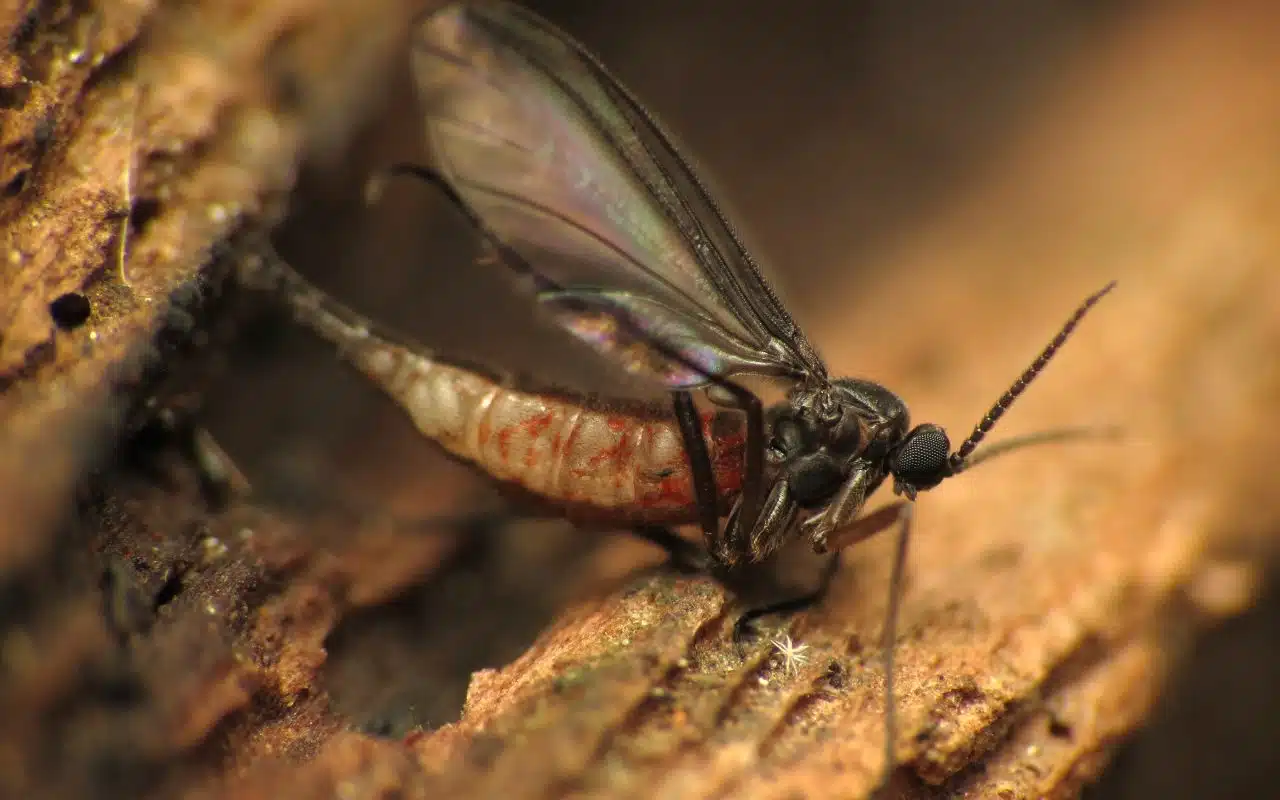
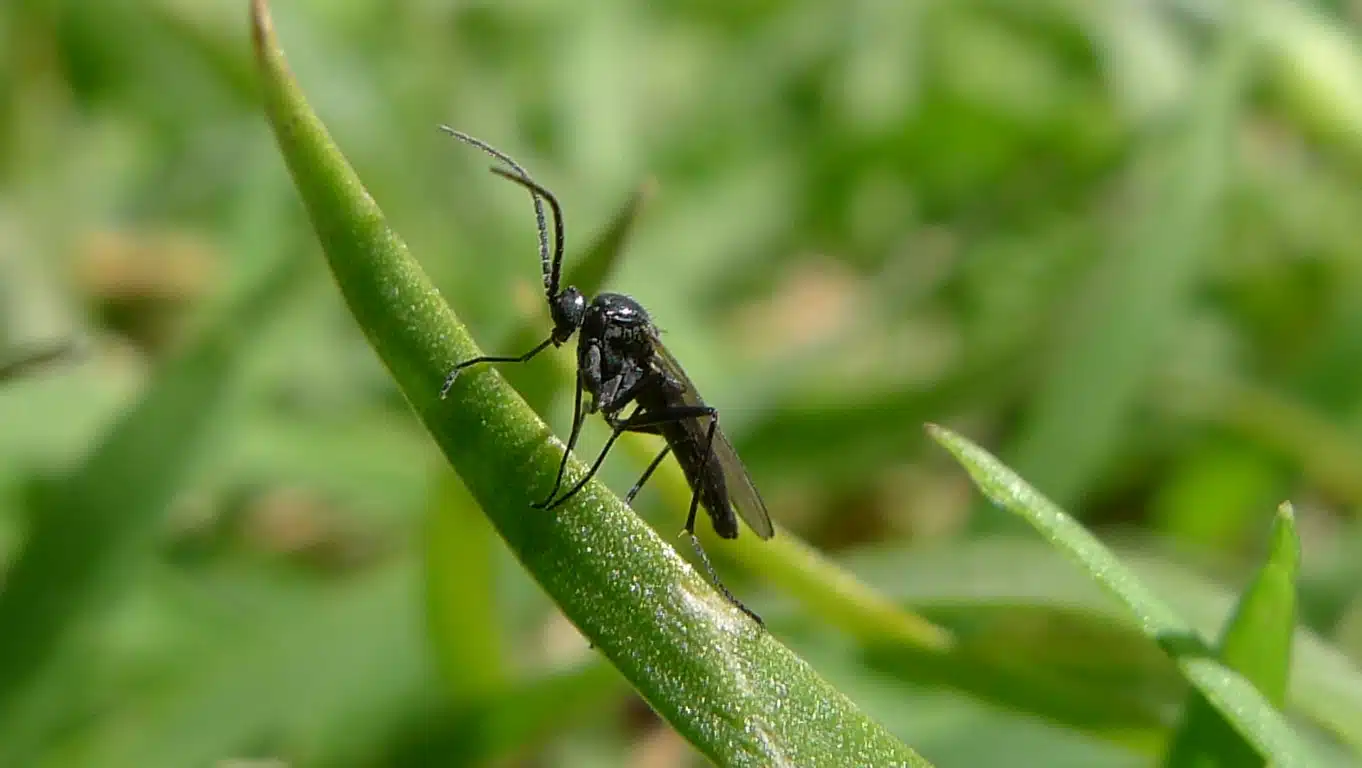
Fungus gnats are small, dark, mosquito-shaped flies in the family Sciaridae, mostly in the genera Bradysia and Orfelia, and adults are harmless beyond being annoying: they do not bite, and they live only a few days. The problem is what they leave behind. A female lays her eggs directly into moist growing medium, and Colorado State University’s AgBio IPM program notes that moist media high in peat moss is particularly attractive to her. The larvae that hatch live in the top inch or two of that soil and feed mostly on fungi, algae, and decaying organic matter; in a heavy infestation they can also chew on fine root hairs, which is the one case where the plant itself takes damage rather than just hosting an annoyance.
Under room conditions, Colorado State puts the full life cycle, egg to adult, at around 17 days, though the exact span shifts with temperature. That is fast enough that a pot watered on the same generous schedule all winter never gets a dry stretch long enough to break the cycle, and the gnat population just keeps overlapping itself. The fix lines up with that biology: change what the soil surface is doing, and the next generation has nowhere to start.
If what is flying around is landing on fruit or hovering near the trash rather than the plant pots, it is probably a different insect: fungus gnats, fruit flies, and drain flies get confused for each other constantly, and the fix for one does nothing for the other two. The full identification guide separates fungus gnats from drain flies specifically, since both show up as small dark flies in damp spots.
Let the top inch dry out between waterings
North Carolina State University’s Cooperative Extension is direct about this: allowing the top inch of soil to dry out between waterings will disrupt the fungus gnat life cycle. Colorado State’s guidance is slightly more generous, recommending the top 1 to 2 inches, and watering only when the plant actually needs it rather than on a fixed calendar. Either range does the same job: dry media is a poor place for a female to lay eggs, and dry media kills the larvae that are already there, because they need consistent moisture to survive.
Skip the moisture meter and use a finger instead: push it into the soil up to the second knuckle, and if it comes out with soil clinging to it, wait. Pots in a sunny window or with a lot of drainage holes dry faster than a shaded pot in a plastic nursery container, so the actual interval is going to be different for every plant in the room; what matters is the dry top inch, not a number of days. A plant that genuinely needs consistent moisture, like a fern or a carnivorous plant, is the exception here, and for those the rest of this routine, bottom watering and a dry topdressing, does more of the work instead.
Water from the bottom when you can
NC State Extension also recommends watering from the bottom where possible: set the pot in a saucer or tray of water and let the soil draw up what it needs through the drainage holes, instead of pouring onto the surface. The roots get the moisture they’re after while the top layer, where eggs actually get laid, stays comparatively dry. It will not work for every plant or every pot, and a pot without drainage holes cannot be bottom-watered at all, but for anything that can take it, it is one habit that does double duty: less surface moisture for gnats, and less risk of overwatering the roots in the first place.
| Watering method | Top inch of soil | Gnat egg-laying risk |
|---|---|---|
| Poured on the surface, same schedule year-round | Rarely dries out | High, especially in winter |
| Poured on the surface, only when the top inch is dry | Dries between waterings | Low |
| Bottom-watered through a saucer | Stays dry while roots are served | Lowest |
Cover the soil surface so there’s nowhere left to lay eggs
A thin topdressing changes what a female fungus gnat finds when she lands on the pot. NC State Extension lists coarse sand, aquarium gravel, or diatomaceous earth spread over the surface as a way to discourage egg-laying and keep that top layer dry between waterings; the point is a dry, loose material she cannot easily push an ovipositor into, not a thick layer that blocks water. It works best paired with the watering changes above, not as a stand-alone fix on soil that stays wet underneath.
A half-inch layer is plenty. Spread it right up to the stem and recheck it after a deep watering; sand and gravel can wash into the soil over a few waterings and need a light top-up, the same way mulch does outdoors.
Inspect new plants before they join the others
Most indoor fungus gnat problems do not start indoors. NC State Extension names contaminated potting soil and newly purchased plants as common entry points, along with open doors and windows. A nursery pot that has sat on wet gravel at a garden center for weeks is exactly the kind of growing medium that already has eggs or larvae in it, and nothing about the leaves will show that. Give a new plant a spot away from the rest of the collection for a week or two, let the soil go through at least one full dry-and-water cycle, and watch for small flies hovering near the pot before it goes anywhere near your other houseplants.
Repot when the soil itself has become the problem
Potting mix breaks down over time. As the organic matter in it ages, it holds more water than it did when it was fresh, which is exactly the condition Colorado State’s guidance flags as attractive to adult gnats, separate from anything you’re doing with the watering can. If a pot has had repeated gnat problems despite a drier watering routine, NC State Extension’s advice is to repot in fresh, well-draining soil, discard the old mix rather than reusing it, and sterilize the pot before the new soil goes in. Colorado State adds that a pasteurized potting mix is worth seeking out specifically where gnats have been a recurring issue, since ordinary bagged mix is not sterile.
What doesn’t actually help
Don’t do this: mist the soil surface to “freshen it up,” or spray the adults you see flying and consider the job done. Misting adds exactly the surface moisture the topdressing and the dry-top-inch habit are meant to remove, and killing adults with a spray does nothing to the eggs and larvae already in the soil, which is where the next generation is actually coming from.
Yellow sticky cards placed near the pots are worth having, not because they end an infestation on their own, but because catching adults before they lay another round of eggs slows things down while the soil dries out. For a heavier infestation, both NC State and Colorado State extension programs note that beneficial nematodes, particularly Steinernema feltiae, and the soil bacterium Bacillus thuringiensis subsp. israelensis (Bti) target the larvae specifically when mixed into the soil as a drench, without the broader effect a general insecticide spray would have. Neither replaces drying out the soil; both work on top of it.
If they’re already swarming a pot this week
Everything above is a habit for the weeks ahead, not a same-day fix for a pot that already has a visible cloud of gnats rising off it when you water. If that’s where you are right now, the full removal protocol walks through confirming the source, drying the pot out faster without stressing the plant, and setting traps while the soil recovers. A vinegar-and-soap trap is also worth setting near the pot in the meantime; it catches adults fast, even though it does nothing for the larvae underground. Once the active infestation clears, come back to this page for the routine that keeps it from starting again, and the whole-house prevention checklist folds this same moisture logic into the kitchen, bathroom, and basement habits that keep other damp-loving bugs out too; the prevention hub links out to the rest of those room-by-room guides.
FAQ
How long after I start drying the soil will the gnats actually go away?
Expect a couple of weeks rather than a couple of days. With a life cycle of roughly 17 days under warm room conditions, the adults you see this week already hatched from eggs laid before you changed anything, and new adults keep emerging until that earlier generation works its way through. Sticking with the dry top inch is what stops the next round from starting.
Do I need to let the soil dry out just once, or keep doing it?
It has to become the normal watering routine for that plant, not a one-time fix. A single dry stretch kills whatever larvae are in the top layer at that moment, but as soon as watering goes back to a wetter schedule, the surface is attractive to egg-laying females again.
Can fungus gnats actually kill a houseplant?
Rarely, and usually only in a seedling or a weakly rooted plant with a heavy larval population feeding on fine root hairs. For most established houseplants, the larvae mainly feed on fungi and decaying matter in the soil and the adults don’t feed on the plant at all, so the damage is more of a nuisance than a threat to the plant’s health.
Will a thin layer of sand on top really stop a female that’s already there?
It makes the surface a much harder place to lay eggs into, which cuts down how many she manages, but it is not a seal. Pair it with letting the soil dry out and bottom watering where you can; the topdressing is one layer of the routine, not the whole fix by itself.
Is misting houseplants around a gnat problem actually making it worse?
If the misting is landing on the soil surface, yes: it keeps the top layer damp at the exact depth where eggs and larvae live, working against the dry-top-inch habit. Misting foliage itself, away from the soil, is a separate question and isn’t what drives a gnat population either way.
Sources
- North Carolina State University Cooperative Extension (Beaufort County Center), Fungus Gnats: Tiny Pests in Houseplants and How to Control Them, 2025.
- Colorado State University, AgBio IPM Program, Fungus Gnats, pest fact sheet.