 Pantry food contamination
 Short answer
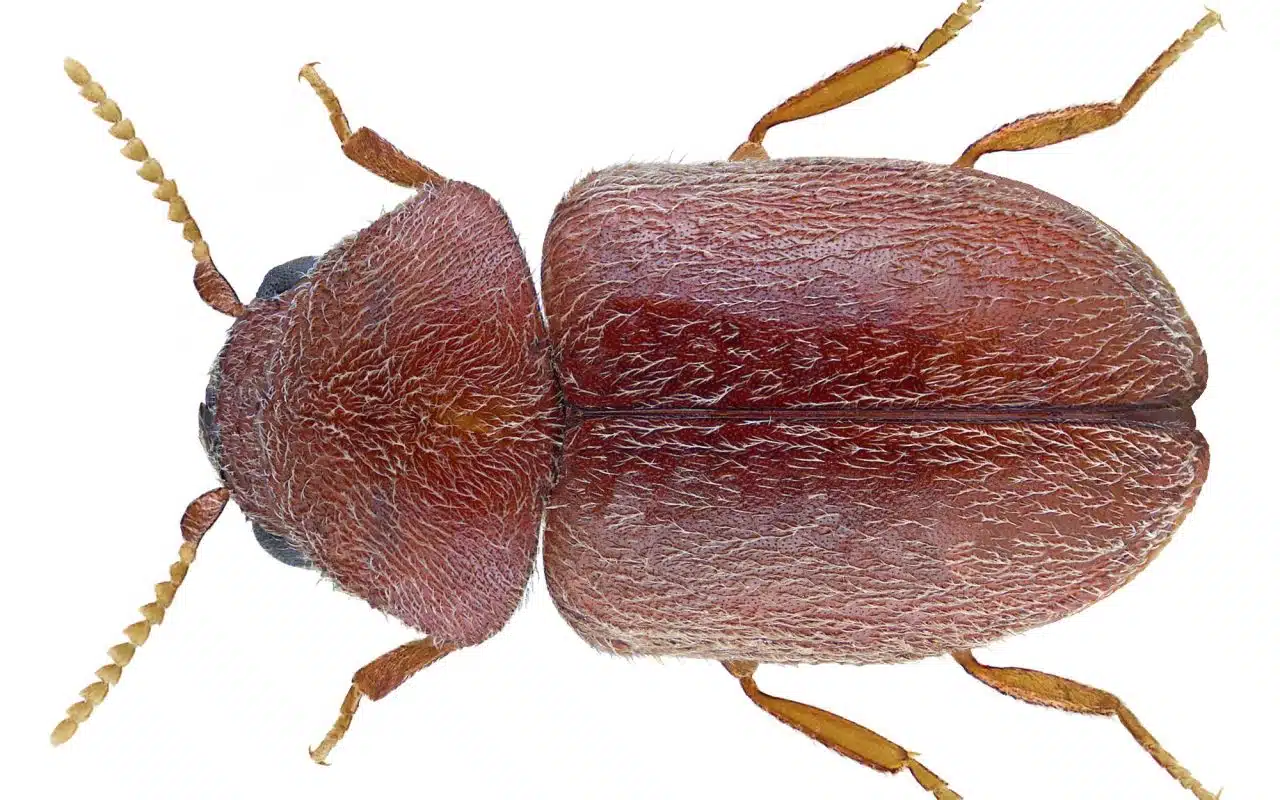
The cigarette beetle is a small, reddish-brown beetle about 2 to 3mm long, with a smooth, rounded back and a humped profile that makes it look almost ball-shaped from the side. It turns up in dried spices, pet food, cereal, and dried flower arrangements, feeding as a larva inside the packaging itself.
- Look for a smooth back with no ridges or dotted lines, and a rounded, humpbacked shape when seen from the side.
- Check dried spices, pet food, cereal boxes, dried fruit, and any dried flowers or potpourri for small holes and fine debris, then move what’s left into sealed containers.
- For more on keeping stored-food pests out, see our pantry pest prevention guide, or start from our bug identification hub if you’re not yet sure what you’re looking at.
Identification

A cigarette beetle measures 2 to 3mm as an adult, oval in outline and covered in a fine layer of pale hair that gives the surface a slightly fuzzy texture under a hand lens. The color sits somewhere between reddish-brown and light tan, and unlike a lot of household beetles, the body reads as one continuous curve rather than a set of clearly separated segments.
Viewed from the side, the head tucks almost entirely under the thorax, which is what gives this beetle its trademark humped, ball-like silhouette. The wing covers (elytra) are smooth, with no grooves, ridges, or rows of punctures running along them. The antennae are serrated, meaning each segment carries a small tooth-like point, rather than ending in a club. It flies readily, and in the evening it’s drawn toward light sources, which is often how people first notice one indoors.
Indoors, cigarette beetles feed on a narrow but persistent list of dry goods: paprika, chili powder, and other dried spices, dry pet food, breakfast cereal, dried fruit, and dried flowers or potpourri. Tobacco was the classic host that gave the species its name, though that’s a rare find in most modern homes. The larvae do the actual damage, chewing through the inside of paper or cardboard packaging while the adults you spot flying around are mostly a sign that something in the pantry is already infested. Moving opened bags into sealed, airtight containers is the simplest way to stop them from spreading between packages. They stay active indoors all year, and warm rooms speed up how fast a population builds.
Look-alikes
The cigarette beetle (Lasioderma serricorne) is most often mistaken for the drugstore beetle (Stegobium paniceum), a close relative that overlaps it almost exactly in size and color: no extension source reports a reliable size difference between the two, so size alone will never settle it. The two are easy to separate once you know where to look. Drugstore beetle elytra carry fine grooves and rows of tiny punctures running lengthwise, while the cigarette beetle’s are completely smooth. The antennae tell the same story from a different angle: drugstore beetles end in a three-segmented club, while cigarette beetle antennae are saw-toothed along their whole length.
Body shape offers a second clue. The cigarette beetle tends to look a bit more rounded and globular overall, especially from directly above, while the drugstore beetle reads as slightly more elongated. Neither trait is obvious at arm’s length, so a loupe or a phone’s macro lens usually settles it. The pantry bug hub has the rest of the cabinet lineup. For photos and notes on other pantry beetles, the full species archive is a good next stop.
The shortcut: hold the beetle under bright light or a phone macro lens and check the wing covers alone — grooved, with rows of punctures, means drugstore beetle; smooth and unstriated means cigarette beetle. Both species are finely hairy, so surface sheen settles nothing.
FAQ
Does the cigarette beetle bite or sting?
No. It has no biting mouthparts capable of breaking skin and no stinger. The only real issue it causes is contaminating stored food, not any direct harm to people or pets.
What attracts cigarette beetles into a home?
Dried spices, pet food, cereal, dried fruit, and dried flowers or potpourri are the main draws, since that’s what the larvae feed on. Adults also fly toward light in the evening, which is often when they’re first spotted near windows or lamps.
How can I tell a cigarette beetle from a drugstore beetle?
Check the wing covers first: smooth means cigarette beetle, grooved and dotted means drugstore beetle. The antennae confirm it, saw-toothed for the cigarette beetle and club-tipped for the drugstore beetle.
Sources
- University of California Statewide Integrated Pest Management Program, Pest Notes: Pantry Pests, UC ANR Publication 7452.
- Penn State Extension, Cigarette Beetles.