Short answer
Four things move in a bag of flour, and one feature settles each. A snout out front means a weevil. Flat, reddish-brown and quick means a flour beetle. Pale, soft and barely a millimeter long means a booklouse, which is a humidity reading rather than a pantry pest. Silk matting the flour into clumps means a moth larva. What you throw out follows from which one it is.
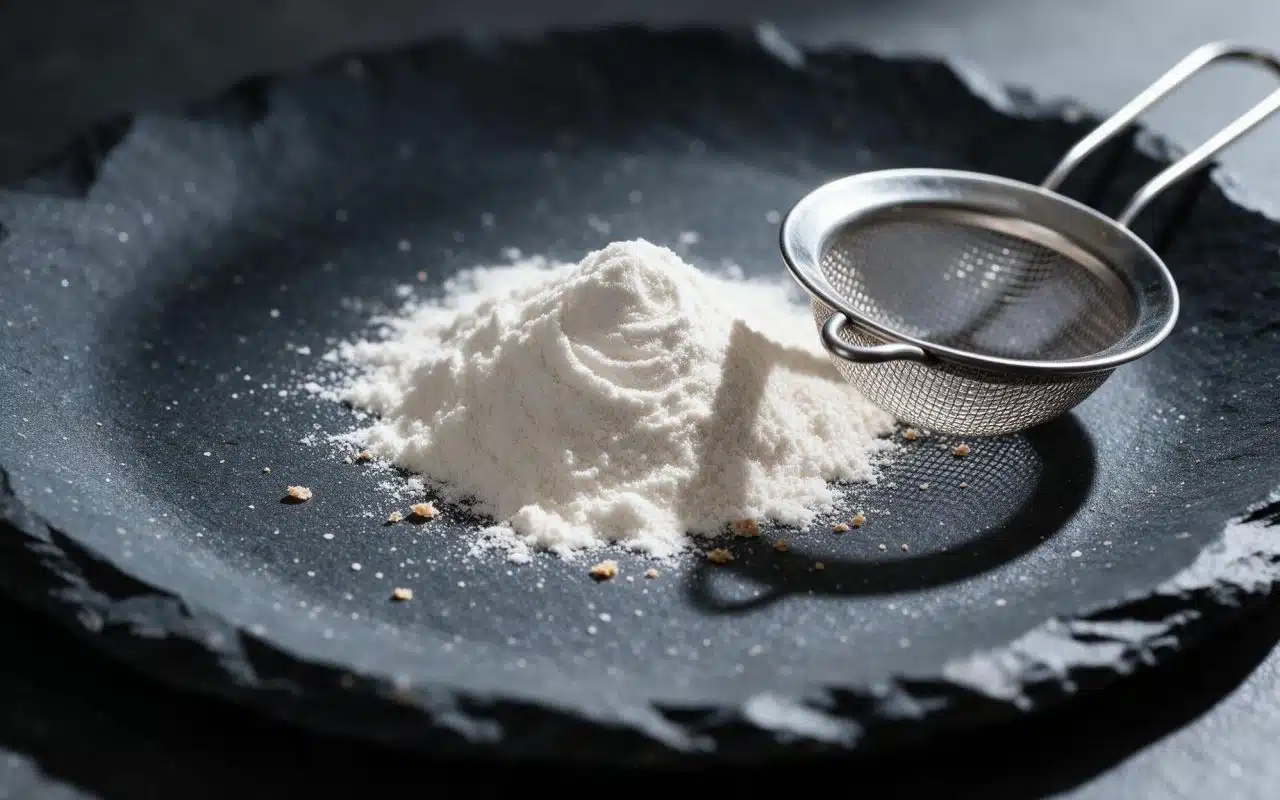
- Sift a cup onto a dark plate and give it two minutes. Nothing shows against white flour until it moves.
- Look at the head from the side. A snout longer than the head is a weevil, and it came out of whole grain elsewhere on the shelf.
- Then sort the cabinet, not just the container: the step-by-step pantry protocol is the cleanup.
Get the flour onto something dark first
White on white is the whole problem. Three of the four adults here run between 1 and 5 mm, pale or reddish enough to vanish into flour under a kitchen light; only a moth larva gets big enough to spot without looking. Sift a cup onto a dark plate: the sifter holds back adults and larvae, so whatever is in there lands on a background it cannot hide on.
Then wait. Insects are cold-blooded, and a container out of a cool pantry gives you sluggish beetles that look exactly like flecks of bran. Two or three minutes at room temperature and anything alive starts walking. What the sieve will not show is eggs: flour beetle eggs are coated in a sticky fluid that flour clings to, camouflaging them against the food they were laid in.
The four-way sort
Work the table in order. The first row that matches is your answer, and sizes are the published ones.
| What you found | Size | The one tell | What it means |
|---|---|---|---|
| Hard dark beetle with a snout | 2.5–5 mm (3/32–3/16 in) | Rostrum longer than the head | It grew inside a whole kernel, not in the flour |
| Flat oval beetle, blunt head, mahogany red | About 3.5 mm (1/8 in) | No snout; flat in profile; walks fast | The flour itself is the food |
| Pale soft speck that walks, no shell | 1–2 mm (about 1/16 in) | Almost translucent, and never jumps | The flour or the room took on moisture |
| Cream caterpillar, or flour clumped together | Larva up to about 12 mm (1/2 in) | Silk, which no beetle produces | A moth is breeding in the cabinet |
A snout means the flour was not the target
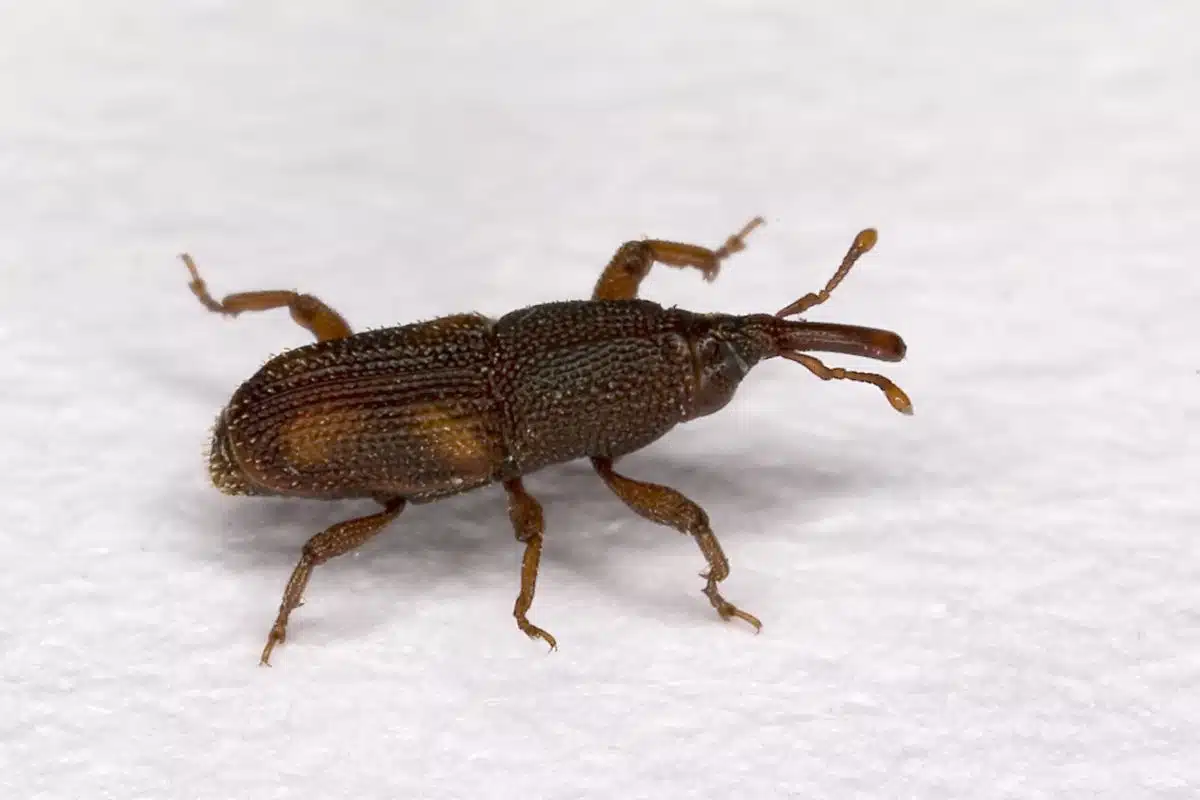
A weevil larva develops inside an intact kernel. The female chews a hole into a grain of rice or wheat, lays one egg in it, and the larva eats its way out over the following weeks. Fine flour offers no kernel to do it in. So an adult weevil walking through your flour is a traveler: it emerged from a kernel in the rice, the wheat berries, the dried corn or the birdseed. Finding it here points you at a different package.
Go find that package and look at the kernels under good light. A weevil that has emerged leaves a round exit hole about the width of a pin. Floating a handful in water is a rough gauge only, since hollowed kernels do float but sound ones sometimes float too. The identification guide to weevils in flour covers the rest, including which of the two species flies.
Flat, reddish and quick: the flour beetle
This is the one people actually have. Flour beetles run about 3.5 mm, flat and oval, reddish brown to almost mahogany, with a blunt head and nothing in front of it. They cannot chew into an undamaged kernel, so milled products and the dust at the bottom of a bag are their whole habitat. One thing worth knowing at the counter: if the flour smells sharp and off, you are late. Crowded flour beetles release quinones, and a population big enough to make flour smell wrong has been running a while. The two species, and the reason one keeps appearing on a bedroom windowsill, are on the page about the pantry beetle that is not a weevil.
Pale and barely there: read it as damp, not as an infestation
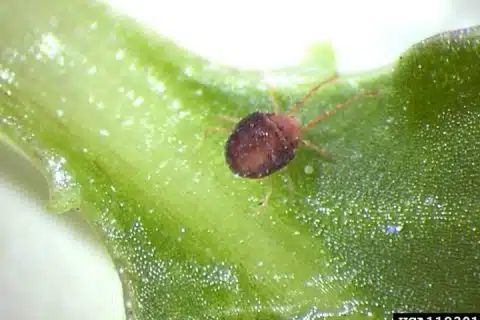
If what you sifted out is 1 to 2 mm long, soft, pale tan to nearly see-through, with no hard shell and no hurry, you have booklice, and the picture changes. Booklice are not eating your flour. They graze the microscopic mold that grows on a starchy surface once it holds enough moisture, which makes the insect the symptom and the flour the surface. Check the container: flour that has picked up humidity cakes, and a spoon leaves a clean cut edge instead of crumbling.
So the fix is drying the room, not treating the cabinet. Numbers climb through muggy weather and above roughly 60 to 70 percent relative humidity. Extension sources put the floor at roughly 45 to 50 percent: below that, booklice do not survive and the film they graze stops growing. So aim under 50 percent, and hold it rather than touching it once. Bringing indoor humidity down, room by room is the actual job, and the booklouse profile covers why they cannot bite.
Silk means a moth, and the moth is not in the bin
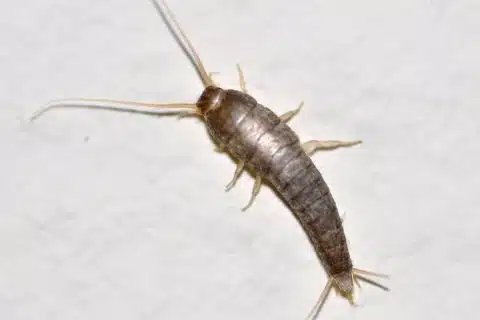
Webbing is the cleanest signal here: no beetle and no weevil produces any. A pantry moth larva trails silk as it feeds and mats flour into clumps you can lift out in one piece. The trap is that the larva leaves the food to pupate, so the cocoon ends up in a shelf joint or under the cabinet lip, and emptying the bin leaves the next generation behind. Why the larvae crawl away from the food is the page for that.
What goes out, and what you can keep
The flour goes out. Not because the insects are dangerous, since they do not bite and no disease is associated with them, but because sifting removes what you can see and leaves what you cannot. UC IPM adds a qualification worth taking seriously: pantry insects can introduce microorganisms that produce mycotoxins in food stored warm and humid. Bag it for the outdoor trash, not the kitchen can.
Sifting is not decontamination: a sieve catches adults and larvae. The eggs are about the size of a flour particle, so flour you sifted clean can still be carrying the next generation.
- Keep as is: rigid containers with an intact gasket seal, cans, anything already cold. Store packaging does not count: a fold-over paper bag and a cardboard box are not barriers, and the infestation usually arrived inside one.
- Keep after a freeze: open packages that shared the shelf and look clean. Freeze at 0°F (-18°C) for at least four days, a floor rather than a guarantee, since a packed home freezer runs warmer than its dial says. A week is safer.
- Throw out: anything with live adults, larvae, webbing, pinholes in the packaging, or that sharp off smell. Check the whole grains too.
Booklice are the exception, and they are why the sort at the top is worth two minutes. Discard the caked flour, wipe the shelf and let it dry, then bring the humidity down. The rest of the shelf is fine, because nothing was breeding in it.
The shortcut: check the package you bought on the same trip before the one sitting next to it. These insects arrive inside a package, so the twin bag beats the jar that has sat untouched for a year.
What does not fix it
Bay leaves in the flour bin are the folk answer, along with cloves and mint. No extension publication reports any of them as a control, and none does anything to an egg already in the flour. Freezing the one bag you found and putting it straight back is the costlier mistake: it treats the package instead of the shelf, and adults walk from the food they emerged from to new packages. A spray has no place in a cabinet holding food. The work here is mechanical.
Then go do the cabinet
Beyond the bin, the cleanup is the same for the weevil, the flour beetle and the moth, and it is written out step by step in the pantry removal protocol. If none of the four matches what you sifted out, the six pests that turn up in a kitchen cabinet sorts the wider lineup.
FAQ
Can I just sift the bugs out and bake with the flour?
Food-safety guidance treats this as a quality question rather than a hazard, so it is your call. Two things are worth weighing first: a sieve does not catch the eggs, and UC IPM notes that pantry insects can introduce microorganisms that produce mycotoxins in food stored warm and humid. That is why the published advice is to discard.
Are the bugs in my flour harmful to eat?
None of the four bites, stings, or is recorded as carrying disease, and swallowing one is not treated as a hazard in extension guidance. If you have eaten some and are worried about a reaction, that is a question for a doctor or a pharmacist, not a pest page.
I cleared the flour and they came back two weeks later. Why?
Because the source was another package. One overlooked box of cornmeal, tub of protein powder or bag of birdseed will reseed the cabinet on its own schedule. Work the whole shelf rather than the container you noticed, and look at the back of the cabinet, where a forgotten package can run a full generation unwatched.
Sources
- University of California Statewide IPM Program (UC IPM), Pest Notes: Pantry Pests.