Short answer
Four bugs in the bathroom get lumped together because they all show up somewhere damp, but they don’t look or move alike, and that’s the fastest way to sort them out. Size rules out most of the field immediately: anything bigger than a fingernail clipping is one specific bug, since the other three all stay under about 3 mm (1/8 inch). Behavior settles the rest, so watch what it actually does for a few seconds before you decide.
- Estimate its size. Over half an inch (12mm+) points to one candidate only; anything smaller narrows you down to three tiny look-alikes.
- Watch what it does. Sprints and never flies, sits still near a drain and flies weakly when nudged, walks in a steady crawl, or jumps sideways when disturbed — each behavior belongs to a different bug.
- If it’s fast, wingless, and gone in a blink, go straight to the silverfish removal guide. If it’s small and the room has been damp for a while, the shared cause is moisture — see fixing bathroom humidity.
Which bug is it?
Start with the big, fast one. A silverfish is easy to place once you’ve seen it move: silver-gray, tapered like a carrot from head to tail, over half an inch long, with three thread-like tails trailing off the back end. It never flies, and when a bathroom light snaps on at night it doesn’t so much scurry as vanish, flattening itself and sprinting for the nearest gap around the tub or baseboard. If that matches what you saw, the silverfish profile covers the rest of the identification, and this bathroom-specific guide walks through where they hide and how to clear them out.
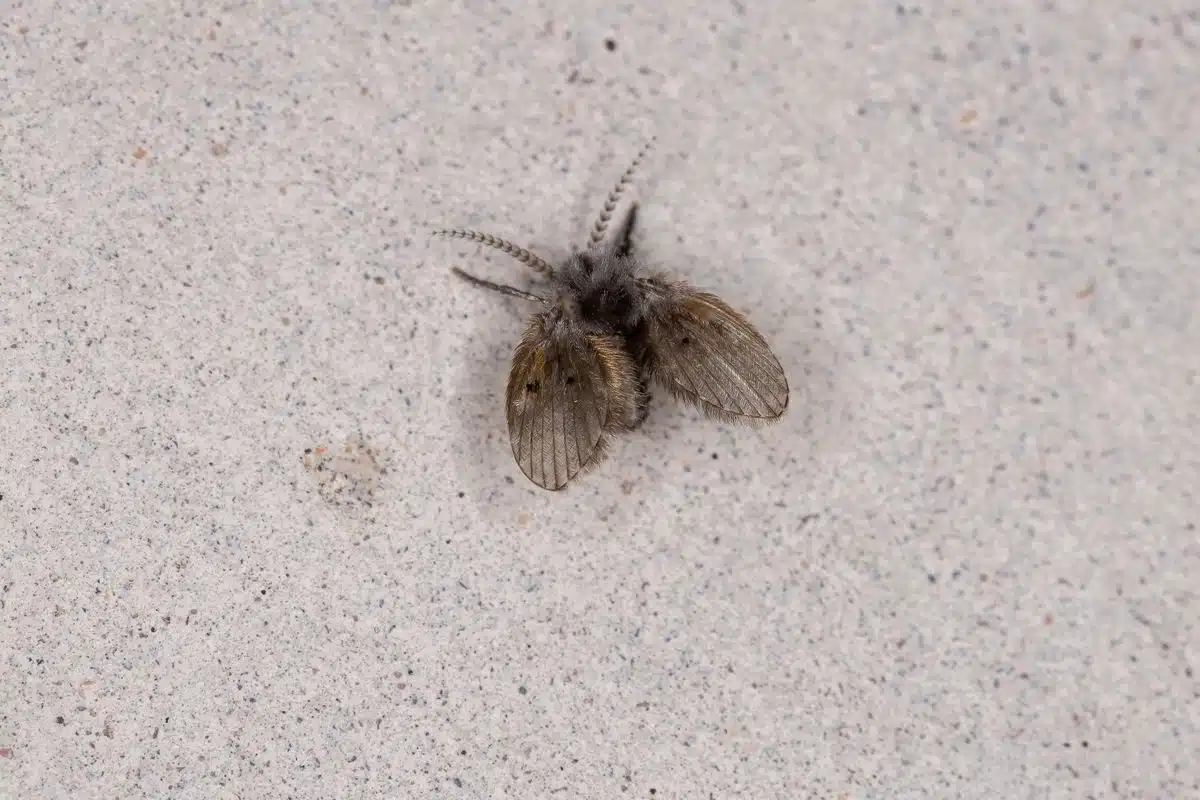
A bug that flies but barely moves once it lands is a different animal. Drain flies, sometimes called moth flies, are small and dark with fuzzy, moth-like wings, and they have a habit of sitting motionless on the tile near a drain, an overflow, or the base of the toilet for long stretches. Nudge one and it tends to hop into a short, clumsy flight rather than dart away cleanly. Their whole life cycle runs inside the film lining a slow or rarely used drain, which is why the gnats and drain flies profile is worth a look before you touch any cleaner.
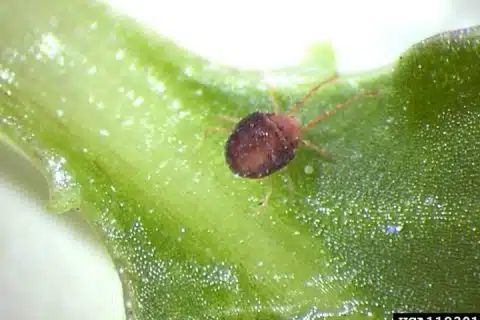
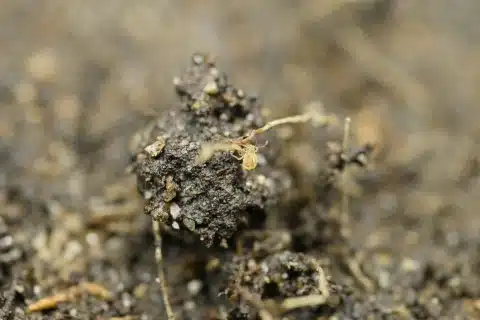
That leaves the smallest two, and the only real way to split them is by watching how they cross a surface. Something pale, soft-bodied, and barely a millimeter or two long that walks in a slow, deliberate crawl is almost always a booklouse. Something closer to gray, roughly the same size, that flicks itself several inches sideways the moment you get close is a springtail, using the spring-loaded tail fork that gives the group its name. The springtail removal protocol covers the drying that ends it. Since walking versus jumping is genuinely hard to judge from memory, this guide to tiny black bugs with no wings and this one on tiny white or pale bugs both go through the comparison in more detail.
Booklice, springtails, and drain flies show up in bathrooms for the same underlying reason: standing moisture, whether that’s condensation on tile, a damp bath mat left bunched on the floor, or grime sitting in a slow drain. Silverfish like humidity too, but they’ve got their own dedicated prevention guide, since drying out a bathroom rarely gets rid of them once they’re established. For the other three, cutting the moisture handles most of the problem — see how to reduce humidity in your bathroom for the details, or head back to the main identification hub if none of this quite matches what you found.
FAQ
Could it be more than one of these at once?
Yes, and it’s common. A humid bathroom that’s grown drain flies can just as easily support springtails or booklice nearby, since all three are responding to the same damp conditions. A silverfish turning up alongside any of the other three is usually a coincidence of habitat rather than one bug causing the other.
Do any of these bite or carry disease?
None of the four bite people, and none are documented vectors of disease in homes. UC IPM does note that drain flies could carry pathogens up from the drain they breed in, and that fragments of dead adults can become airborne allergens. Otherwise they’re a nuisance, and for drain flies in particular a sign that organic buildup is decaying somewhere in a drain.
Sources
- University of California Statewide Integrated Pest Management Program, Pest Notes: Moth or Drain Flies, UC ANR Publication 74167.