Short answer
Ask where the moth was flying before you ask what it looks like. One crossing an open room, drifting up toward a ceiling or a lamp, is almost always a pantry moth. One that ducks into a dark closet corner is a clothes moth.
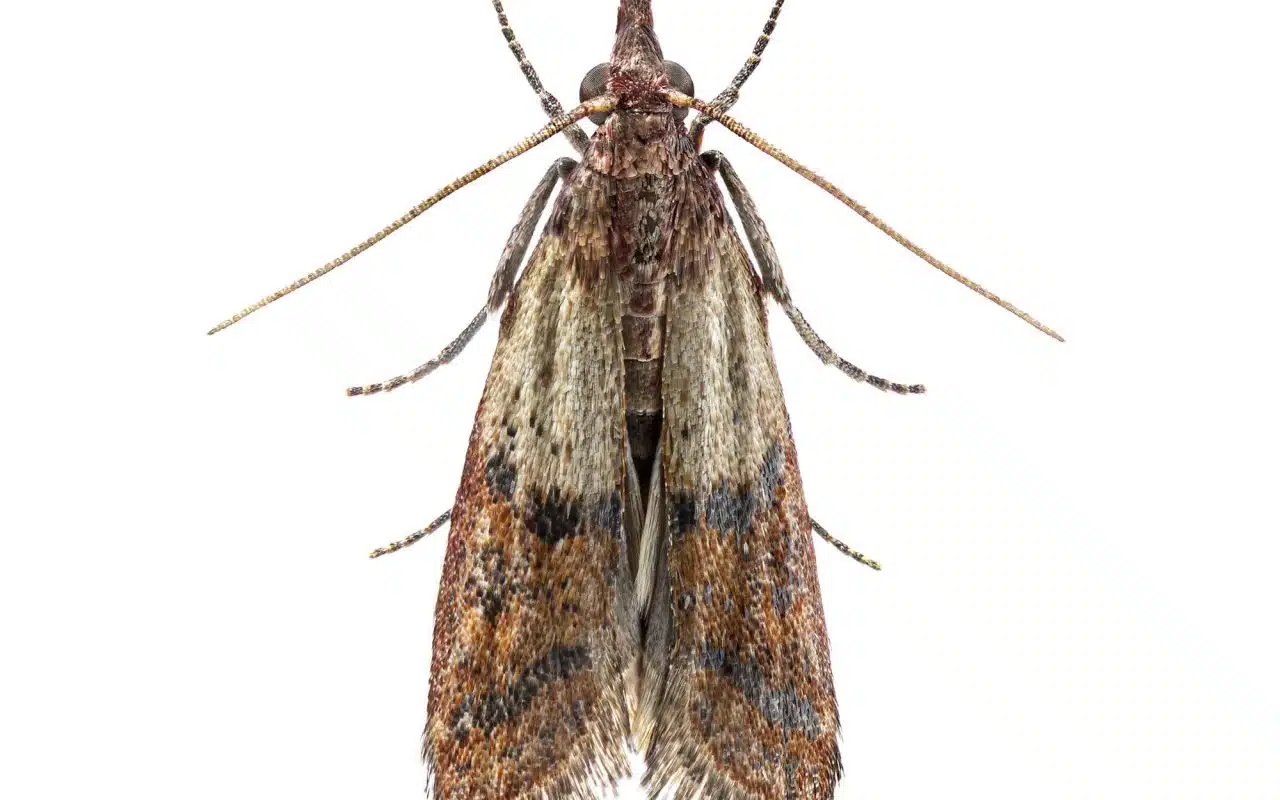
- Pantry moth forewings are two-toned: pale at the base, reddish brown with a coppery sheen over the outer two-thirds. More in the pantry moth profile.
- Clothes moth wings are plain buff gold, no pattern anywhere, and the moth is smaller. More in the clothes moth profile.
- The answer decides what you buy: the two pheromone lures are not interchangeable, and the wrong one catches nothing.
Where it was flying tells you more than what it looks like
Most moth ID advice opens with wing color. That works on an insect sitting still in good light. It fails at ten at night, when the moth is a blur going past your head. The behavior test works on a blur.
Indian meal moths (Plodia interpunctella) are behind nearly every pantry moth complaint, and they are the ones people describe flying around the kitchen at night. They are most active near dusk, they cross open rooms, and they end up at lamps and windows. One flying out into the middle of the room already tells you something.
Webbing clothes moths (Tineola bisselliella) do the opposite. They are weak flyers that are not drawn to light. Every stage of the species avoids it, and the larvae are repelled strongly enough to drop off a garment rather than sit exposed. Adults stay near whatever the larvae are eating, usually in a dark part of a closet, and hide when disturbed. That is why the problem usually surfaces only when a damaged sweater turns up.
So a moth flapping across your living room argues against the clothes moth before you have looked at it. Not proof, since a startled one flies a short distance, but the odds are lopsided.
The wing pattern, once the moth lands
Once the moth settles, the forewings answer fast, and this is the most reliable check on the list. A pantry moth is two-toned in a way that is hard to unsee. The third of the wing nearest the body is whitish gray or pale tan. The outer two-thirds is reddish brown with a coppery luster, and the change between them is a hard line rather than a fade. Extension fact sheets lean on the same feature and state plainly that the clothes moth does not have two-toned wings.
A clothes moth is uniform buff gold with no markings at all, and it is smaller: about a quarter inch long against a third to two-fifths of an inch for the pantry moth. Up close there is a tuft of reddish gold hairs on top of the head and a fringe of long hairs along the wing edges, both visible in a cropped phone photo. The profile pages go deeper on anatomy and life cycle.
Side by side
| Pantry moth (Indian meal moth) | Clothes moth (webbing clothes moth) | |
|---|---|---|
| Adult size | A third to two-fifths of an inch long, wingspan near three-fifths of an inch | About a quarter inch long, wingspan near half an inch |
| Wing pattern | Two-toned: pale base third, reddish brown with a coppery luster over the outer two-thirds | Plain buff gold, no markings; tuft of reddish gold hairs on the head |
| Flight | Crosses open rooms, often ends up high; flies in kitchens at night | Weak flyer, short hops near the infested item |
| Reaction to light | Drifts toward lamps and windows | Avoids light at every stage; larvae drop off cloth to escape it |
| What the larva eats | Stored food: grain products, dried fruit, nuts, seeds, birdseed, dry pet food | Keratin: wool, fur, feathers, hair, and the debris around it |
| Where the source is | Dry goods, opened and sealed alike; look for webbing in food | Dark, undisturbed storage: closet floors, garment folds, boxed woolens |
| Pheromone trap | Indian meal moth lure | Clothes moth lure, which will not cross-catch |
Pantry moths in the bedroom: the case that fools people
A moth in a bedroom, nowhere near food, reads as a clothes moth. Often it is not one.
An Indian meal moth larva that has finished feeding, about two-thirds of an inch long by then, leaves its food entirely and travels a considerable distance to find somewhere to pupate. It heads for the joint between wall and ceiling, the gap behind a shelf, a tight fold in packaging. The adult that emerges weeks later can turn up well away from the bag of cereal that produced it.
Getting this backwards costs you an afternoon: emptying a closet and washing every wool garment in it is a lot of work for an insect that came out of a sack of birdseed in the garage.
One supporting clue: pantry moth larvae leave silk threads wherever they travel, often enough to catch the eye. Silk in a bedroom ceiling corner, with no fabric damage anywhere, points to a wandering pantry moth rather than a closet problem. Here is what that trail looks like.
Do pantry moths eat clothes?
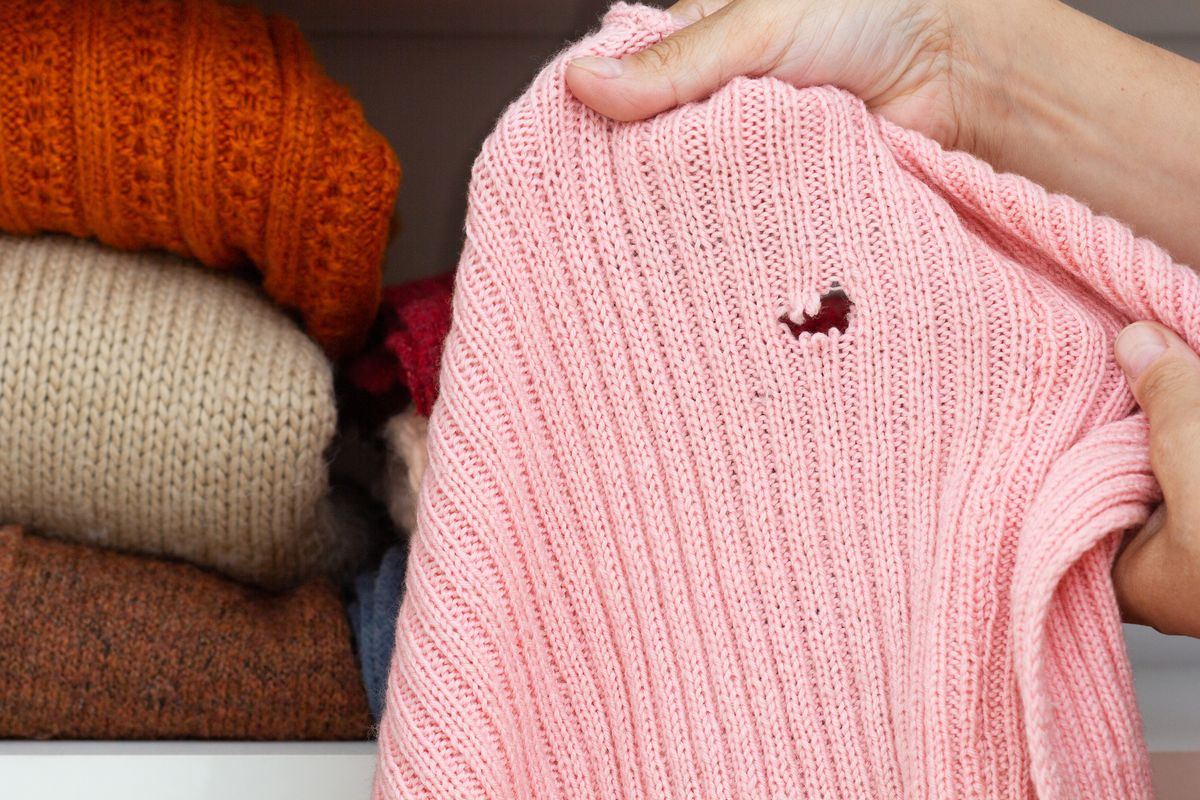
No. The larva eats stored food: grain and grain products, dried fruit, nuts and seeds, powdered milk, chocolate, dried herbs, birdseed, dry dog and cat food. Wool is not on that list, and the pantry moth has no use for keratin.
It works the same in reverse. Clothes moth larvae eat keratin: wool, fur, feathers, hair, and the debris that gathers with it. They will not develop in your flour.
In both species the adult does no damage at all. Swatting the moth you can see removes one that has probably already laid. The feeding stage is what you have to find, and clothes moth larvae hide somewhere entirely different from pantry moth larvae.
What changes once you know
Pheromone traps are species specific. A trap loaded with the Indian meal moth lure can hang in a closet for a month and catch nothing while clothes moths breed a few feet away, and the clothes moth lure is just as blind to pantry moths. The empty trap then reads as “no infestation.” Our notes on moth pheromone traps say which lure targets which species.
The search area changes too. The pantry bug hub covers what else can be in the cabinet. For a pantry moth, clearing out the pantry means going through dry goods one package at a time, sealed ones included, looking for webbing and grains stuck together. For a clothes moth, treating the closet targets dark, undisturbed storage: closet floors, garment folds, boxed woolens. Closet prevention and pantry prevention are two different jobs.
Cheapest test first: the flight and light check costs nothing and takes ten seconds. Run it before you order traps.
FAQ
Are pantry moths harmful?
Not to you directly. They do not bite or sting, and the damage lands on stored food, not on the house. The cost is groceries and an hour clearing a shelf. If you ate something you think was infested and you are worried, ask a doctor or your poison control center.
What size is a pantry moth?
A third to two-fifths of an inch long, wingspan close to three-fifths of an inch. A clothes moth is smaller: about a quarter inch long, wingspan near half an inch. Alone on a wall that gap is hard to judge, which is why the wing pattern beats size.
What do clothes moths look like?
Small and plain. Uniform buff gold wings with no markings, a tuft of reddish gold hairs on top of the head, and a fringe of long hairs along the wing edges. Any pattern on the wings rules the clothes moth out.
Can I have both at the same time?
Yes. They belong to different moth families and eat different things. Finding one tells you nothing about the other.
I killed the moth. Is it over?
No. Adults of both species cause no feeding damage, and a female has usually laid before you see her. Nothing is settled until you find the larvae.
Sources
- University of California Statewide Integrated Pest Management Program, Pest Notes: Clothes Moths.
- Michigan State University Extension, Plant & Pest Diagnostics, Clothes moths.
- Colorado State University Extension, Indian Meal Moth, fact sheet 5.598.
- Colorado State University Extension, Moths in the Home.
- Clemson Cooperative Extension, Home & Garden Information Center, Indian Meal Moth.